

Key Takeaways
- An amortization schedule breaks every loan payment into its principal and interest components.
- Early payments are weighted heavily toward interest; the balance shifts over time.
- Knowing your schedule helps you evaluate whether making extra payments is worthwhile.
- The total interest row reveals the true cost of borrowing beyond the sticker price.
- You can request your amortization schedule from your lender at any time, usually at no cost.
What you will need
What an Amortization Schedule Actually Shows
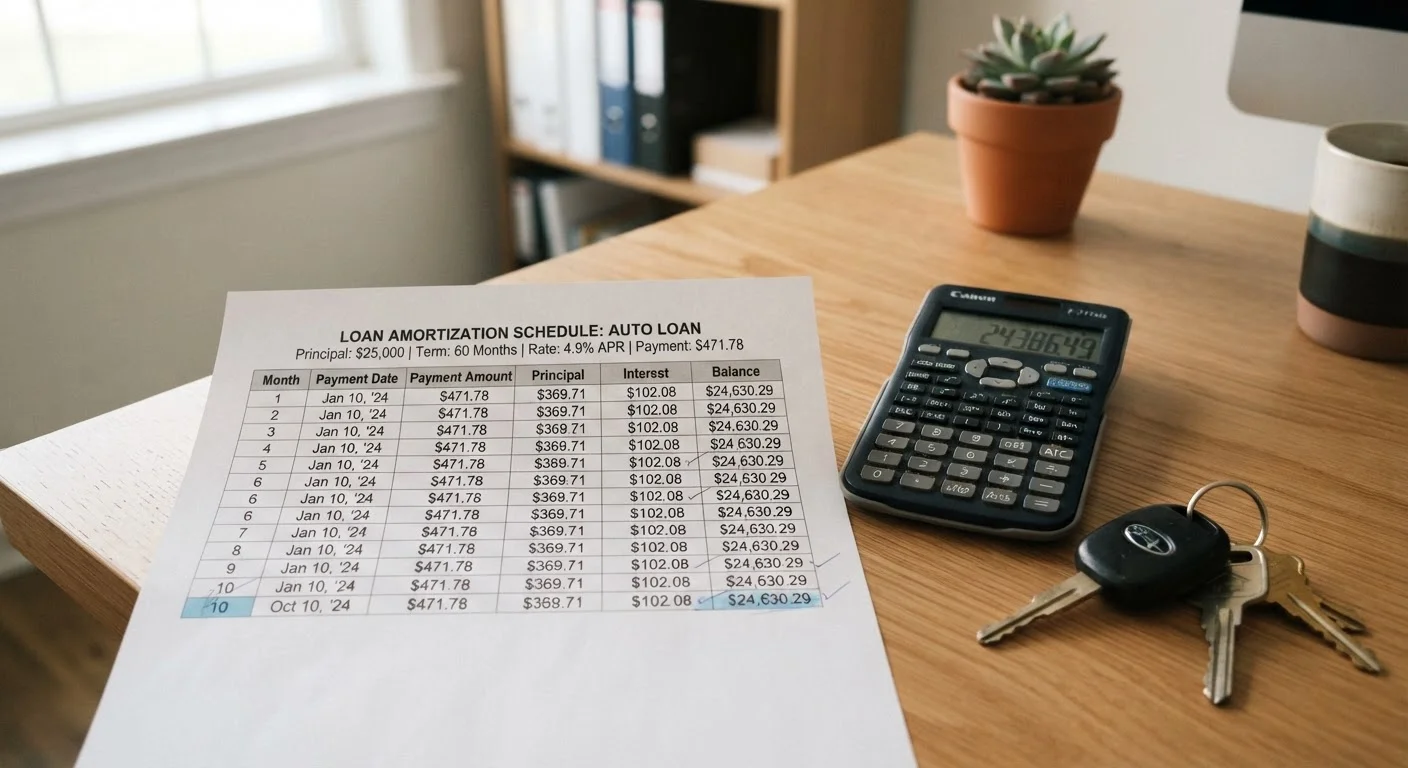
An amortization schedule is a complete, payment-by-payment breakdown of your auto loan - not just a summary. It shows exactly how each fixed monthly payment is divided between reducing your debt (principal) and paying the lender for the use of their money (interest). Understanding this split matters because your loan balance does not decrease in a straight line, even though your payment amount stays constant throughout the term.
If you're unfamiliar with foundational borrowing vocabulary - principal, interest, APR, loan term - it's worth reviewing Key Terms Every Borrower Should Know Before Taking On Debt before working through your schedule. The schedule itself is a direct product of those concepts in action.
What you will need
Step-by-Step: How to Read Your Schedule
This Is General Financial Information
This article explains how to read an amortization schedule for educational purposes only. It is not personalized financial advice. For decisions specific to your loan or financial situation, consult a licensed financial professional.
Loan Amortization Schedule
The document - from your lender or a loan calculator - that lists every scheduled payment broken down by principal and interest.
Loan Contract or Monthly Statement
Provides the original principal, APR, and loan term needed to verify or generate your schedule.
Calculator or Spreadsheet
Lets you run scenarios such as the impact of an extra monthly principal payment.
Obtain your amortization schedule
Log in to your lender's online account portal and look for a section labeled Loan Details, Payment Schedule, or Amortization. If it isn't available online, call customer service and request a full amortization schedule in writing - lenders are generally required to provide one. Alternatively, use a free online loan calculator with your exact principal, APR, and term to generate a matching schedule, then verify the monthly payment matches your contract.
Identify the four core columns
Every standard amortization schedule contains at least four columns for each payment row:
- Payment number - the sequential count (1 through 60 on a 5-year loan, for example).
- Principal paid - the portion of this payment that reduces your balance.
- Interest paid - the portion that goes to the lender as borrowing cost.
- Remaining balance - how much you still owe after this payment is applied.
Some schedules also include a cumulative interest column, which runs a running total of all interest paid to date.
Understand how interest is calculated each period
Auto loans typically use simple interest, meaning interest accrues on the current outstanding balance. For any given month, the interest portion is calculated as:
Monthly Interest = Remaining Balance × (APR ÷ 12)
The rest of your fixed monthly payment reduces the principal. Because the balance is highest at the start, interest charges are also highest early in the loan. For a deeper explanation of APR and how it affects total cost, see What APR Actually Means on an Auto Loan.
Find the front-loading pattern
Scroll to the first several rows and note the principal vs. interest split. On a typical 60-month auto loan, the majority of early payments can go toward interest rather than reducing what you owe. Then scroll toward the midpoint and the final rows. You will see the principal column growing steadily while the interest column shrinks. This pattern - called front-loading - is why selling or trading in a car in the first year or two often leaves owners with a balance very close to the vehicle's depreciated value, or even exceeding it.
Locate the total interest row
Most schedules include a summary row at the bottom totaling all principal paid (should match your original loan amount) and all interest paid over the life of the loan. This figure is the true cost of financing your vehicle beyond the purchase price. Compare it against the loan amount to understand the full picture. For context on how lender choice affects this number, see Financing a Car Through a Dealership vs. a Bank or Credit Union.
Model the effect of extra principal payments
To test whether paying extra makes financial sense, identify a row mid-schedule and note the remaining balance. Apply a hypothetical extra payment to that balance, then recalculate using the same monthly interest formula. Each dollar applied to principal directly reduces the base on which future interest is calculated, shortening the loan and reducing total interest. Many online calculators allow you to input an additional monthly amount and will show you revised totals automatically.
Generate Your Own Schedule for Free
Most lenders are required to provide an amortization schedule on request. You can also generate one using any reputable online loan calculator by entering your principal, interest rate, and loan term. Cross-check the output against your loan documents to make sure the figures align.
Practical Takeaways for Car Owners
Reading your amortization schedule just once gives you information most borrowers never act on. You can see precisely when your outstanding balance will drop below the vehicle's likely market value - an important milestone if you're weighing a trade-in or concerned about being underwater (owing more than the car is worth). You'll also know how much interest you'll avoid if you pay off the loan early, which helps you weigh that option against other uses of the same cash.
Prepayment Penalties Can Offset Savings
Some auto loan agreements include prepayment penalties - fees charged if you pay off the loan early. Before making extra principal payments, review your loan contract or ask your lender directly to confirm whether such a clause exists.
If you've ever missed a payment or are worried about falling behind, the consequences go beyond a one-time fee. See What Happens If You Can't Make a Car Payment for a clear overview of what to expect and what options are typically available.
This article is for general informational and educational purposes only and does not constitute personalized financial or legal advice. Consult a qualified financial professional for guidance specific to your situation.