

Key Takeaways
- Meditation is a trainable mental skill, not a personality trait or spiritual prerequisite.
- Even brief daily sessions - as short as five minutes - are supported by research for stress reduction.
- The goal is not to stop thoughts but to notice them without getting swept along.
- Consistency matters far more than session length, especially when starting out.
- A distraction-free environment and a fixed daily trigger make practice far more sustainable.
Start here
What Meditation Actually Is
Understand the why
What the Evidence Says About Benefits
Try it now
Your First Five-Minute Practice
Troubleshoot
Common Obstacles and How to Work Through Them
Make it stick
Building a Habit That Lasts
What Meditation Actually Is
Meditation is the practice of deliberately directing your attention - typically to a single focus like the breath - and repeatedly returning to it when the mind wanders. That's the entire mechanism. No special beliefs, equipment, or flexibility required.
The word covers dozens of distinct techniques, from focused-attention practices (concentrating on a single anchor) to open-monitoring styles (observing thoughts without attachment) and loving-kindness exercises. For beginners, breath-focused attention is the most practical entry point: it's always available, costs nothing, and is the most researched format.
It helps to know what meditation is not. It isn't emptying the mind, achieving bliss, or suppressing thought. The mind generates thoughts continuously - that's its job. Meditation trains you to notice those thoughts without automatically following them, which is a genuinely learnable skill. See our overview of mindfulness vs. meditation if you want to understand how these concepts relate.
Focused-attention meditation
A style of meditation where you direct and hold attention on a single anchor - most commonly the breath - and return to it whenever the mind wanders.
Open monitoring
A meditation style where instead of fixing on one object, you observe whatever thoughts, feelings, or sensations arise without engaging or reacting to them.
Mindfulness
A quality of non-judgmental, present-moment awareness. It can be developed through formal meditation but also practiced informally during everyday activities.
MBSR
Mindfulness-Based Stress Reduction - a structured, evidence-supported program developed to teach mindfulness skills for managing stress, pain, and related conditions.
Attention anchor
The focal point you return to during meditation - often the breath - that gives the wandering mind somewhere to come back to.
What the Evidence Says About Benefits
The research base for meditation has grown substantially over the past two decades. The most robust findings - drawn from randomized controlled trials and systematic reviews - center on stress reduction, attention regulation, and emotional wellbeing.
- Stress and anxiety: Mindfulness-based programs have been shown to reduce self-reported stress and anxiety across multiple populations. The American Psychological Association recognizes mindfulness-based stress reduction (MBSR) as an evidence-supported approach.
- Attention and focus: Regular practice is associated with measurable improvements in sustained attention, working memory, and cognitive flexibility.
- Sleep quality: Several studies link mindfulness practice to improvements in sleep onset and quality, particularly for those experiencing stress-related sleep disruption.
- Emotional regulation: Meditation appears to support the ability to pause before reacting - a capacity that benefits interpersonal relationships and general resilience.
It's worth being clear about what the evidence doesn't show: meditation is not a treatment for any medical condition, and effect sizes vary considerably across studies. It is best understood as a health-supporting habit, not a cure. Always consult a qualified healthcare professional if you're managing a specific health concern.
Your First Five-Minute Practice
The simplest beginner session requires nothing but a timer and somewhere to sit. Here's a format you can use today:
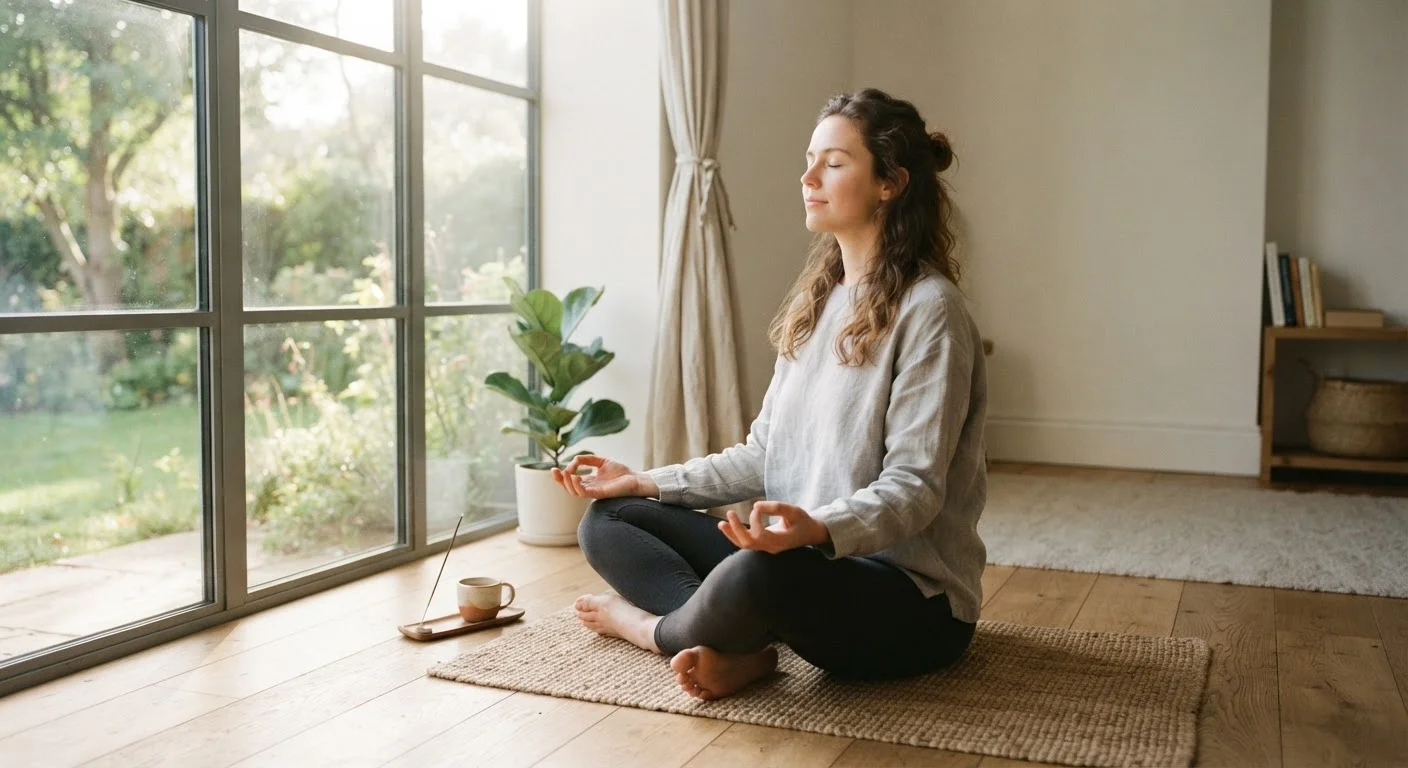
- Choose a seat. Sit on a chair or the floor with your back reasonably upright. Rest your hands in your lap. You don't need a cushion or special clothing.
- Set a timer for five minutes. Using a timer removes clock-watching and lets you fully commit to the session.
- Close your eyes or soften your gaze downward. Either works - use whichever feels natural.
- Focus on your breath. Notice the physical sensation of each inhale and exhale - the rise of your chest, the air at your nostrils. You're not controlling the breath, just observing it.
- When your mind wanders, return. This will happen repeatedly. Each time you notice and gently redirect attention back to the breath, that's the practice working exactly as it should.
- When the timer sounds, pause before standing. Take one slow breath and notice how you feel before re-entering your day.
The One-Breath Rule for Rough Days
On days when five minutes feels impossible, commit to just one conscious breath. Inhale slowly, exhale fully, and notice the sensation. That single moment of intentional attention counts as practice and keeps the habit alive during high-stress periods. Perfection is never the goal - continuity is.
That's the complete practice. Resist the urge to complicate it in the early weeks. Simplicity is what makes it repeatable.
Common Obstacles and How to Work Through Them
Nearly every new meditator encounters the same handful of friction points. Knowing them in advance reduces the chance you'll interpret them as failure:
- "My mind is too busy."
- A busy mind isn't an obstacle - it's the raw material. The practice is noticing busyness, not eliminating it. Expecting silence sets an unrealistic standard.
- "I don't have time."
- Five minutes is genuinely sufficient to start. Attaching the session to an existing routine - right after morning coffee, before brushing teeth at night - removes the friction of deciding when. The guide on building daily habits from zero covers this approach in depth.
- "I keep falling asleep."
- Try meditating earlier in the day, or with eyes slightly open and gaze directed at the floor. Fatigue is information - it may signal you need rest more than focus.
- "I'm not sure I'm doing it right."
- If you're sitting, focusing on your breath, and noticing when you drift, you're doing it right. There is no perfect session.
Building a Habit That Lasts
The research on habit formation consistently points to the same levers: simplicity, consistency, and a reliable trigger. Apply them to meditation directly:
- Start smaller than feels meaningful. Two minutes feels trivial - that's the point. Once the habit is anchored, extending it is easy. Overcommitting in week one is a common reason people quit.
- Attach practice to an existing anchor. "After I pour my morning coffee" is more durable than "sometime in the morning." Specificity dramatically increases follow-through.
- Track streaks loosely. A simple checkmark on a paper calendar provides enough feedback to maintain momentum without becoming a source of stress.
- Expect gaps and plan for them. Missing one day is not failure. The only rule that matters: never miss twice in a row.
If you want to prepare yourself more systematically before committing to a daily practice, our pre-practice checklist can help you set up the right conditions from the start.
This article is for general informational and educational purposes only. It is not medical advice. If you have a health condition or mental health concern, please consult a qualified healthcare professional before beginning any new wellness practice.