

Key Takeaways
- Lifestyle inflation erodes income gains by quietly expanding spending to match every raise or bonus.
- Small upgrades — a streaming add-on, a gym membership, dining out more — compound into significant monthly outflows.
- The fix isn't deprivation; it's intentionally directing a portion of every income increase before spending habits adjust.
- Tracking your savings rate over time is a more reliable progress indicator than your gross income.
- Recognizing the pattern is the first step — most people don't notice lifestyle inflation while it's happening.
Lifestyle Inflation
Lifestyle inflation happens when your spending rises in step with your income, leaving you no better off financially despite earning more. It's the pattern where a raise gets absorbed by a nicer apartment, newer car, or upgraded subscriptions rather than savings or debt payoff. The result is that wealth-building stalls even as your paycheck grows.
Economists sometimes call this 'lifestyle creep' or 'hedonic adaptation' — the tendency for people to reset their baseline expectations upward as their circumstances improve, making previous luxuries feel like necessities.
Why More Money Doesn't Always Mean More Progress
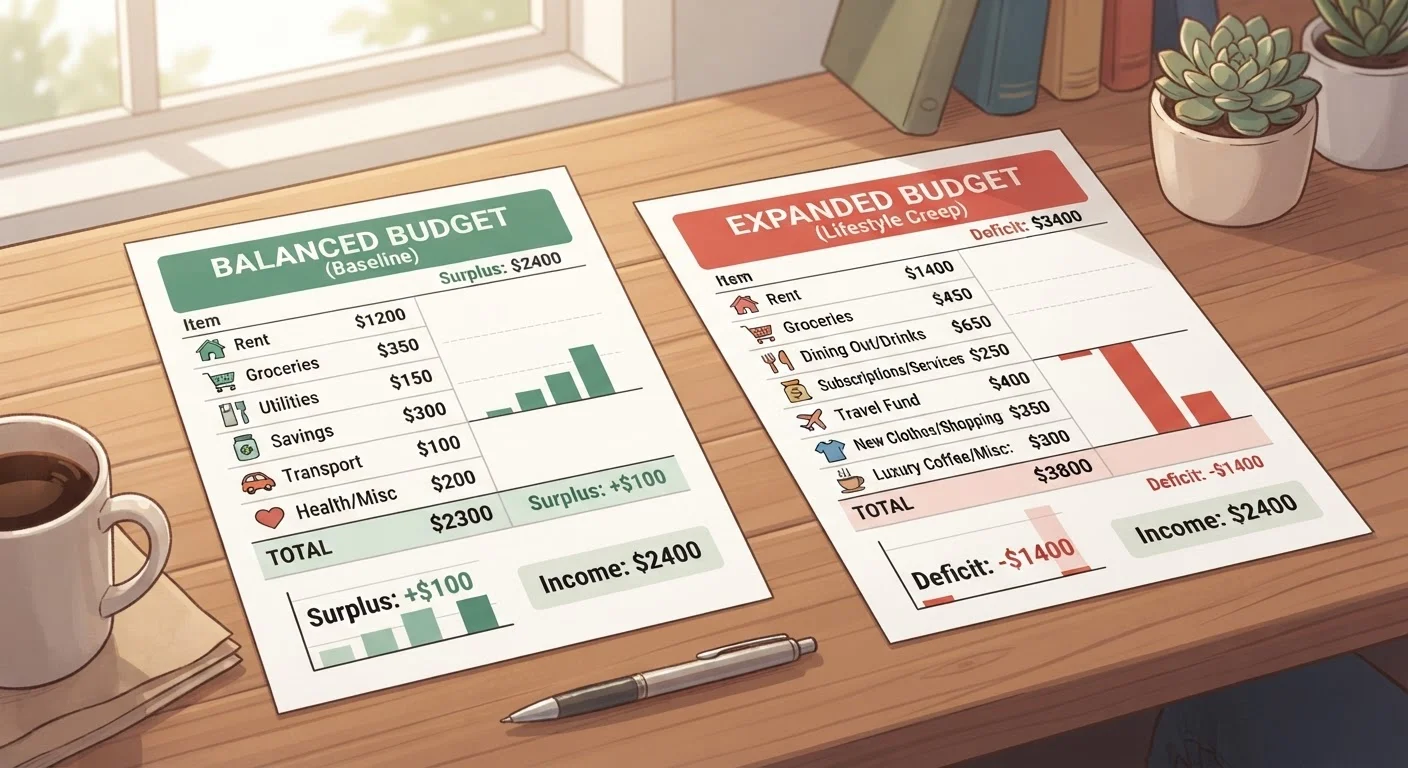
You get a raise. Your paycheck goes up. But six months later, you're not saving any more than before — and you're not quite sure where the extra money went. This is lifestyle inflation, and it's one of the most common ways income gains quietly disappear.
It doesn't require lavish purchases. A streaming service upgrade here, restaurant meals instead of cooking there, a slightly nicer apartment on the next lease renewal — each decision feels reasonable in isolation. Together, they recalibrate your baseline so that your new income level feels exactly as tight as the old one.
Some spending patterns do their damage gradually, and lifestyle inflation is a prime example. Because each individual choice seems justified — you're earning more, after all — the cumulative effect rarely triggers alarm.
~70%
Americans living paycheck to paycheck
Survey data from multiple years of financial research consistently shows a majority of U.S. adults report little financial cushion regardless of income level, suggesting spending expands with earnings broadly.
50%
Suggested share of raises to save
Many financial planners recommend directing at least half of each income increase to savings or debt reduction before adjusting lifestyle spending.
$200–$400
Typical monthly creep from small upgrades
Adding common lifestyle upgrades — a gym membership, streaming services, dining out more frequently — often totals several hundred dollars monthly within a year of an income increase.
How Lifestyle Inflation Takes Hold
The mechanism is straightforward: income rises, expectations reset upward, and spending follows. Psychologists call this hedonic adaptation — the human tendency to normalize improvements quickly and then treat them as the new floor.
A practical sequence might look like this: A promotion brings an extra $400 a month. You move to a unit with in-unit laundry ($75 more per month). You upgrade your gym to one closer to the new office ($30 more). You start ordering lunch at work more often ($60 more). You add a premium streaming tier ($10 more). That's $175 monthly in new fixed and semi-fixed costs — without any single decision feeling excessive.
The issue compounds when upgrades become recurring. A one-time purchase fades; a monthly subscription stacks. Over a year, that $175 in new monthly costs totals $2,100 — real money that could have gone toward an emergency fund, retirement contribution, or paying down debt.
Spotting It in Your Own Budget
The clearest signal is a flat or declining savings rate despite income growth. If you earned $55,000 last year, earn $62,000 this year, and you're saving the same dollar amount (not percentage), lifestyle inflation has likely eaten the difference.
A quick audit: pull three months of bank and credit card statements and highlight any recurring charge that didn't exist 12–18 months ago. Don't just look for big items — look for the pattern. Multiple small additions often add up to more than one obvious splurge.
If your budget feels stretched at a higher income than it did before, that's a reliable sign. It's also worth noting that lifestyle inflation can disguise itself as practical decisions — car costs are a common example, where a modest vehicle gets replaced with a more expensive one simply because the payment now feels affordable on a higher salary.
Try the '50% Rule' for Every Raise
When your income goes up, commit to saving or investing at least half the increase before adjusting your spending habits. Even if the rest funds a real quality-of-life improvement, this rule ensures some portion of every income gain actually builds your financial position. Set up an automatic transfer on payday so the decision is made once, not every month.
Practical Ways to Get Ahead of It
The most reliable countermeasure is to act before your spending habits adjust. When income increases — whether from a raise, a bonus, or a side project — decide what portion goes to savings before the rest gets absorbed into daily life. Automating this through payroll deductions or automatic transfers removes the decision from the moment entirely.
A common guideline is to save or invest at least half of any income increase while allowing the rest to improve your day-to-day life. This isn't about refusing yourself anything; it's about making sure income growth actually moves you forward. For those navigating variable paychecks, budgeting strategies for irregular income can help apply the same principle even when earnings fluctuate month to month.
Tracking your savings rate — not just your dollar amount saved — is the most honest measure of financial progress. A rising income that doesn't improve your savings rate isn't building wealth; it's funding a more expensive version of the same financial position.
This article is for general informational and educational purposes only and does not constitute personalized financial advice. Consider consulting a qualified financial professional for guidance specific to your situation.