

Key Takeaways
- Both clicker and verbal cue training are rooted in positive reinforcement and proven behavioral science.
- Clickers offer unmatched timing precision; verbal cues offer convenience and are always available.
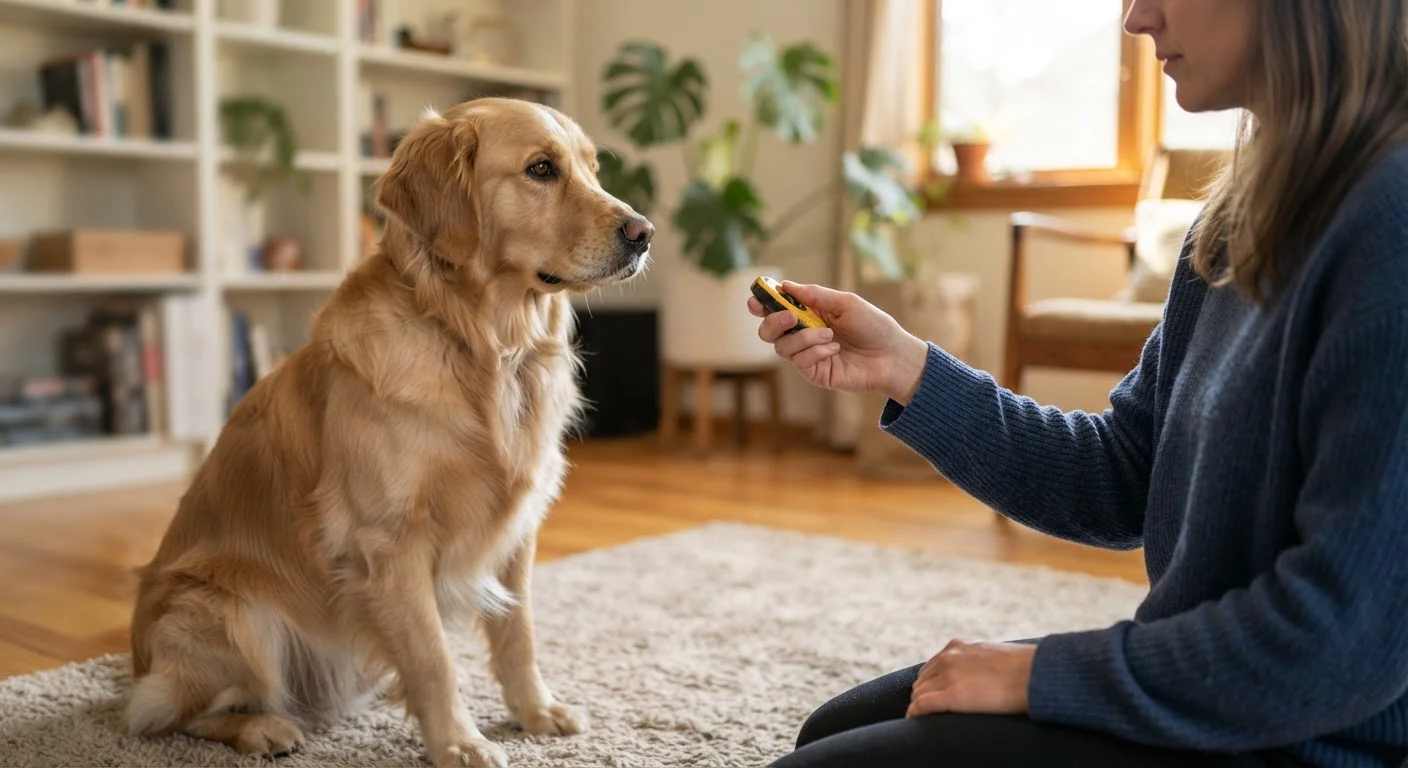
- The clicker itself is a bridge signal — it marks the moment of correct behavior before the reward arrives.
- Verbal cues can vary in tone and volume, which may slow learning for some pets.
- Either method can be effective; consistency and timing matter more than the tool you choose.
- Some owners successfully combine both approaches across different training contexts.
Option A
Clicker Training
The precise, consistent signal method.
Best for: Pets and owners who benefit from an unmistakably clear marker signal that's identical every single session.
Option B
Verbal Cue Training
The hands-free, always-available approach.
Best for: Owners who want to train without tools on hand and pets who respond naturally to vocal communication.
If your pet is easily distracted and needs crystal-clear feedback
Clicker Training
The clicker's distinct, consistent sound cuts through environmental noise and marks the exact desired behavior, reducing confusion for easily distracted animals.
If you want to train on the go without carrying any equipment
Verbal Cue Training
Your voice is always with you, making verbal cues ideal for spontaneous training moments at the park, vet's office, or anywhere else.
If you are training a hearing-impaired pet
Clicker Training
For hearing-impaired pets, a tactile vibration clicker or visual marker paired with treats can replace verbal cues effectively — no sound required.
If multiple family members share training duties
Clicker Training
A clicker produces the same sound regardless of who uses it, eliminating the tonal inconsistency that can arise when different voices deliver verbal cues.
If you have a highly social pet already bonded to your voice
Verbal Cue Training
Pets deeply attuned to their owner's vocal patterns can progress quickly with verbal cues, especially when tone and enthusiasm are used consistently.
How Each Method Works
Both clicker training and verbal cue training are forms of operant conditioning — a learning process in which a behavior is strengthened by a consequence that follows it. In practical terms, that means your pet does something right, gets a clear signal, and then receives a reward. Over time, the behavior becomes reliable.
With clicker training, a small handheld device produces a short, sharp click sound. That sound serves as a bridge signal (sometimes called a marker) — it tells your pet the instant their behavior was correct, even before the treat reaches them. Timing is everything in behavioral learning, and the clicker's speed and consistency allow owners to mark a behavior within a fraction of a second.
Verbal cue training replaces the clicker with a spoken word or phrase — commonly "yes," "good," or a similar short, upbeat sound. The underlying principle is identical: the word marks the moment of success and predicts the reward. What differs is the delivery mechanism and the consistency it demands from the trainer.
Understanding why positive reinforcement outperforms punishment helps clarify why both of these marker-based approaches tend to produce calmer, more engaged learners.
| Criterion | Clicker Training | Verbal Cue Training |
|---|---|---|
| Signal consistency | Identical every time | Varies with mood and tone |
| Timing precision | Very high — near-instant mark | Good, but slightly slower |
| Equipment needed | Small clicker device | None — voice only |
| Hands required | Yes, one hand | No |
| Multi-trainer consistency | Excellent — same sound always | Can vary between people |
| Suitable for hearing-impaired pets | Yes, with tactile/visual variant | Limited |
| Learning curve for owner | Moderate — timing practice needed | Lower — more intuitive |
| Species versatility | Dogs, cats, birds, rabbits, more | Best for dogs; varies by species |
Practical Strengths and Limitations
The clicker's biggest strength is mechanical precision. A click is always 0.2–0.3 seconds long and always sounds the same. A human voice, by contrast, varies with mood, fatigue, and excitement — subtle differences that sensitive animals can detect, potentially slowing the learning curve.
On the other hand, the clicker requires at least one hand to operate, and you have to have it with you. Many owners find it cumbersome during busy real-world moments. Verbal cues solve this entirely: your voice is always available, whether you're mid-walk, at the vet, or redirecting behavior at the dinner table.
~0.3 sec
Typical clicker sound duration
Behavioral researchers note that markers must fall within roughly half a second of the target behavior to be effective — the clicker's speed makes this achievable.
2–5 min
Recommended session length per training block
Animal behaviorists generally recommend keeping individual training sessions short to maintain attention and prevent frustration in most domestic species.
3–4 weeks
Typical timeframe for a new behavior to become reliable
While individual variation is significant, consistent daily practice with positive reinforcement often produces reliable beginner behaviors within a few weeks.
Another consideration is species and individual temperament. Dogs generally respond well to both methods. Cats, rabbits, and birds can also be clicker trained successfully, since the marker's neutrality avoids the emotional noise that human voice inflections can carry. For pets with noise sensitivities, some trainers use a softer mouth click or a short verbal marker instead of a mechanical device.
If you're working with an older animal, patience with either method matters more than the tool itself. Our guide on training an older dog covers how to adjust your approach for animals with established habits.
Choosing, Combining, and Getting Started
There is no universal winner here — both methods produce results when applied consistently and paired with meaningful rewards. The right choice often depends on your lifestyle, your pet's individual sensitivity, and how many people are involved in training.
If you're new to marker training, starting with a verbal marker like "yes" can lower the learning curve for you before adding a clicker later. If precision is your priority — for example, capturing a fleeting behavior like a bird's wing position or the exact moment a dog's rear touches the floor — the clicker's speed is genuinely hard to match.
Many experienced trainers use both: a clicker for teaching new, precise behaviors, and a verbal cue once the behavior is well-established and needs no further shaping. This hybrid approach plays to each method's strengths.
Whichever method you choose, embedding it inside a structured daily routine will accelerate progress. Short, frequent sessions — typically two to five minutes — tend to outperform long, infrequent ones for most species. Keep rewards high-value during the learning phase, and expect to invest a few weeks of practice before behaviors become reliably fluent.
This article is for general educational purposes only. For personalized training guidance, especially for pets with behavioral challenges or anxiety, consult a certified professional animal trainer or veterinary behaviorist.