
Note-Taking Approaches Compared: Cornell, Outlining, Mind Mapping, and Freeform

Key Takeaways
- No single note-taking method outperforms all others for every learner or content type.
- The Cornell Method structures review built into the page, supporting retrieval practice.
- Mind mapping suits visual thinkers and brainstorming; outlining works well for linear, hierarchical content.
- Freeform notes offer flexibility but require deliberate review habits to aid retention.
- Switching methods based on content type may produce better recall than sticking to one approach.
Our Verdict
Each note-taking approach has genuine strengths, and research suggests the best method is often the one matched to the task at hand. The Cornell Method offers the most built-in structure for review, while outlining suits lectures and readings with clear hierarchies. Mind mapping shines for creative or conceptual material, and freeform notes serve fast-paced or exploratory contexts best.
| Best for | Recommended |
|---|---|
| Learners who want built-in review prompts and retrieval practice | Cornell Method |
| Structured lectures, textbooks, or step-by-step subject matter | Outlining |
| Visual thinkers or brainstorming conceptual relationships | Mind Mapping |
| Fast-paced environments or exploratory personal study | Freeform |
Why Your Note-Taking Method Actually Matters
Most adults treat note-taking as simple transcription — a way to capture information before it disappears. But cognitive science research consistently shows that how you record information is at least as important as how much you record. The act of encoding information — organizing, paraphrasing, and connecting ideas in real time — drives deeper retention than passive copying.
Understanding core concepts like retrieval practice (the act of recalling information from memory) and elaborative interrogation (asking yourself why something is true) can help you choose a method that actually supports your goals. For a grounding in these terms, see Key Terms Every Adult Learner Should Understand.
The four methods below — Cornell, Outlining, Mind Mapping, and Freeform — each engage the brain differently. Knowing their trade-offs lets you pick the right tool for the right situation.
The Four Methods at a Glance
Here is a structured look at how the four approaches compare across the criteria that matter most for adult learners:
| Cornell Method | Outlining | Mind Mapping | Freeform | |
|---|---|---|---|---|
| Structure level | High — predefined zones | High — nested hierarchy | Medium — radial, self-defined | None — open format |
| Best content type | Lectures, textbook chapters | Sequential or hierarchical topics | Conceptual, creative, or relational | Fast-paced or exploratory |
| Review support | Built-in via cue column | Good if consistently formatted | Moderate; needs a summary | Weak without extra effort |
| Setup time required | Moderate — pre-divide page | Low | Low | None |
| Visual appeal / engagement | Low to moderate | Low | High | Variable |
| Retrieval practice support | Strong — cues prompt recall | Moderate | Moderate | Low without restructuring |
Each method has a distinct footprint. Cornell and outlining impose structure before you start; mind mapping and freeform let structure emerge — or not — from the material itself.
Cornell Method: Structure That Prompts Review
Developed at Cornell University in the 1950s, this method divides each page into three zones: a narrow left column for cue questions, a wider right column for notes taken during the session, and a summary section at the bottom written after the fact.
The design is deliberately review-oriented. After a learning session, you cover your notes and use the cue column questions to quiz yourself — a direct application of retrieval practice. Research on spaced repetition and self-testing supports this kind of built-in review loop as particularly effective for long-term retention.
Cornell works best for structured input: lectures, instructional videos, and textbook chapters with clear main ideas. Its main limitation is setup time; it can feel cumbersome for fast-moving or highly visual content.
Make the Cue Column Work for You
After a Cornell session, write your cue questions in plain language — as if you were quizzing a friend. Then cover the notes column and try to answer them aloud or in writing before checking your answers. This self-testing step is where the majority of Cornell's retention benefit comes from, and skipping it reduces the method to a formatting exercise.
Outlining: Clarity Through Hierarchy
Outlining organizes notes as nested bullet points or numbered lists, moving from broad topics down to supporting details. Most word processors default to this format, and it maps naturally onto material that is already logically sequenced — a technical manual, a step-by-step course, or a well-organized lecture.
Its strength is immediate readability. Outlines are easy to scan, and the hierarchical structure makes relationships between ideas explicit. The weakness is rigidity: if the content does not follow a clear hierarchy — say, an interdisciplinary seminar or a creative workshop — outlining can impose false order or cause you to miss lateral connections.
For adults taking online courses, outlining is often the default approach and works reliably when the course itself is well-structured.
Mind Mapping: Connecting Ideas Visually
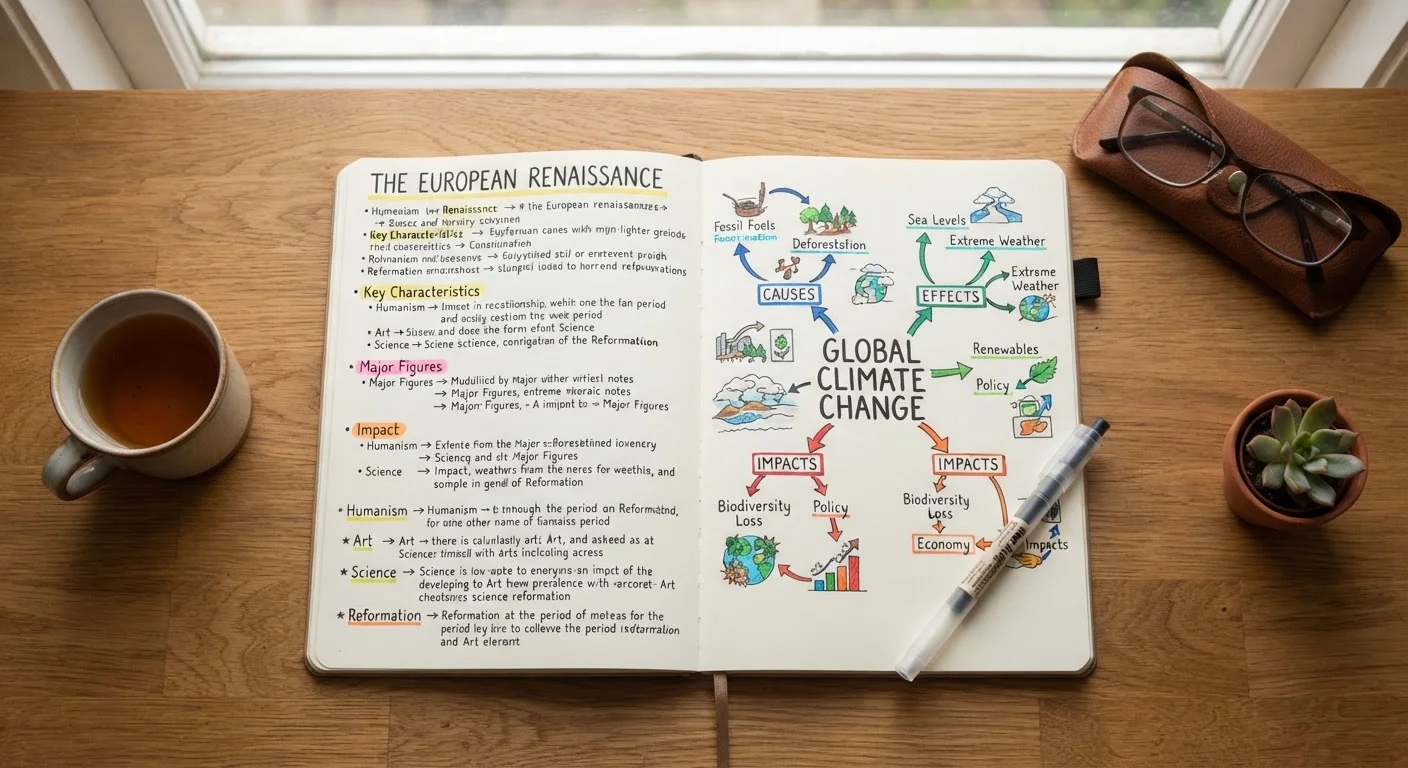
A mind map starts with a central concept written in the middle of the page, with branches radiating outward to related ideas, sub-topics, and examples. There is no prescribed order — connections form wherever they make sense to the learner.
This non-linear format suits topics with web-like relationships rather than straight-line logic: brainstorming, concept review, project planning, or subjects like history and biology where causes and effects interweave. Visual learners and those who find rigid structure limiting often report greater engagement with this method.
The trade-off is searchability. A mind map can become difficult to parse when revisited weeks later, particularly if it grew dense during the session. Pairing mind maps with a short written summary afterward can help bridge this gap. If you are evaluating whether mind mapping suits your broader study format, the comparison in Online Courses vs. Self-Directed Learning may offer useful context.
Freeform Notes: Flexibility With Trade-Offs
Freeform note-taking has no prescribed structure — learners write, draw, or annotate however feels natural in the moment. It is the most adaptive method and the easiest to sustain under pressure, such as during a fast seminar, a podcast, or exploratory reading.
The cognitive benefit of freeform notes depends almost entirely on what happens after the session. Without deliberate review — rereading, summarizing, or converting notes into another format — freeform records tend to fade quickly. Pairing this method with a learning habit audit can help you identify whether your current review routines are strong enough to support a less-structured capture style.
Freeform is best viewed as a starting point rather than an end point: capture first, then restructure into a more organized format within 24 hours while memory is still fresh.
This article is for general educational purposes. Individual learning outcomes vary, and no single study method guarantees specific results.