
The Forgetting Curve: What Ebbinghaus's Research Actually Tells Us About Memory Decay

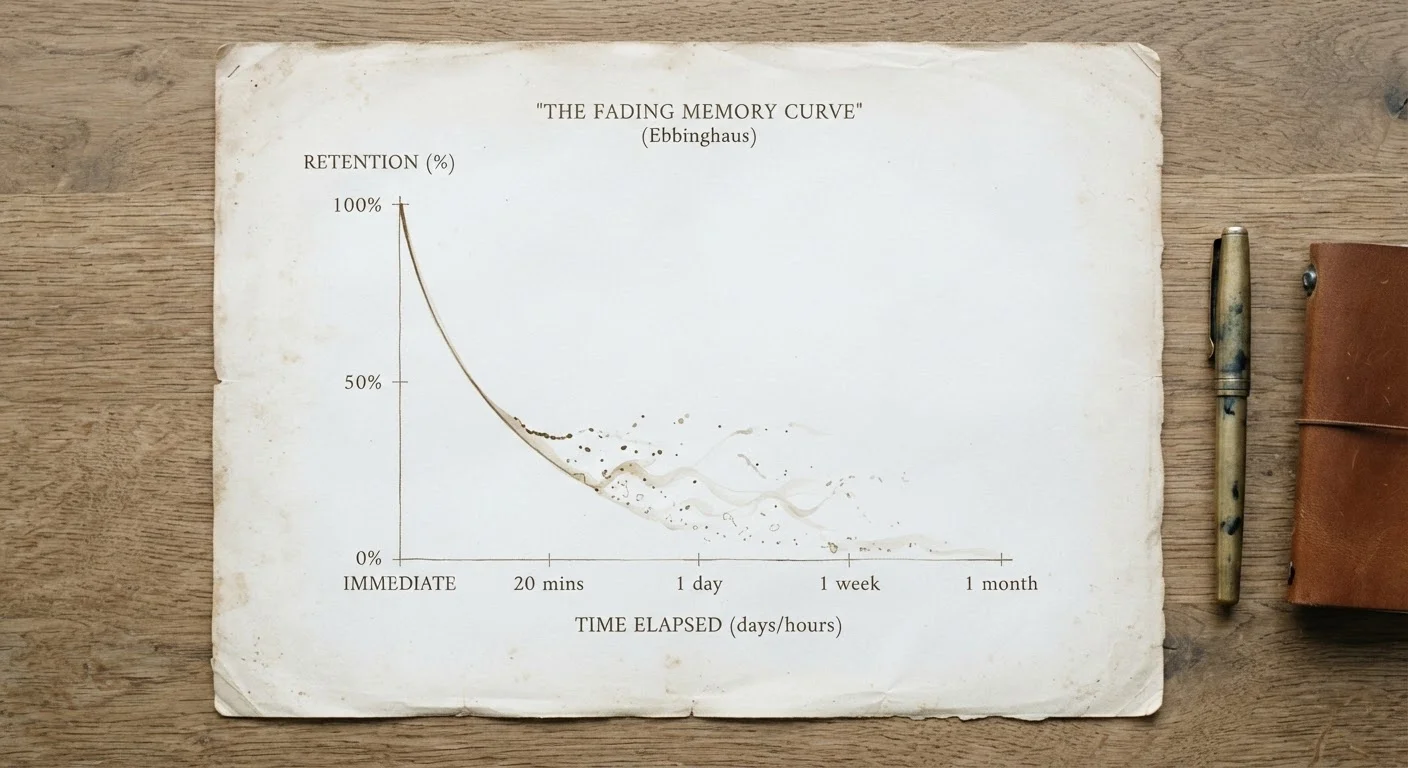
| Researcher | Hermann Ebbinghaus (Published 1885, Über das Gedächtnis (On Memory)) |
| Retention after 1 hour (no review) | ~44–56% (Based on Ebbinghaus's original self-experiments) |
| Retention after 24 hours (no review) | ~30% (Ebbinghaus, 1885; widely replicated in general form) |
| Retention after 1 week (no review) | ~20–25% (Ebbinghaus original data; varies with meaningful material) |
| Key countermeasure | Spaced repetition (Supported by decades of memory research) |
| Material type in original research | Nonsense syllables (context-free) (Ebbinghaus used artificial stimuli to control for prior knowledge) |
What Ebbinghaus Actually Did
In the 1880s, German psychologist Hermann Ebbinghaus became the first researcher to rigorously measure memory using controlled experiments — and he used himself as the sole subject. He memorized lists of nonsense syllables (meaningless combinations like "DAX" or "BUP"), then tested how much he retained at set intervals. From this, he produced what became known as the forgetting curve: a mathematical description of how memory fades over time without reinforcement.
His core finding was striking: without any review, people forget roughly half of newly learned information within an hour, and up to 70% within 24 hours. After a week, retention may fall below 25%. These numbers are often cited loosely, so it's worth being precise — Ebbinghaus worked with artificial, context-free material. Real-world learning involving meaning, emotion, or prior knowledge decays more slowly. Still, the general pattern holds: memory is not passive storage. It degrades unless actively maintained.
| Researcher | Hermann Ebbinghaus (Published 1885, Über das Gedächtnis (On Memory)) |
| Retention after 1 hour (no review) | ~44–56% (Based on Ebbinghaus's original self-experiments) |
| Retention after 24 hours (no review) | ~30% (Ebbinghaus, 1885; widely replicated in general form) |
| Retention after 1 week (no review) | ~20–25% (Ebbinghaus original data; varies with meaningful material) |
| Key countermeasure | Spaced repetition (Supported by decades of memory research) |
| Material type in original research | Nonsense syllables (context-free) (Ebbinghaus used artificial stimuli to control for prior knowledge) |
The Mechanism Behind the Curve
Memory researchers distinguish between encoding (getting information in), consolidation (stabilizing it), and retrieval (pulling it back out). The forgetting curve reflects what happens when consolidation is weak — typically because information was encountered only once, without meaningful connection to existing knowledge.
Ebbinghaus also identified what he called the savings effect: relearning forgotten material takes less time than learning it originally. This suggests that even memories that feel completely lost leave some trace. Neuroscience now describes this in terms of synaptic connections — partial traces persist even when conscious recall fails. For adult learners, this means restarting a topic you once studied is rarely starting from zero. Cognitive principles that shape adult learning help explain why this relearning advantage exists and how prior experience accelerates new skill acquisition.
Forgetting Curve
A graphical representation of how memory retention declines over time without review or reinforcement. Ebbinghaus described it as an exponential decay function.
Spaced Repetition
A learning technique that schedules review of material at gradually increasing intervals. It exploits the spacing effect to strengthen memory consolidation before decay sets in.
Savings Effect
Ebbinghaus's observation that relearning previously forgotten material requires less effort than the original learning. It indicates that some memory trace persists even when conscious recall fails.
Memory Consolidation
The process by which newly encoded information is stabilized in long-term memory. Consolidation is influenced by sleep, repetition, and meaningful connection to existing knowledge.
Massed Practice
Studying material in one concentrated session, sometimes called cramming. Research consistently shows this produces weaker long-term retention than spaced practice.
Elaborative Interrogation
A study strategy that involves asking explanatory questions — such as "why is this true?" — about the material being learned. It deepens encoding by linking new facts to existing knowledge.
How to Work With the Curve, Not Against It
The most direct application of Ebbinghaus's research is spaced repetition — reviewing material at increasing intervals just before it would otherwise be forgotten. Instead of studying a topic intensely in one session (massed practice, sometimes called "cramming"), spaced repetition spreads review across days and weeks. Each review strengthens the memory trace and pushes the next forgetting threshold further out.
Practically, this can look like: reviewing notes the evening after a learning session, again two days later, then after a week, then a month. Many flashcard systems and language apps are built around this principle, though you can apply it manually with a simple review schedule. For adults juggling busy schedules, even brief, consistent review windows of 10–15 minutes can meaningfully slow decay. See evidence-based habits that improve retention for more strategies aligned with how memory actually works.
Meaning also matters enormously. Ebbinghaus's nonsense syllables decayed fast precisely because they had no context. When you connect new information to something you already know — a story, a real-world application, an existing mental model — consolidation strengthens. This is why elaborative interrogation (asking "why does this work this way?") and self-explanation are more durable than passive re-reading.
If you want to audit your current study habits against these principles, the Learning Habit Audit offers a structured self-check to identify where your retention may be breaking down.