

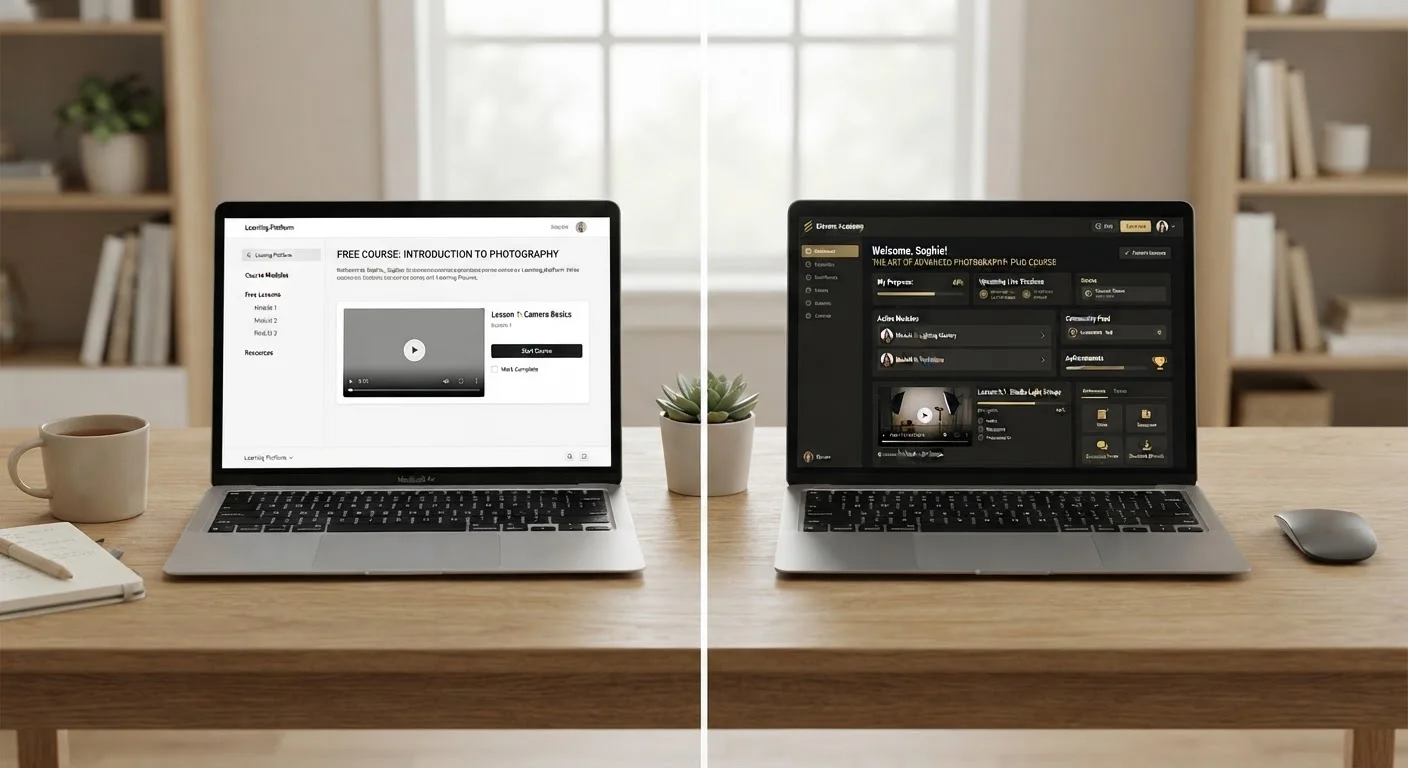
Key Takeaways
- Free courses excel at exploration and foundational knowledge but rarely include graded feedback or recognized credentials.
- Paid courses often add value through structure, instructor access, and certificates—but price alone doesn't guarantee quality.
- The right choice depends on your specific goal, not on which option costs more or less.
- Completion rates are lower for free courses, partly because low stakes reduce accountability.
- Audit options on many platforms let you access paid course content free—with key features removed.
- Evaluate any course—free or paid—on curriculum depth, instructor credibility, and community support.
Option A
Free Online Courses
The accessible, low-commitment entry point to new skills.
Best for: Explorers testing a subject area, budget-conscious learners, or anyone building foundational knowledge without a credential goal.
Option B
Paid Online Courses
The structured, accountable path for serious skill investment.
Best for: Learners pursuing career advancement, recognized credentials, or guided instruction with substantive feedback and support.
If you want to explore a new subject before committing
Free Online Courses
Free courses let you test interest and build baseline knowledge with zero financial risk. Many high-quality introductory options exist across major platforms.
If you need a credential for a job application or promotion
Paid Online Courses
Recognized certificates and verifiable credentials are almost exclusively tied to paid tiers, and employers are more likely to acknowledge them.
If you learn best with accountability and instructor feedback
Paid Online Courses
Paid courses typically include graded assessments, cohort interaction, and direct instructor access—factors that meaningfully improve completion and retention.
If you are on a tight budget but have strong self-discipline
Free Online Courses
With a clear study schedule and a concrete goal, disciplined learners can extract significant value from free content alone.
If you want to evaluate a paid course before spending money
Free Online Courses
Audit options and free preview lessons let you assess teaching style and content quality before committing to a paid enrollment.
What You Actually Get—and Give Up—at Each Price Point
The instinct to equate price with quality is understandable, but in online education it frequently misleads. Some free courses—particularly those offered through university partnerships on major platforms—cover the same academic content as their paid counterparts. The real differences lie in what surrounds the content: feedback, credentials, and community.
Free courses typically offer video lectures, reading materials, and sometimes quizzes. What they rarely include is meaningful assessment of your work, a certificate an employer can verify, or a live person responding to your questions. You gain access; you lose structure and accountability.
Paid courses add layers: graded projects, peer or instructor review, certificates of completion, and in many cases cohort-based interaction. That scaffolding isn't just administrative—research on adult learning consistently finds that feedback loops and social accountability improve both retention and completion. Before committing to any course at any price, it helps to understand the broader landscape. Our guide to online course formats explains the distinctions between MOOCs, cohort courses, and self-paced modules so you can match format to goal.
| Criterion | Free Online Courses | Paid Online Courses |
|---|---|---|
| Cost | No financial commitment | Ranges from modest to significant |
| Credential / Certificate | Rarely included or unverified | Typically included and verifiable |
| Instructor Feedback | Usually absent | Often included, varies by format |
| Accountability Structures | Low — self-directed only | Higher — deadlines, grades, peers |
| Completion Rates | Generally lower | Generally higher |
| Content Depth | Varies widely; can be substantial | Varies widely; not guaranteed deeper |
| Best Use Case | Exploration, foundational learning | Career goals, credentialing, structure |
When Paying More Actually Pays Off
Cost becomes worth it when your learning goal has external stakes—a job application, a career pivot, a professional license exam. In those cases, a verifiable certificate carries weight a self-declared free completion cannot. Employers reviewing candidates generally treat platform-issued certificates that require assessed work differently from audit completions that involve no graded component.
Paid enrollment also raises the psychological stakes in ways that help completion. Research on online learning consistently identifies low perceived cost as a factor in high dropout rates for free courses. Spending real money creates a commitment device—not a guarantee of success, but a nudge toward follow-through.
~5%
Average MOOC completion rate
Studies across multiple large-scale open online course providers have consistently found average completion rates below 10%, with low-stakes enrollment cited as a contributing factor.
2–3×
Higher completion in paid cohort courses
Research on adult online learning suggests that structured, paid cohort formats produce meaningfully higher completion rates compared to self-paced free equivalents.
That said, paying more does not automatically mean learning more. A poorly structured paid course from an unvetted instructor will underdeliver compared to a rigorous free course from a reputable institution. Our course evaluation framework gives you a practical way to compare options on the factors that actually predict learning outcomes, regardless of price.
Smart Strategies for Navigating Both Options
You don't have to choose one category and stick with it. Many experienced online learners use a two-stage approach: audit a free or preview version of a course to assess fit, then enroll in the paid tier if the content and instructor style match their needs.
A few practical principles to guide your decision:
- Match the stakes to the cost. Casual curiosity rarely justifies significant tuition. Career-critical skills often do.
- Check what the free tier actually includes. Some platforms offer audit access to all video content with only assessments and certificates locked. Others strip out substantial material. Read the tier comparison carefully before assuming free equals full access.
- Look for institutional credibility. A free course from a university or professional association often carries more signal than a paid course from an anonymous creator, even when the price tags suggest otherwise.
- Consider the format alongside the price. Structure and pacing matter independently of cost. Our comparison of self-paced and cohort-based formats can help you decide which learning rhythm fits your life before you spend anything.
If you find that online courses—at any price—feel limiting for your goals, it may also be worth exploring whether a more open, self-directed approach fits your situation better. See how online courses compare to self-directed learning for a clear breakdown of when each approach wins.