

Key Takeaways
- Microlearning is most effective for reinforcing existing skills or exploring new topics in small increments.
- Bootcamps suit adults who need job-ready skills quickly and can commit to an intensive schedule.
- Degree programs signal deep credential value but demand significant time and financial investment.
- The right format depends on your goal first — then your available time and budget.
- Mixing formats strategically can accelerate learning while managing cost and commitment.
Our Verdict
No single format is universally superior — each serves a different purpose. Microlearning excels at habit-building and skill refreshes; bootcamps compress job-relevant training into weeks; degree programs build credentialed, foundational expertise over years. Matching format to your actual goal — not just convenience or cost — is what determines whether your investment pays off.
| Best for | Recommended |
|---|---|
| Adults who want to build a daily learning habit or fill specific knowledge gaps | Microlearning |
| Career changers who need demonstrable, employer-facing skills quickly | Bootcamp |
| Those pursuing roles that formally require accredited credentials | Degree Program |
| Learners who want breadth first, then depth in a specific area | Microlearning followed by a Bootcamp |
Why Format Matters as Much as Content
Most adults pick an online course based on topic and price — format is an afterthought. That's a costly mistake. The structure of how you learn shapes retention, accountability, pacing, and ultimately whether a credential carries weight with an employer or graduate school.
Before comparing formats, it helps to clarify what you're actually after. Are you trying to stay current in your field? Transition to a new career? Earn a credential your employer recognizes? Each goal points toward a different format. For a broader orientation to the learning landscape, see what all those course formats actually mean.
| Microlearning | Bootcamp | Degree Program | |
|---|---|---|---|
| Typical time commitment | 5–15 min/day, ongoing | 8–24 weeks, intensive | 2–4+ years, part- or full-time |
| Depth of learning | Narrow, concept-level | Practical, project-based | Broad and deep, foundational |
| Credential recognition | Low to moderate | Moderate (field-dependent) | High (accredited) |
| Cost range | Low to free | Moderate to high | High to very high |
| Best for | Skill refreshes, habit building | Career transition, job readiness | Licensed professions, academic roles |
| Flexibility | Very high | Moderate | Low to moderate |
Microlearning: Small Sessions, Specific Wins
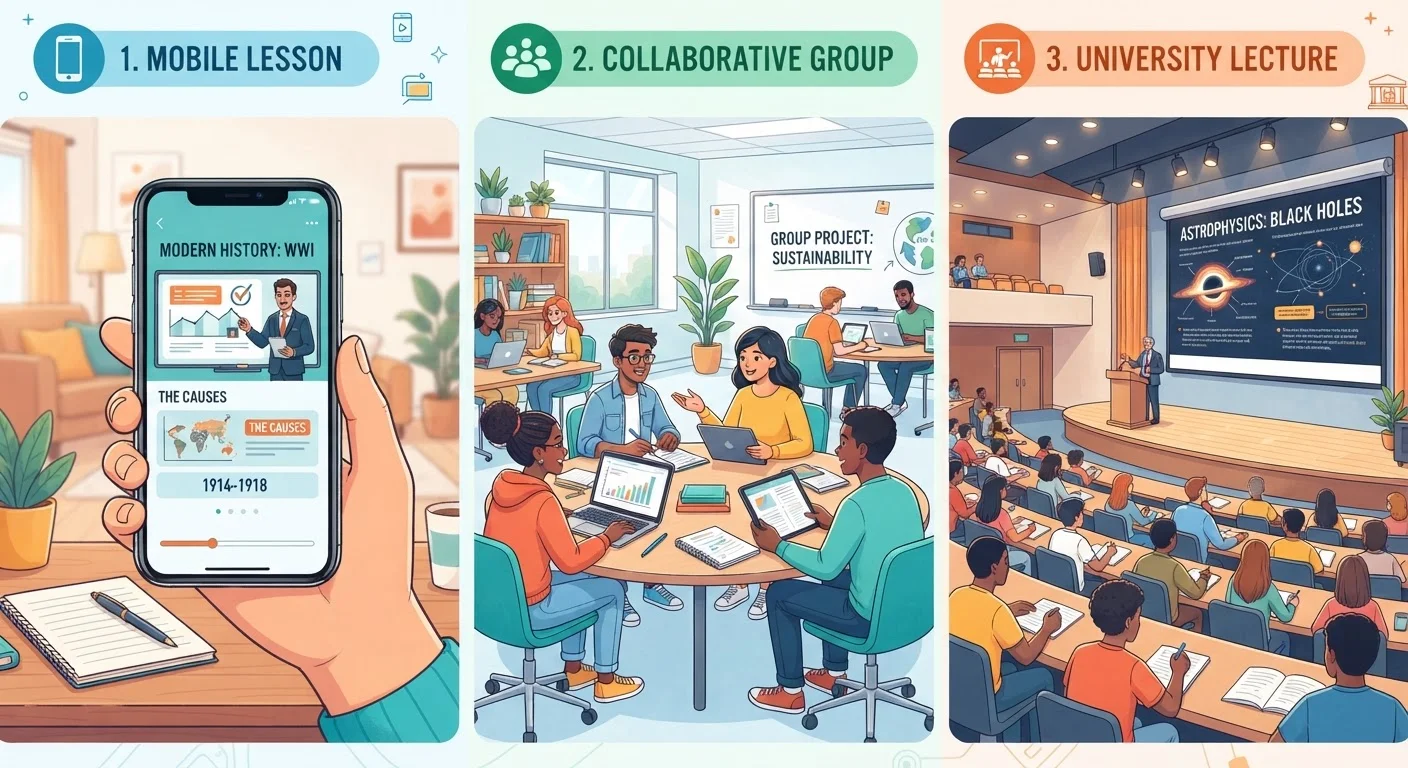
Microlearning refers to content consumed in short, focused bursts — typically five to fifteen minutes per session. Think short video modules, flashcard decks, or single-concept quizzes. It's well-suited to busy adults who can't block out large chunks of time but want to make steady progress.
Research into spaced repetition and retrieval practice supports the idea that frequent, brief exposures to material can improve long-term retention compared to marathon study sessions. However, microlearning has real limits: it tends to reinforce existing frameworks rather than build new ones from scratch. If you're entirely new to a field, short snippets rarely provide enough context or depth to develop transferable skills.
Microlearning works well as a complement to other formats. For example, you might use it to preview concepts before a bootcamp or to maintain a skill after formal training. If you're structuring short sessions intentionally, micro-learning habits that build over time offers practical guidance on making those minutes add up.
Use Microlearning as a Bridge, Not a Destination
If you're preparing for a bootcamp or degree program, microlearning can be an effective on-ramp — use it to build familiarity with key terms and concepts before the intensive work begins. Treat it as preparation, not a substitute. A few weeks of short daily sessions can meaningfully reduce the cognitive load once you're in a structured program.
Bootcamps: Fast, Focused, and High-Stakes
A bootcamp (short for intensive training program) compresses months of skill-building into weeks — typically eight to twenty-four weeks of full- or part-time study. Originally associated with coding, bootcamp-style programs now cover data analytics, UX design, digital marketing, cybersecurity, and more.
The format's key advantage is practical depth. Bootcamps generally emphasize project-based learning and portfolio development over theoretical coursework, which is why many employers in technical fields have come to recognize them. The trade-off is intensity: dropping out rates are non-trivial when learners underestimate the workload or enroll without a clear use for the credential.
Bootcamps are not accredited in the same way that universities are, which matters in fields where licensing or formal credentials are required. For anyone using a bootcamp as a career-change vehicle, it's worth reading what to expect when using online education to pivot careers before committing.
Degree Programs: Depth, Credentials, and Long Horizons
Accredited degree programs — associate, bachelor's, master's, or doctoral — remain the gold standard for fields where credentialed expertise is non-negotiable: nursing, engineering, law, education, and many others. Online delivery has made degree programs more accessible without eliminating their defining features: structured curriculum, faculty oversight, peer cohorts, and institutional accreditation.
The commitment is substantial. A bachelor's degree typically requires four years of full-time study; an online master's may take two to three years part-time. Costs vary widely, but degree programs generally represent the largest financial investment of the three formats. The payoff — for the right goal — is a credential with durable, widely recognized value.
It's also worth noting that not every degree program is equal. Accreditation type, institutional reputation, and program alignment with your target field all shape how employers and licensing boards view the credential. how structured courses compare to self-directed study can help frame that decision for learners still weighing options.
40%
Adults enrolled in some form of online education
According to the National Center for Education Statistics, roughly 40% of all undergraduate students take at least some distance education courses.
73%
Bootcamp graduates employed in field within 180 days
Course Report's annual alumni outcomes survey has consistently found that around 70–75% of bootcamp graduates report employment in a relevant role within six months of graduation.
How to Choose: A Goal-First Framework
Rather than starting with format, start with a clear statement of your goal. Then layer in your constraints.
- Goal: Refresh or expand a skill you already have. Microlearning or a short self-paced course is likely sufficient — and far less disruptive to your schedule.
- Goal: Build a portfolio and get hired in a new field within a year. A reputable bootcamp aligned with employer expectations in that field is worth investigating.
- Goal: Qualify for roles that require an accredited credential. A degree program is the appropriate path, and shortcuts rarely satisfy gatekeepers.
- Goal: Explore a topic before committing. Start with microlearning or a single MOOC (massive open online course) to test your interest before enrolling in something longer and costlier.
Whichever format you choose, structure matters inside the format too. self-paced vs. cohort-based online courses explores how pacing and accountability shape your actual learning experience, regardless of format.