
Skill Stacking: Building Complementary Abilities That Multiply Your Usefulness

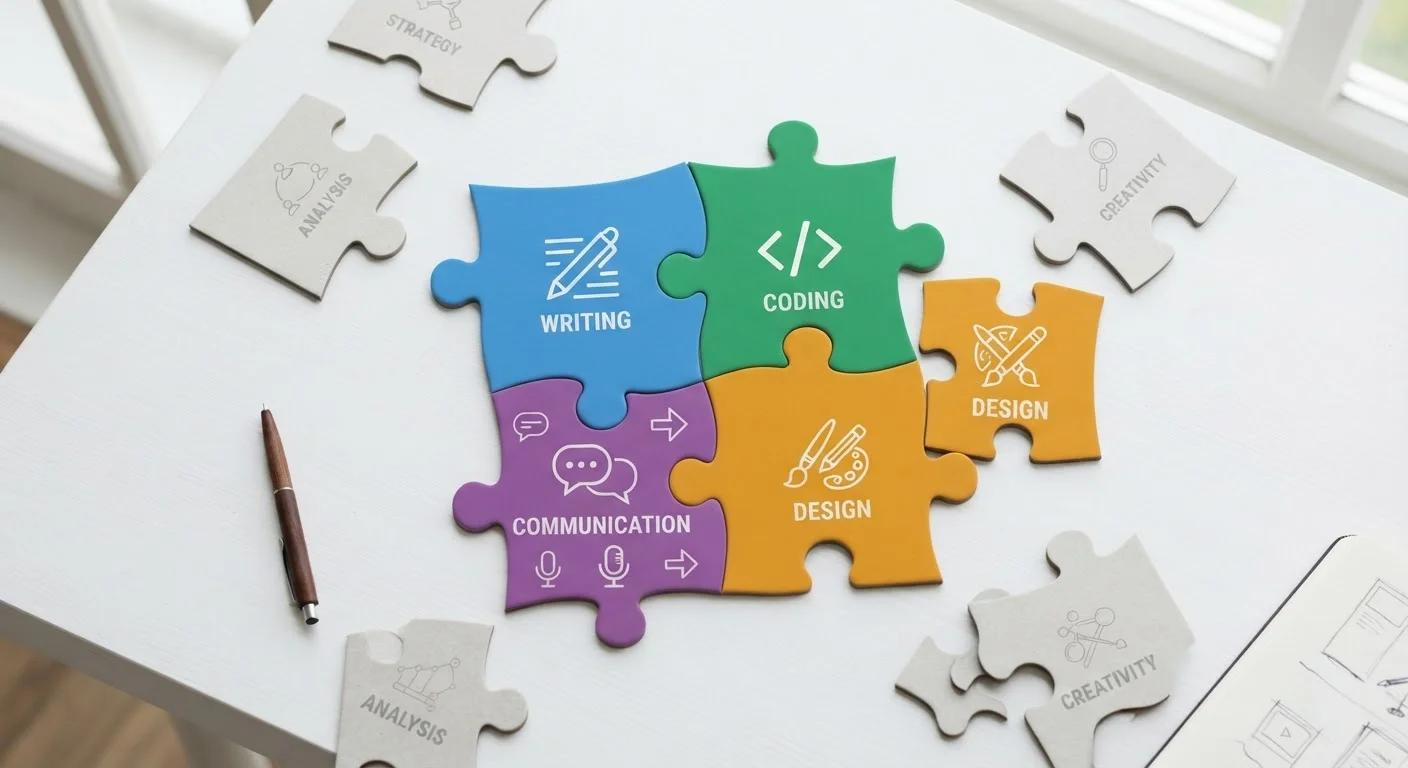
Key Takeaways
- Combining complementary skills creates compound value that isolated expertise rarely achieves.
- You don't need to master every skill in your stack — functional proficiency in each is enough.
- The rarer the combination, the more distinctive your value in a job market or creative field.
- Skill stacking works best when each ability has a clear relationship to the others.
- Adult learners benefit especially because existing experience gives new skills immediate context.
Skill Stacking
Skill stacking is the practice of deliberately combining several related — but distinct — abilities so they reinforce one another and produce an outcome greater than any single skill could. Instead of trying to become the world's foremost expert in one narrow area, you build a small portfolio of complementary skills that, together, make you unusually effective. The idea is that rare combinations are often more valuable than depth in a single lane.
The concept draws on insights from cognitive science around transfer learning — the brain's ability to apply knowledge from one domain to accelerate learning in adjacent domains — making deliberate pairing more efficient than random skill acquisition.
Why One Skill Is Rarely Enough
The traditional advice has long been to pick one thing and get very, very good at it. That advice still has merit in some contexts. But in most modern work and creative environments, pure depth in a single skill often hits a ceiling quickly. A writer who understands basic data analysis can produce more compelling, evidence-backed articles. A project manager who knows enough coding to read a technical spec makes fewer costly miscommunications. The difference is skill stacking.
The leverage comes from intersection. Each skill you add doesn't merely sit alongside the others — it multiplies what the others can do. This is why thoughtful pairing matters far more than accumulating unrelated abilities. Randomly adding skills is just multitasking disguised as strategy.
If you find yourself consuming courses without building real ability, skill stacking gives you a purposeful lens for what to learn next — and why.
2–4
Complementary skills for effective stacking
Learning researchers and career educators broadly suggest that pairing two to four related skills produces the most practical leverage without overwhelming focus.
Top 25%
Proficiency level needed per skill
Popularized in discussions of skill stacking, functional proficiency — rather than expert mastery — in each area is typically sufficient for the combination to generate distinctive value.
~40%
Faster learning in adjacent skill domains
Research on transfer learning suggests that prior domain knowledge can meaningfully reduce the time needed to reach proficiency in a closely related skill.
How to Identify Your Stack
Effective stacks share one quality: each skill addresses a gap the other skills leave open. Here's a practical approach to identifying yours.
- Start with what you already have. List skills you use regularly — even informally. These are your foundation. Adults often underestimate how much transferable ability they already possess.
- Identify the friction point. Where does your current skill fall short? What task would become dramatically easier with one additional capability?
- Look one step sideways, not upward. Rather than going deeper into your existing specialty, explore adjacent skills. A graphic designer's friction point might be client communication, not more advanced illustration technique.
- Test the combination quickly. Apply both skills on a real, low-stakes project before investing months in formal study. This reveals whether the pairing actually creates value for you.
Before committing to a new learning path, it's worth running through a pre-skill checklist to clarify your goal and set up realistic practice conditions.
Look for Adjacent, Not Random, Skills
A strong stack has a clear logical thread running through it. Before adding a new skill, ask: 'Does this make my existing skills more powerful?' If the answer isn't immediately obvious, the pairing likely won't produce the leverage you're hoping for. Adjacency — not variety — is the key principle.
Putting Your Stack to Work
Knowing your intended stack is only half the job. The other half is building each skill to a level of functional proficiency — enough to apply it confidently, not necessarily enough to teach a masterclass. Cognitive scientists who study transfer learning note that acquiring a second skill in an adjacent domain tends to go faster than the first, because the brain reuses existing mental frameworks. In practice, this means your second and third stack additions often require less time investment than the foundational skill did.
Consistency of practice matters more than session length. Short, well-structured sessions spread across weeks outperform occasional marathon study days for most adult learners. If you want a systematic framework for scheduling this around your existing commitments, a personal skill-learning plan can help you map realistic timelines.
Finally, make the combination visible. Whether that means updating a professional profile, creating a project that demonstrates both skills, or simply describing the pairing when introducing yourself — the value of a stack only compounds when others understand what you bring to the table.