

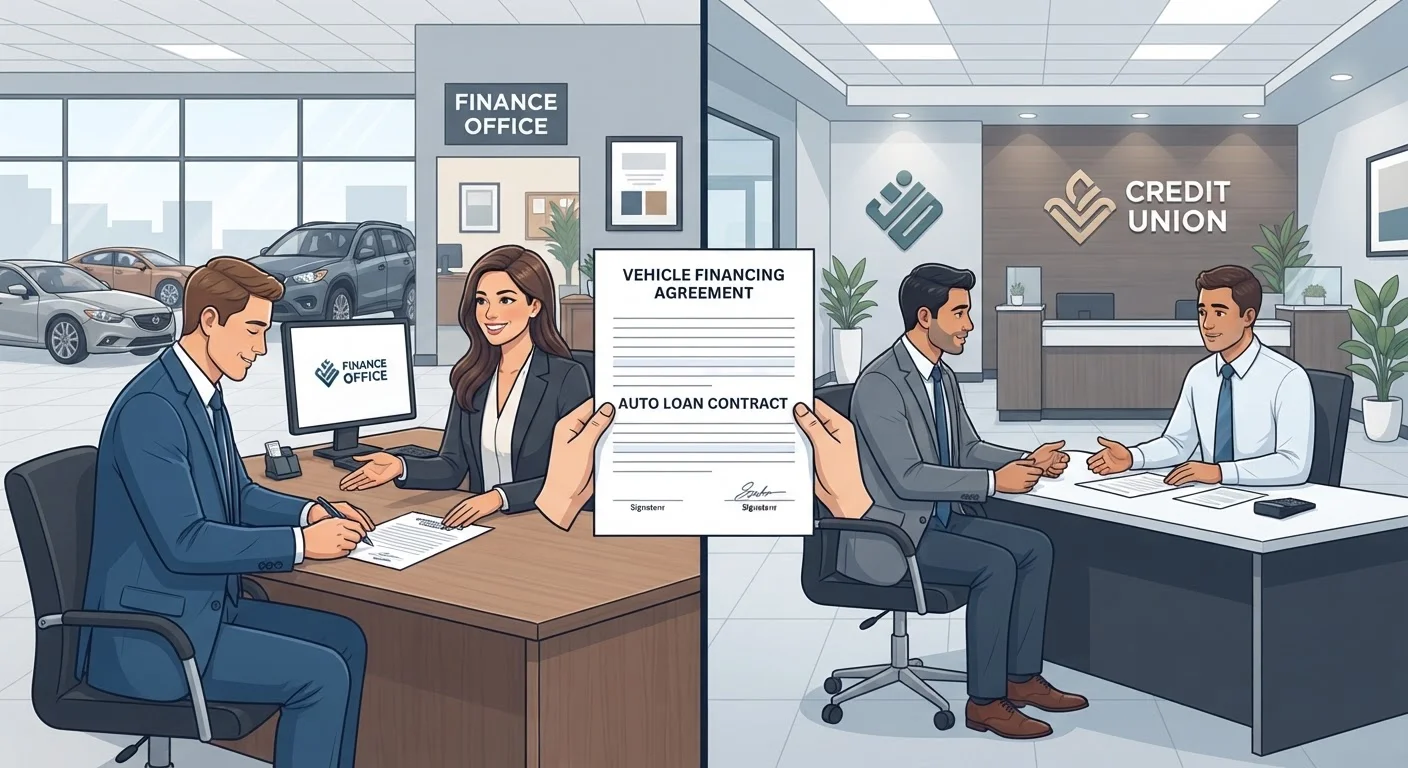
Key Takeaways
- Dealer financing routes your loan through the dealership's lending partners, which may add a markup to the interest rate.
- Pre-approval from a bank or credit union lets you separate the vehicle price negotiation from the loan terms.
- Credit unions often offer competitive rates, especially for members with established accounts.
- Neither route is universally cheaper - your credit profile, loan term, and vehicle type all affect the final rate.
- Shopping multiple lenders before visiting a dealership gives you a benchmark to evaluate any dealer offer against.
- Understanding key loan terms is essential before committing to any auto financing arrangement.
Option A
Dealer Financing
The one-stop-shop convenience option.
Best for: Buyers who want to handle the purchase and financing in a single visit, or who may qualify for manufacturer-subsidized rate promotions.
Option B
Bank or Credit Union Financing
The independent, pre-approved lending route.
Best for: Buyers who want to shop with a firm loan offer in hand and negotiate the vehicle price separately from the financing terms.
If you want a streamlined, single-visit car-buying experience
Dealer Financing
Dealers can often finalize a purchase and loan in one sitting, which reduces the logistical steps for buyers who prefer convenience over extensive rate shopping.
If you want the most leverage when negotiating vehicle price
Bank or Credit Union Financing
Arriving with a pre-approval in hand lets you treat the car price and loan as separate conversations, reducing the dealer's ability to blend margins across both.
If you have a strong existing relationship with a credit union
Bank or Credit Union Financing
Credit unions frequently offer member-preferred rates and lower fees, making them worth checking before any other lender.
If a manufacturer is running a low-APR incentive promotion
Dealer Financing
Subsidized rates from manufacturers - such as 0% or 1.9% APR - are only accessible through dealership financing and can represent genuine savings for qualified buyers.
If you have limited or rebuilding credit
Dealer Financing
Dealerships often work with a wider network of lenders who specialize in non-prime borrowers, though this flexibility typically comes with higher rates.
How Each Financing Route Works
When you finance a car through a dealership, the dealer acts as an intermediary. You apply for credit at the dealership, and the finance department submits your application to one or more lenders - banks, captive finance arms (lenders owned by manufacturers), or specialty auto lenders. The dealer then presents you with terms, which may include a markup above the rate the lender actually approved. This spread, sometimes called the dealer reserve, is legal in most states and is how dealers earn income from the financing side of a sale.
When you finance through a bank or credit union directly - a process called direct lending - you apply for a loan before or separately from visiting the dealership. If approved, you receive a pre-approval letter or a blank check up to a set amount. At the dealership, you're effectively a cash buyer from the seller's perspective, which simplifies the price negotiation. Before committing to any loan, it's worth reviewing our glossary of key auto finance terms so you can evaluate offers on an apples-to-apples basis.
| Criterion | Dealer Financing | Bank or Credit Union Financing |
|---|---|---|
| Application process | Done at the dealership, often same day | Applied for independently, before dealership visit |
| Rate transparency | Rate may include dealer markup | Rate is quoted directly by the lender |
| Access to manufacturer promotions | Yes - subsidized rates available | No - promotions are dealer-exclusive |
| Negotiating position | Price and financing often bundled | Price and financing negotiated separately |
| Lender network | Multiple lenders submitted simultaneously | Single lender of your choice |
| Credit union option | Rarely available through dealers | Available if you are a member |
| Convenience | High - one location, one visit | Requires separate pre-approval step |
| Add-on product pressure | Common in finance office | Generally lower; terms set in advance |
Rate Differences and Hidden Costs to Watch
Interest rates on auto loans vary based on your credit score, loan term, vehicle age, and lender type - not just where you finance. That said, the structure of dealer financing introduces a layer that direct lending does not: the possibility of a marked-up rate. A lender might approve you at 6.5% APR, but the dealer may quote you 7.5% and keep the difference over the life of the loan.
This doesn't mean dealer financing is always more expensive. Manufacturer-subsidized promotions - where the automaker's captive lender offers below-market rates to move inventory - are exclusively available through dealers. A 0% or low-APR incentive offer, if you qualify, can outperform virtually any rate you'd find independently. The key is knowing your benchmark rate before you walk in. Getting pre-approved by your bank or credit union gives you exactly that.
~80%
New car buyers who use some form of financing
According to Experian's State of the Automotive Finance Market reports, roughly four in five new vehicle purchases in the US involve financing.
1-2%
Typical dealer reserve markup range
The Consumer Financial Protection Bureau has noted that dealer markup on auto loans commonly ranges from one to two percentage points above the lender's buy rate.
~30%
Auto loans originated by credit unions
The National Credit Union Administration has reported that credit unions hold a meaningful share of the US auto loan market, reflecting their competitive positioning on rates.
Also watch for add-ons that can be bundled into dealer financing contracts, such as extended service contracts, GAP coverage (which pays the difference between what you owe and what the car is worth if it's totaled), or credit insurance. These are not inherently bad products, but rolling them into a loan increases the principal you pay interest on over time. For more on how each payment breaks down, see our guide on reading a loan amortization schedule.
Credit Unions: A Frequently Overlooked Option
Credit unions deserve special mention because they operate as member-owned, not-for-profit institutions. Profits are returned to members in the form of lower fees and better rates rather than to shareholders. For auto loans specifically, credit unions have historically offered competitive APRs, particularly for borrowers with good-to-excellent credit.
If you're not already a member of a credit union, eligibility is often broader than people assume - many accept members based on employer, geographic region, or community affiliation. Checking with a local credit union before finalizing any financing decision takes little time and can meaningfully affect your total loan cost. To understand how auto financing interacts with your credit profile more broadly, see our article on common myths about car loans and credit scores.
Rate Shopping and Your Credit Score
Applying to multiple auto lenders within a short window - typically 14 to 45 days depending on the credit scoring model - is generally treated as a single inquiry for scoring purposes. This means rate shopping across several banks, credit unions, and a dealership's lender network is unlikely to significantly hurt your credit score. For more context, see our article on auto loan and credit score myths.
This article is for general informational purposes only and does not constitute financial or legal advice. Consult a qualified financial professional for guidance specific to your situation.