

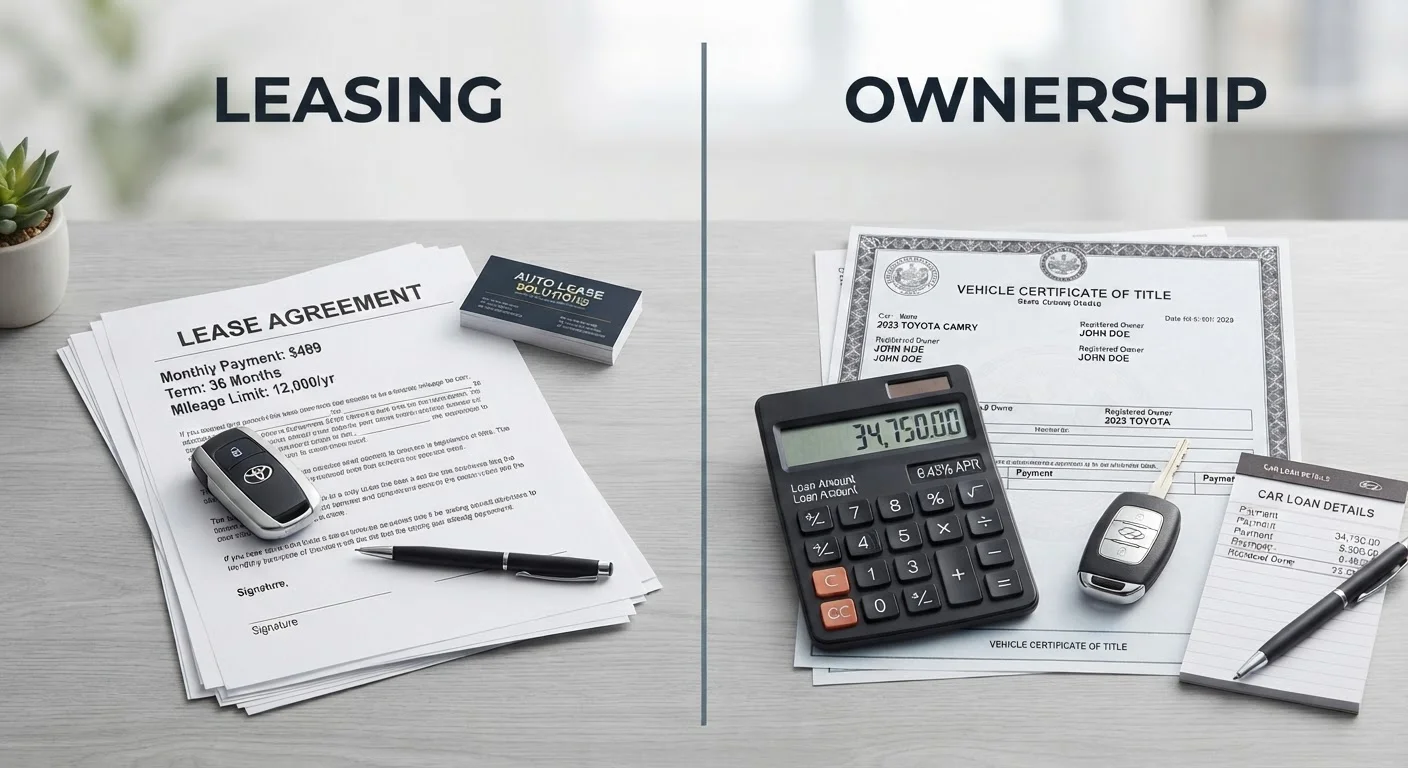
Key Takeaways
- Leasing typically offers lower monthly payments but builds no equity in the vehicle.
- Buying costs more upfront but results in ownership and eventually payment-free transportation.
- Mileage limits and wear-and-tear fees can make leasing expensive for high-mileage drivers.
- Total long-term cost of repeated leasing often exceeds the cost of owning a vehicle outright.
- Your credit score, driving habits, and financial goals should all factor into the decision.
Lower monthly payments than a comparable auto loan
Because you're financing only the vehicle's depreciation during the lease term rather than its full value, monthly lease payments are typically lower than loan payments on the same model.
Access to a newer vehicle every two to three years
Lease terms usually run 24-36 months, allowing drivers to switch to updated models with the latest safety and technology features without the hassle of selling a used car.
Maintenance often covered under factory warranty
Since leased vehicles are generally newer and the term aligns with the manufacturer's warranty period, major mechanical repairs are less likely to become an out-of-pocket expense.
Possible tax advantages for business use
Drivers who use a vehicle for business purposes may be able to deduct a portion of lease payments as a business expense - consult a qualified tax professional for guidance specific to your situation.
No equity or ownership at lease end
Lease payments do not build toward ownership. At the end of the term, you return the car with nothing to show financially unless you choose to purchase it at the residual value.
Mileage limits can trigger costly penalties
Most leases cap annual mileage at 10,000-15,000 miles. Exceeding that limit typically results in per-mile overage charges that can add hundreds or thousands of dollars at lease end. See hidden costs in car lease agreements for a full breakdown.
Wear-and-tear charges add unpredictable costs
Lessees are responsible for returning the vehicle in acceptable condition. Scratches, interior damage, or worn tires beyond defined thresholds can result in fees assessed at turn-in.
Long-term leasing is typically more expensive than owning
A driver who leases continuously over ten years will generally spend more in total than one who buys and keeps a vehicle for the same period, since there is no payoff point and no asset retained.
Early termination is costly and complicated
Exiting a lease before the term ends usually involves significant penalties, making leases a poor fit for drivers whose circumstances - income, location, or household size - may change.
Our Verdict
Leasing suits drivers who prioritize lower monthly costs, prefer driving newer vehicles, and stay within moderate mileage limits. Buying - whether outright or financed - makes more financial sense for most drivers over the long run, particularly those who drive frequently, plan to keep the vehicle several years, or want to build equity. Neither option is universally superior; the right path depends on your personal cash flow, driving patterns, and financial priorities.
Leasing is best for drivers who value flexibility and predictable low payments; buying is better for those seeking long-term value and ownership.
How Leasing and Buying Actually Work
When you buy a vehicle - whether with cash or through an auto loan - you acquire ownership. A financed purchase means making monthly payments that reduce the principal balance, and once paid off, the car is yours outright. When you lease, you are essentially renting the vehicle for a set term, typically 24 to 48 months. Payments cover the vehicle's projected depreciation over that term plus a financing charge (the money factor), not the full purchase price.
Understanding the terminology on both sides is important before signing anything. For a plain-language guide to terms like capitalized cost, residual value, and APR, see key auto finance terms every car buyer should know.
This Is General Financial Information
The comparison on this page is for educational purposes only and does not constitute personalised financial or tax advice. Auto financing decisions depend on your individual credit profile, income, and goals. Consider consulting a licensed financial adviser or accountant before committing to either a lease or a purchase loan.
The Financial Case for Leasing
Leasing's most obvious appeal is the monthly payment. Because you're only financing the depreciation portion of the vehicle's value, payments are often meaningfully lower than a loan on the same model - freeing up cash flow for other expenses or savings goals.
Lower monthly payments than a comparable auto loan
Because you're financing only the vehicle's depreciation during the lease term rather than its full value, monthly lease payments are typically lower than loan payments on the same model.
Access to a newer vehicle every two to three years
Lease terms usually run 24-36 months, allowing drivers to switch to updated models with the latest safety and technology features without the hassle of selling a used car.
Maintenance often covered under factory warranty
Since leased vehicles are generally newer and the term aligns with the manufacturer's warranty period, major mechanical repairs are less likely to become an out-of-pocket expense.
Possible tax advantages for business use
Drivers who use a vehicle for business purposes may be able to deduct a portion of lease payments as a business expense - consult a qualified tax professional for guidance specific to your situation.
For drivers who value driving a current-generation vehicle and don't want to manage a private-party sale every few years, leasing offers a predictable, low-friction cycle. Business owners who drive primarily for work may also find lease payments partially deductible - though this depends on individual tax circumstances and should be confirmed with a tax professional.
The Financial Case for Buying
Buying a vehicle - even with financing - puts you on a path to ownership. Once the loan is paid off, the monthly obligation disappears, and even a depreciating asset still holds residual value you can recover through a private sale or trade-in. The true cost of owning a car in the US includes insurance, maintenance, and depreciation, but over a 7-10 year ownership window, buying almost always delivers a lower total outlay than perpetual leasing.
No equity or ownership at lease end
Lease payments do not build toward ownership. At the end of the term, you return the car with nothing to show financially unless you choose to purchase it at the residual value.
Mileage limits can trigger costly penalties
Most leases cap annual mileage at 10,000-15,000 miles. Exceeding that limit typically results in per-mile overage charges that can add hundreds or thousands of dollars at lease end. See hidden costs in car lease agreements for a full breakdown.
Wear-and-tear charges add unpredictable costs
Lessees are responsible for returning the vehicle in acceptable condition. Scratches, interior damage, or worn tires beyond defined thresholds can result in fees assessed at turn-in.
Long-term leasing is typically more expensive than owning
A driver who leases continuously over ten years will generally spend more in total than one who buys and keeps a vehicle for the same period, since there is no payoff point and no asset retained.
Early termination is costly and complicated
Exiting a lease before the term ends usually involves significant penalties, making leases a poor fit for drivers whose circumstances - income, location, or household size - may change.
If you're financing, where you get the loan matters too. Financing through a dealership versus a bank or credit union involves different rate structures and incentives worth understanding before you sit down at the dealership.
~30%
Share of new vehicles financed via lease in recent years
Experian's State of the Automotive Finance Market reports have consistently tracked leasing as a significant but minority share of new-vehicle transactions in the US.
10,000-15,000
Typical annual mileage cap on standard US leases
Most US lease agreements set annual mileage limits in this range, with per-mile overage fees commonly ranging from $0.15 to $0.30.
8+ years
Average age of vehicles currently on US roads
According to S&P Global Mobility data, the average age of light vehicles in operation in the US has risen steadily, reflecting longer ownership periods among buyers.
Which Option Fits Your Situation?
There's no universal right answer, but a few questions help clarify the decision:
- How many miles do you drive annually? Drivers who regularly exceed 15,000 miles per year often face punishing overage fees under a standard lease.
- How long do you plan to keep the vehicle? If you tend to hold onto cars for five or more years, buying provides better long-term value.
- How important is cash flow flexibility? Lower lease payments can make sense if you're managing a tight monthly budget, but the lack of equity accumulation is a real cost. See managing car costs on a fixed or variable income for practical strategies.
- Do you modify or use vehicles hard? Leases restrict modifications and charge for above-average wear, making them a poor fit for drivers who work vehicles heavily.
This article is for general informational purposes only and does not constitute financial, tax, or legal advice. Consult a qualified professional before making decisions based on your individual circumstances.