

Key Takeaways
- Motor oil breaks down chemically over time, losing its ability to lubricate and protect engine parts.
- Skipping oil changes causes cumulative damage - sludge, bearing wear, and overheating - that compounds with each missed interval.
- Most modern engines specify oil change intervals in the owner's manual; following that guidance is the single most cost-effective habit a driver can build.
- Switching to synthetic oil does not eliminate the need for regular changes - it may extend intervals, but not indefinitely.
- Early warning signs like a dark dipstick reading or engine noise should prompt immediate action, not a wait-and-see approach.
Why Oil Degrades - and Why It Matters
Motor oil has two jobs: lubricate moving metal parts so they don't grind against each other, and carry heat and contaminants away from those parts. Fresh oil handles both jobs well. Over time, it can't.
The degradation is chemical, not just cosmetic. Heat cycles break down the oil's base molecules. The additive package - detergents, dispersants, anti-wear compounds - gets consumed. Combustion byproducts, metal particles, and moisture accumulate in the oil. By the time oil looks black on the dipstick, many of its protective properties are already compromised. See our guide to checking your fluids for how to read a dipstick correctly and what color changes actually mean.
The consequences aren't hypothetical. They follow a predictable sequence, and each missed oil change moves an engine further along that sequence.
Relying on the 3,000-mile rule as a universal standard.
Why it happens: The 3,000-mile interval was standard advice for decades and still circulates widely, so many drivers apply it regardless of what their owner's manual actually specifies.
Ignoring the oil change reminder light until it's convenient.
Why it happens: The light feels like a suggestion rather than a warning, and daily schedules make it easy to defer until the right moment never quite arrives.
Topping off oil instead of changing it.
Why it happens: Adding a quart of fresh oil to degraded oil looks like a fix on the dipstick, and it's faster and cheaper than a full change.
Skipping changes because the car 'seems fine.'
Why it happens: Engine damage from oil neglect is largely silent until it becomes severe. No knocking noise or warning light appears in the early stages of wear.
Assuming synthetic oil never needs changing.
Why it happens: Synthetic oil's longer service life is sometimes interpreted as indefinite service life, especially among drivers who've recently switched from conventional oil.
The Cumulative Cost of Deferred Changes
Engine damage from neglected oil rarely announces itself with a single dramatic failure. It accumulates quietly. Bearings wear thin. Piston rings lose their seal. Valve train components - camshafts, lifters, rockers - develop scoring that never fully heals. Eventually a repair that could have cost $50 becomes one that costs $3,000 or more.
$4,000+
Typical engine sludge repair or replacement cost
Engine sludge - the end state of severely neglected oil - often requires partial or full engine replacement, with repair costs commonly exceeding $4,000 at independent shops.
40%
Of engine wear occurs at startup
Industry engineering data consistently shows that a significant share of total engine wear happens during cold starts, when oil must reach all surfaces quickly - degraded oil does this less effectively.
High-mileage vehicles are especially vulnerable. If you're focused on keeping an older car reliable, maintaining consistent oil changes past 150,000 miles is one of the most impactful things you can do to extend its useful life.
Drivers who are newer to vehicle ownership often underestimate how quickly neglect compounds. Building early maintenance habits - with oil changes at the center - is the most reliable way to avoid large, unexpected repair bills.
One important nuance: the type of oil in your engine affects interval length, not the need for intervals. Synthetic oil can support longer change intervals than conventional oil in many vehicles, but it still degrades and must be changed. Always defer to the manufacturer's interval specified in the owner's manual - not assumptions about oil type alone.
Sludge Is Not Reversible
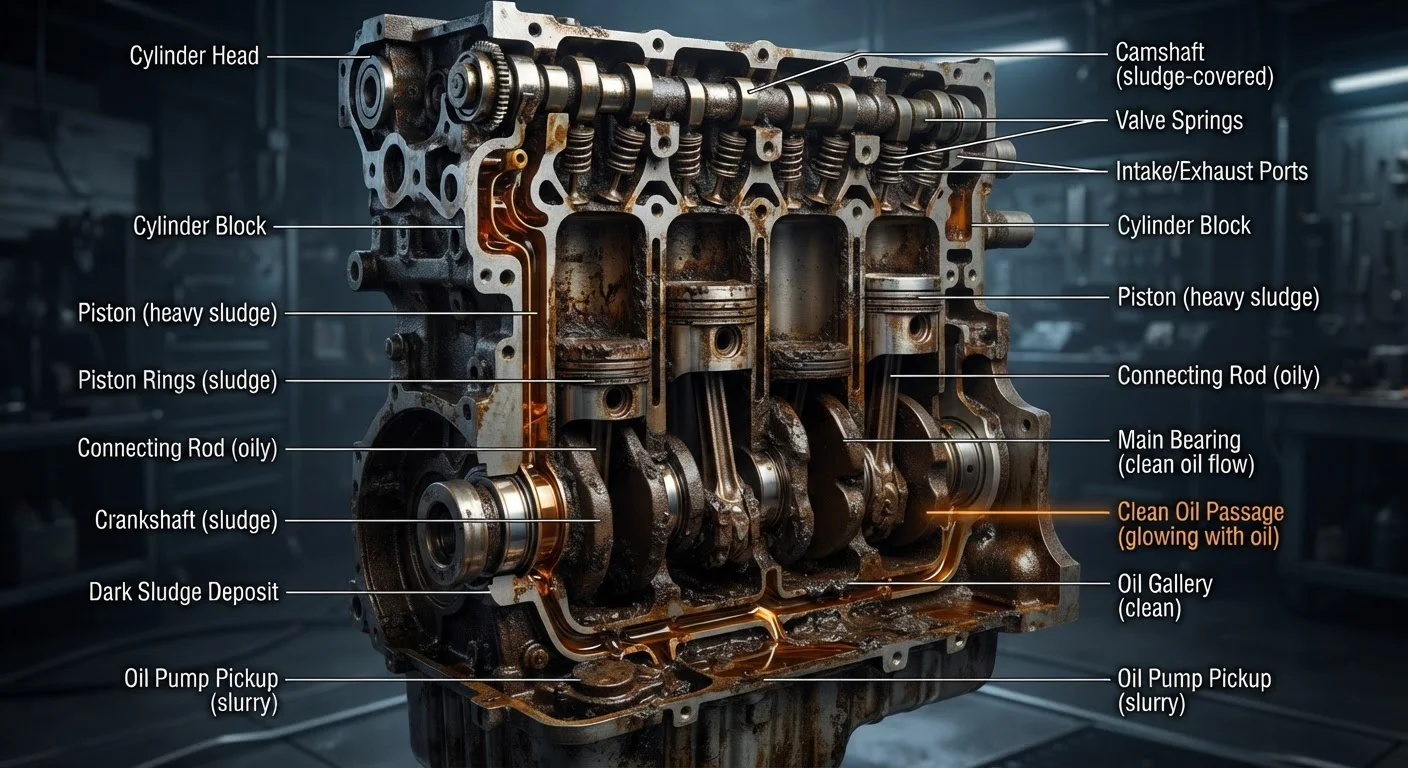
When oil breaks down completely and is not changed, it oxidizes into a thick, tar-like sludge that blocks oil passages and starves engine components of lubrication. Unlike early-stage wear, sludge buildup cannot be undone with an additive or a single fresh oil change. In most cases, severe sludge requires professional cleaning or, in advanced situations, partial or full engine replacement. Prevention - regular oil changes on schedule - is the only reliable strategy.