

Key Takeaways
- The correct tire pressure for your car is on the door jamb sticker, not the tire sidewall.
- Cold weather causes tire pressure to drop roughly 1 PSI for every 10°F decrease in temperature.
- Visually inspecting a tire is not a reliable way to detect dangerous under-inflation.
- TPMS warning lights only activate when pressure is significantly low - not as a prevention tool.
- Overinflated tires wear faster in the center and reduce traction and ride quality.
Why Tire Pressure Myths Persist
Tire pressure is one of the simplest maintenance tasks a driver can perform, yet it's surrounded by persistent misconceptions that lead to real consequences - accelerated tread wear, reduced fuel efficiency, and in serious cases, tire failure. The myths endure partly because tires look fine even when they're not, and partly because the numbers stamped on the tire itself create genuine confusion at the pump.
Getting this right doesn't require mechanical expertise. It requires knowing which number to trust and understanding how pressure behaves under real-world conditions. The myth-and-fact pairs below address the most common errors drivers make.
Myth
Inflate your tires to the maximum PSI printed on the sidewall.
Fact
The sidewall number is the tire's maximum rated pressure, not the recommended operating pressure for your vehicle.
The number molded into the tire sidewall - often 44, 51, or 65 PSI - tells you the most pressure that tire can safely hold under maximum load. It is a structural limit set by the tire manufacturer, not a target. Running tires at or near that ceiling causes the center of the tread to carry all the load, accelerating wear in a narrow stripe down the middle and reducing the contact patch that keeps you on the road.
The correct pressure for your specific vehicle is printed on a sticker inside the driver's door jamb or in the owner's manual. Most passenger cars call for 32-36 PSI. Use that number every time you inflate.
Myth
If the tire looks normal, the pressure is probably fine.
Fact
A tire can be significantly under-inflated and still look full to the naked eye.
Modern radial tires are designed to maintain their shape even when substantially low on air. A tire that is 10-15 PSI under the recommended pressure may show only a very slight bulge at the bottom - one that's nearly invisible when the vehicle is parked. Meanwhile, that tire is running hotter, flexing excessively with every rotation, and wearing the outer edges of its tread far faster than normal.
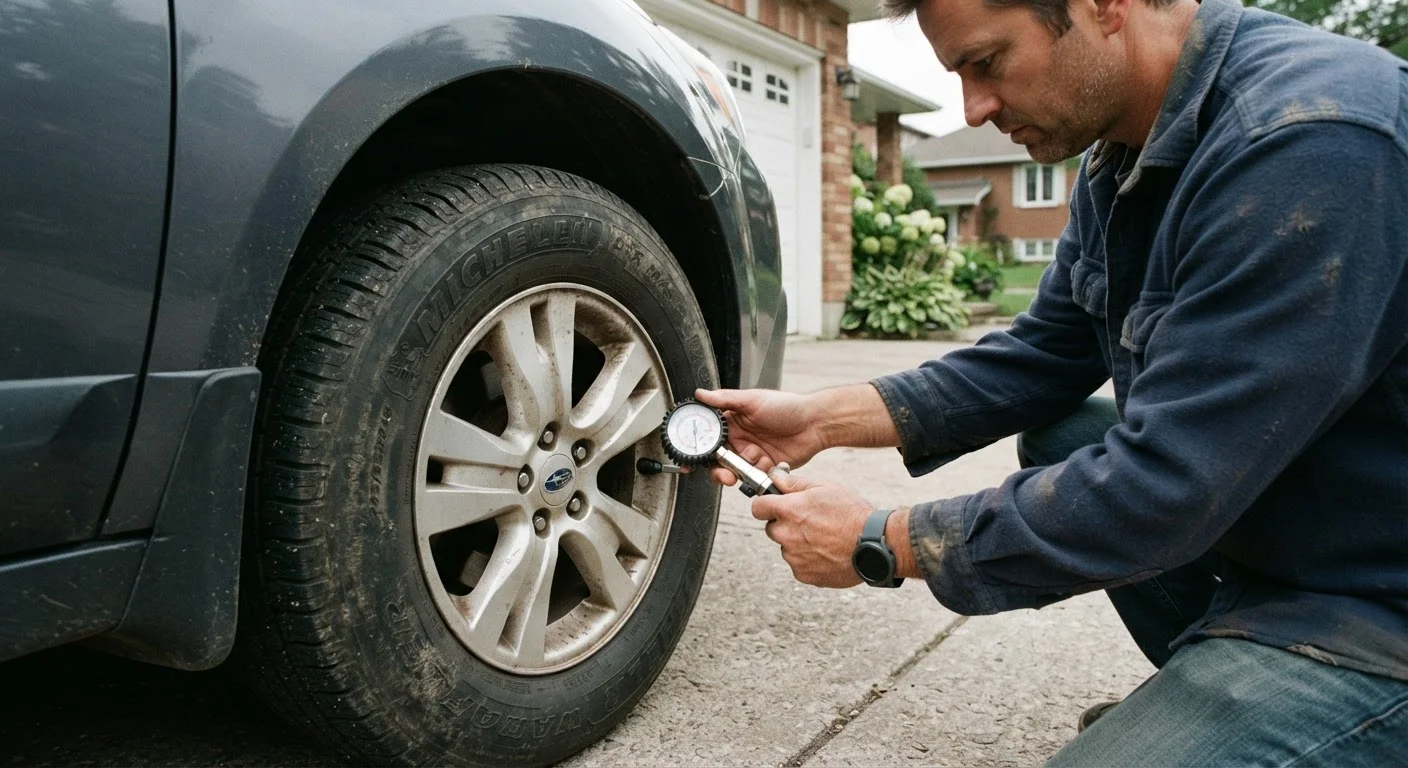
The only reliable way to know your pressure is to measure it with a gauge. A quick visual check before driving is a good safety habit, but it should complement gauge readings, not replace them.
Myth
The TPMS light tells you when to add air - so you don't need a gauge.
Fact
TPMS warning lights typically activate only when a tire is already 25% below the recommended pressure.
The Tire Pressure Monitoring System mandated in US vehicles since 2008 is an emergency alert, not a maintenance tool. Federal standards require it to warn when a tire drops to 25% below the vehicle's placard pressure - meaning on a tire recommended at 35 PSI, the light may not come on until pressure is around 26 PSI or lower. Driving on tires in that range for any extended period causes measurable tread damage and can generate dangerous heat buildup at highway speeds.
A quality tire pressure gauge costs a few dollars and takes about two minutes to use. Relying solely on the TPMS light means your tires are already impaired before you act.
Myth
Tire pressure doesn't change unless you have a leak.
Fact
Temperature alone causes tire pressure to rise and fall predictably throughout the year.
Air pressure in a tire changes with temperature at a rate of roughly 1 PSI for every 10°F change in ambient temperature. In practical terms, tires that were correctly inflated in September at 75°F may be running 4-6 PSI low by January when temperatures dip to 25°F - with no leak at all. The reverse is also true: driving on a warm day or at highway speed raises tire temperature and pressure.
This is why the standard recommendation is to check pressure when tires are cold - ideally in the morning before the vehicle has been driven more than a mile. It gives you an accurate baseline unaffected by driving heat or midday temperatures.
Myth
More air means better fuel economy, so slightly overinflating is smart.
Fact
Overinflation does marginally reduce rolling resistance, but the tradeoffs in safety and wear far outweigh that small gain.
There is a grain of truth here: a harder tire does roll with slightly less resistance. However, the efficiency benefit of inflating beyond the recommended PSI is minimal - typically fractions of an MPG improvement - while the drawbacks are significant. An overinflated tire has a smaller, stiffer contact patch, which reduces grip especially in wet conditions, creates a harsher ride, and concentrates wear on the center tread. That uneven wear shortens tire life and ultimately costs more than the minor fuel savings could offset.
Proper inflation - at the vehicle manufacturer's specification - already optimizes the balance between rolling resistance, traction, and longevity. There is no efficiency benefit to going higher.
Temperature, TPMS, and Pressure Habits That Matter
One of the most practical implications of proper tire pressure management shows up with seasonal temperature swings. As outside temperatures drop in fall and winter, tire pressure falls with them - a relationship that catches many drivers off guard. If you're heading into colder months, this is worth reading alongside broader seasonal prep guidance: seasonal car care tips cover what to check beyond just tires.
For drivers choosing between tire types in cold weather, pressure behavior also differs by tire construction. Understanding how all-season and winter tires differ can sharpen decisions before the temperature drops significantly.
~1 PSI
Pressure lost per 10°F temperature drop
This rule of thumb is widely cited by the National Highway Traffic Safety Administration (NHTSA) and tire industry guides to explain seasonal pressure loss.
25%
Below placard pressure before TPMS triggers
US federal TPMS standards (FMVSS 138) require the warning light to activate when any tire reaches 25% below the vehicle manufacturer's recommended inflation pressure.
1 in 5
Vehicles with at least one significantly under-inflated tire
NHTSA roadside surveys have consistently found roughly one in five vehicles on US roads to have at least one tire significantly under-inflated.
The most reliable habit is simple: check pressure with a quality gauge once a month and always before long trips - in the morning before driving, when tires are cold. Inflate to the vehicle manufacturer's specification on the door jamb sticker, not the tire sidewall. That one adjustment in routine eliminates most of the damage these myths cause.
Check Pressure Before Long Trips, Not During
Checking pressure after highway driving gives you an inflated reading - driving heat raises PSI by several points. Always measure cold tire pressure, before the vehicle has been driven or has sat for at least three hours. Releasing air from a hot tire to reach the target number will leave you under-inflated once the tire cools down.