

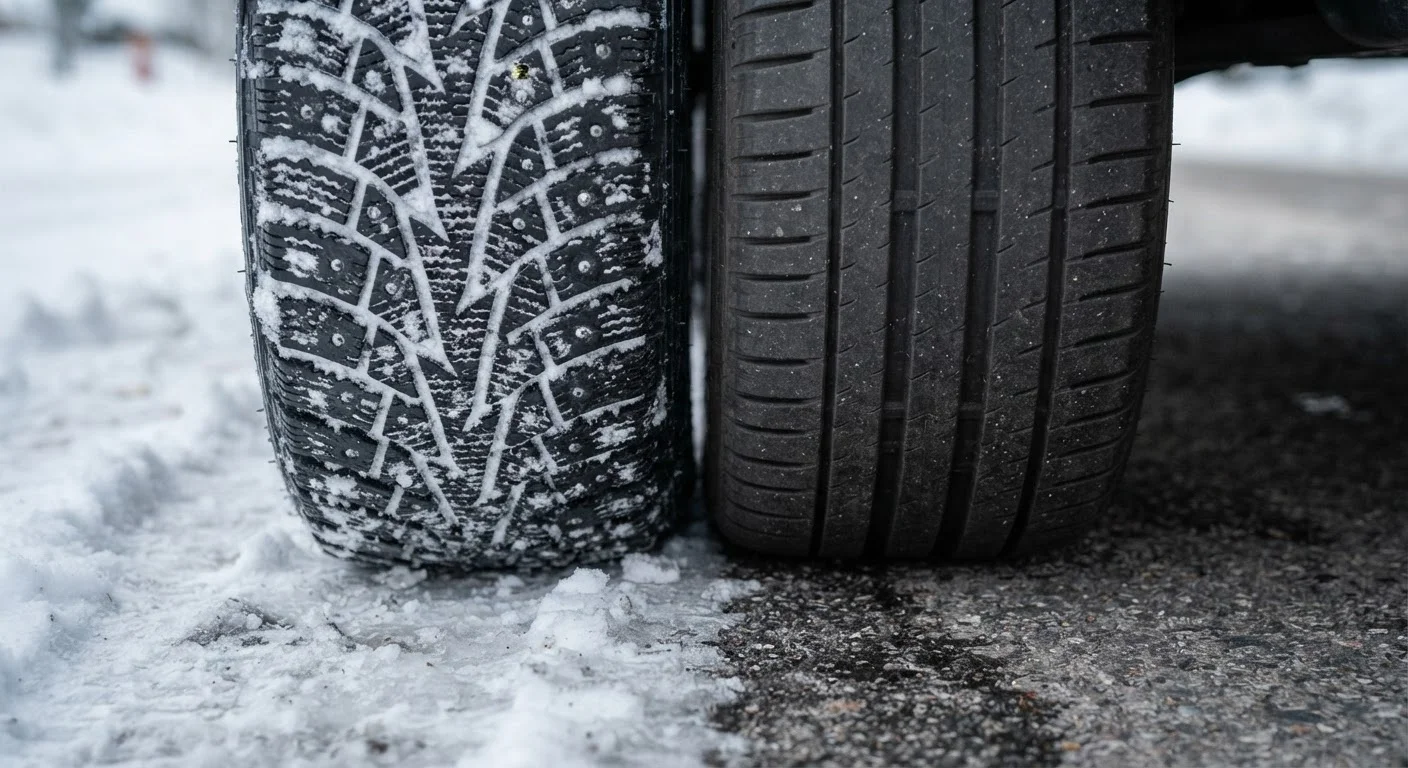
Key Takeaways
- Winter tires use a softer rubber compound that stays pliable below 45°F, where all-season rubber begins to harden.
- The three-peak mountain snowflake (3PMSF) symbol on a tire indicates it meets minimum severe snow traction standards.
- Stopping distance on snow and ice can be dramatically shorter with winter tires than all-seasons at the same speed.
- All-season tires wear faster if used in sustained winter conditions; winter tires wear faster in warm weather.
- Four matching winter tires should always be fitted together - mixing types creates unpredictable handling.
Option A
All-Season Tires
The year-round compromise built for convenience.
Best for: Drivers in mild climates who face occasional light rain or cool temperatures but rarely encounter sustained snow or ice.
Option B
Winter Tires
The purpose-built cold-weather performer.
Best for: Drivers in regions with consistent sub-freezing temperatures, significant snowfall, or regular ice - typically November through March.
If you live in the Sun Belt or a region with mild winters
All-Season Tires
Temperatures rarely drop far enough to compromise all-season rubber, and the year-round convenience outweighs any marginal cold-weather gain from winter tires.
If you regularly drive in snow, ice, or temperatures consistently below 45°F
Winter Tires
The compound and tread advantages deliver meaningfully shorter stopping distances and better control - a genuine safety benefit, not a marketing claim.
If you drive in a transitional climate with occasional cold snaps
All-Season Tires
For infrequent cold events, all-seasons offer an acceptable balance; however, consider winter tires if those cold events involve ice or packed snow.
If you want to avoid the cost and logistics of two tire sets
All-Season Tires
All-seasons eliminate the need for seasonal swaps and a second set of tires, which is a reasonable trade-off in milder climates where winter tires offer little practical advantage.
What Each Tire Is Actually Built to Do
The name "all-season" suggests comprehensive capability, but the term is more accurately read as most-season. All-season tires are engineered to perform acceptably across a wide temperature range - dry summer pavement, wet spring roads, and light autumn frost. They are not engineered to excel in any single condition. The compound is a medium-hardness blend designed to remain functional from roughly 20°F to well above 100°F, but it represents a series of engineering trade-offs rather than an optimized cold-weather solution.
Winter tires (also called snow tires) are built around one priority: maintaining grip when temperatures fall and precipitation freezes. Two engineering choices define them. First, the rubber compound uses a higher silica content that stays soft and pliable below 45°F. Softer rubber conforms better to road irregularities, meaning more contact patch and more friction. Second, the tread pattern incorporates far more sipes - small slits cut into each tread block that create thousands of biting edges on ice and compacted snow. Many winter tires also include larger, more aggressive void channels to evacuate loose snow quickly.
For broader context on how road conditions affect control and stopping distance, see how rain, snow, and fog change vehicle dynamics.
The Performance Gap in Cold Conditions
The most consequential difference between these two tire types is stopping distance. Multiple independent testing programs have documented that at highway speeds on snow-covered roads, vehicles equipped with winter tires can stop in significantly shorter distances than the same vehicle on all-season tires. The gap widens further on ice, where the compound softness advantage is most pronounced.
≈25-40%
Reduction in snow stopping distance
Independent tire testing organizations have documented winter tires stopping 25-40% shorter than all-season tires on compacted snow at the same vehicle speed.
45°F
Temperature threshold for compound stiffening
Tire engineers and safety researchers commonly cite 45°F as the point at which all-season rubber begins to stiffen meaningfully, reducing grip even on dry pavement.
70%
US drivers relying solely on all-seasons
Industry estimates suggest the substantial majority of US drivers use all-season tires year-round, including in regions with significant winter weather.
It is also worth understanding the three-peak mountain snowflake (3PMSF) symbol. This marking - distinct from the M+S (mud and snow) designation found on many all-season tires - indicates a tire has passed a minimum traction performance threshold in standardized snow testing. M+S is a self-certification category with no independent test requirement; 3PMSF requires third-party validation. Some all-season tires carry the 3PMSF symbol, which narrows - but does not eliminate - the gap with dedicated winter tires, particularly on ice.
Temperature alone triggers degradation in all-season performance. Once ambient temperatures consistently sit below 45°F, the rubber compound begins to stiffen noticeably, reducing the contact patch flexibility that generates grip. This matters even on dry, cold pavement - not just in snow.
Head-to-Head: Key Differences at a Glance
The table below summarizes where each tire type has a clear advantage or limitation across the criteria that matter most to everyday drivers.
| Criterion | All-Season Tires | Winter Tires |
|---|---|---|
| Optimal temperature range | Above 45°F year-round | Below 45°F consistently |
| Rubber compound | Medium hardness, broad-range blend | Soft, high-silica; stays pliable in cold |
| Sipe density (biting edges) | Moderate | High - engineered for ice and snow |
| Snow/ice stopping distance | Longer | Shorter - measurable safety advantage |
| Warm-weather performance | Good | Reduced - softer compound wears faster |
| Year-round usability | Yes - no swap required | No - seasonal use only recommended |
| 3PMSF certification availability | Some models qualify | Standard on nearly all winter tires |
| Cost and logistics | Single set, no seasonal swap | Second set plus mounting costs |
One practical note: winter tires wear more rapidly in warm or hot conditions because the softer compound degrades faster on warm pavement. Running winter tires year-round in a moderate climate shortens their usable life considerably. Conversely, all-season tires used through repeated harsh winters may wear unevenly due to compound hardening. For a broader look at tire care and longevity, tire rotation, balancing, and alignment each serve a different purpose and understanding the distinction helps you maintain any tire type correctly.
Making the Right Call for Your Region and Driving Habits
Geography is the single most useful filter. Drivers in the northern tier states - the Upper Midwest, New England, mountain West - who face months of sub-freezing temperatures and regular snowfall have the most to gain from a dedicated winter tire set. Drivers in the mid-Atlantic or Pacific Northwest face more variable conditions; a 3PMSF-rated all-season may be an acceptable compromise for many, though genuine winter tires remain the safer choice if ice is a regular occurrence. Drivers in the South or arid Southwest rarely encounter conditions that justify the added cost and logistics of seasonal tire changes.
Mixing Tire Types Is Unsafe
If you switch to winter tires, fit all four corners - not just the drive axle. Fitting winter tires only on the front (or rear) creates an imbalance in grip that can cause the vehicle to rotate unpredictably under braking or cornering. This is a consistent recommendation from tire manufacturers and safety organizations. Always consult a qualified tire professional before changing your configuration.
Storage and cost logistics are real considerations. Running two sets of tires means purchasing and storing the second set, plus paying for seasonal mounting and balancing. However, because each set is only used for roughly half the year, total wear across both sets can be comparable to running a single all-season set year-round - meaning the long-run cost difference is often smaller than the upfront investment suggests.
Whatever tire type you run, keep tire pressure properly managed through temperature swings. Cold air causes pressure to drop, and underinflated tires compromise handling and wear regardless of compound type. Common tire pressure myths can lead drivers to under- or over-inflate without realizing it. And if you're reviewing your full seasonal vehicle routine, seasonal car care adjustments cover everything from battery checks to fluid changes alongside tire decisions.