

Why the Confusion Exists
Ask a driver what tire rotation, balancing, and alignment have in common, and most will say something like "they're all tire stuff." That's true - but it's a bit like saying a haircut, a dental cleaning, and an eye exam are all "health stuff." Each targets a completely different problem, requires different equipment, and happens on a different schedule.
Confusing the three is more than a vocabulary issue. It can lead to skipping a service you actually need, or assuming one service covers a problem it doesn't address. As part of a broader maintenance schedule most drivers quietly ignore, these three services are among the most commonly misunderstood line items on any shop invoice.
Tire Rotation: Moving Tires to Even Out Wear
Rotation means physically moving the tires from one position on the vehicle to another - front-left to rear-right, for example - according to a set pattern. No balancing, no steering geometry involved.
Why it matters: Front tires on most vehicles carry a disproportionate load. On front-wheel-drive cars, they handle both steering and power delivery, so they wear faster than the rears. Regular rotation redistributes that wear so all four tires age at roughly the same rate, which maximizes tread life and delays the cost of a full set replacement.
Typical interval: Most manufacturers recommend rotation every 5,000-7,500 miles, often aligned with oil changes for convenience. Check your owner's manual for the number specific to your vehicle - some all-wheel-drive systems have more prescriptive requirements. Skipping rotation doesn't produce immediate symptoms, which is exactly why it's easy to overlook. The unexpected costs that catch car owners off guard often include premature tire replacement that rotation could have delayed.
Tire Balancing: Eliminating Vibration from Weight Imbalances
Balancing addresses a different issue entirely: uneven weight distribution around a tire-and-wheel assembly. No tire or wheel is perfectly uniform from the factory. When small heavy spots exist, the wheel wobbles slightly at speed - you may feel it as a vibration in the steering wheel or seat, typically appearing above 50-60 mph.
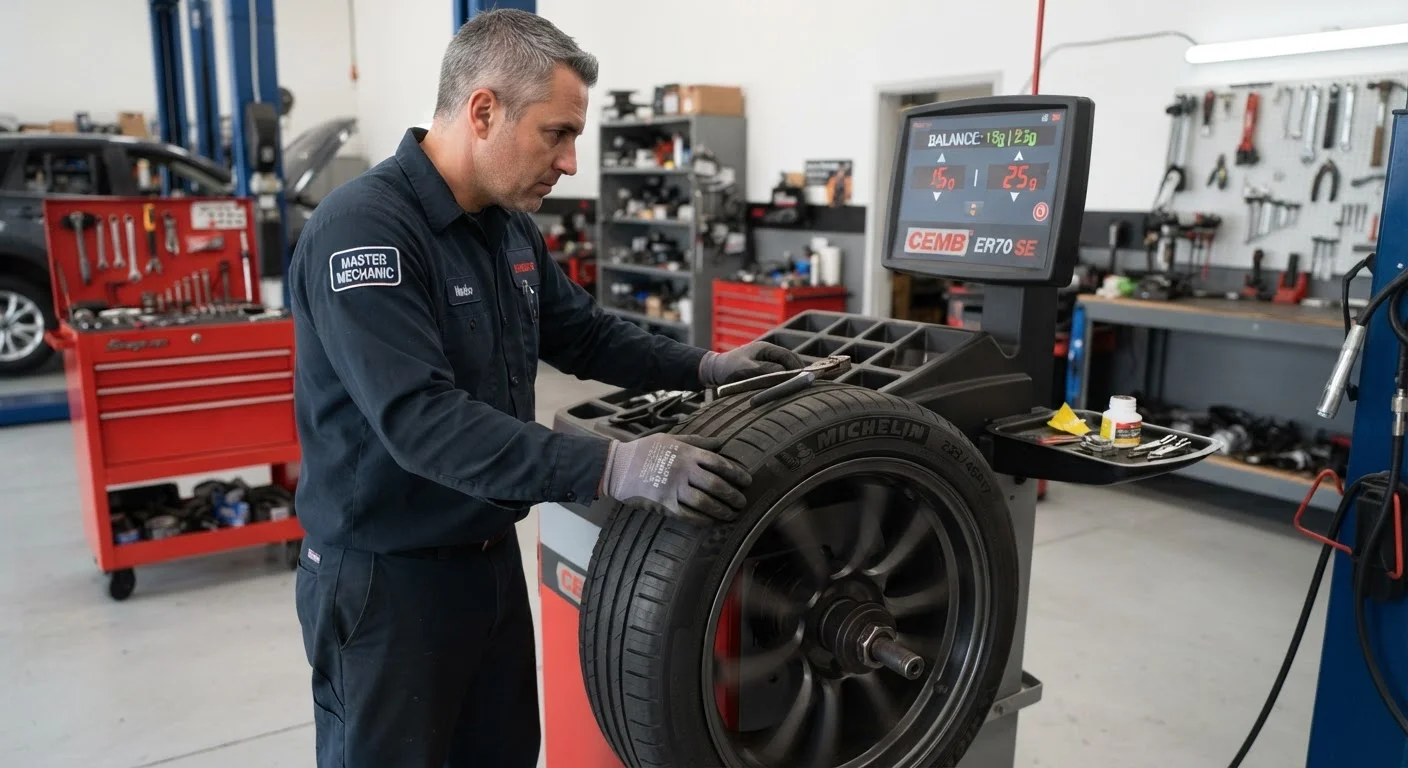
A technician mounts the tire on a spin balancer, identifies the heavy spots, then attaches small counterweights to the rim to compensate. This is precision work requiring dedicated equipment - not something covered by simply moving a tire to a new position.
Typical interval: Most shops recommend balancing when new tires are installed, whenever a vibration appears, or roughly every 12,000-15,000 miles. Wheel weights can fall off over time, and road impacts can shift the balance of an otherwise healthy tire. If you're uncertain whether a service is DIY-appropriate, the DIY vs. shop decision framework provides a practical way to evaluate the risk - balancing squarely belongs in the shop column.
Tire rotation
The process of moving tires from one wheel position to another (e.g., front to rear) to distribute tread wear more evenly across all four tires over time.
Tire balancing
A service that corrects uneven weight distribution in a tire-and-wheel assembly by attaching small counterweights to the rim, eliminating vibration at speed.
Wheel alignment
Adjustment of suspension angles - primarily camber, toe, and caster - so that tires sit at the correct angle relative to the road and to each other, preventing uneven wear and pulling.
Camber
The inward or outward tilt of a tire when viewed from the front of the vehicle. Incorrect camber causes one-sided tread wear.
Toe
The degree to which the fronts of the tires point inward (toe-in) or outward (toe-out) relative to the vehicle's centerline. Toe misalignment is a common cause of rapid, feathered tread wear.
Caster
The angle of the steering axis as viewed from the side of the vehicle. Caster affects steering stability and straight-line tracking.
Wheel Alignment: Correcting the Angles of Your Suspension
Alignment has nothing to do with moving tires or adding weights. It's about the angles at which your tires contact the road - adjusted through the suspension and steering components, not the tires themselves. The three primary angles are camber (inward/outward tilt), toe (pointing in or out relative to center), and caster (steering axis tilt).
When these angles drift out of specification - from a pothole, curb strike, or gradual mechanical wear - tires scrub unevenly against the road surface. The result is accelerated, irregular wear on one edge of the tread, reduced fuel efficiency, and a vehicle that pulls to one side.
Typical interval: Many manufacturers suggest checking alignment annually or after any significant impact. It's also worth checking when you install a new set of tires, since bad alignment will degrade a fresh set quickly. Seasonal driving conditions can accelerate alignment drift; the seasonal car care guide covers what to inspect as conditions change.
If you're switching between tire types, understanding the tires themselves matters too. The differences between all-season and winter tires can affect alignment sensitivity, tread wear patterns, and how often you may need to revisit these services.
Putting It Together: A Quick Decision Guide
When a symptom appears, it helps to trace it to the right service:
- Uneven tread wear across all tires, wearing faster than expected: likely a rotation interval problem.
- Vibration at highway speed, especially in the steering wheel: likely a balancing issue.
- Car pulls to one side, or tread wearing heavily on one edge: likely an alignment problem.
- Vibration and pulling: could be both balancing and alignment - they're not mutually exclusive.
These services don't substitute for each other, but they're often performed together for efficiency. Understanding what each one does gives you a clearer conversation with your mechanic and a better basis for deciding what actually needs to be done - which is part of the broader case for understanding the real costs of vehicle ownership.