

Key Takeaways
- Water is essential for breaking down food and transporting nutrients through your digestive tract.
- Dehydration can blunt hunger-satiety signals, sometimes causing thirst to be mistaken for hunger.
- Many whole foods - fruits, vegetables, legumes - contribute meaningfully to daily fluid intake.
- Water-soluble vitamins depend on adequate hydration for absorption and distribution in the body.
- Drinking water around meals supports digestion but does not significantly dilute stomach acid.
- Individual fluid needs vary based on body size, activity level, climate, and diet composition.
Hydration and Nutrition Interaction
The relationship between water and nutrition describes how your body uses water to digest food, absorb nutrients, and regulate appetite. Water isn't just a beverage - it's an active participant in nearly every metabolic process tied to what you eat. Getting enough fluid supports the systems that extract value from your meals.
Water acts as a solvent and transport medium for water-soluble vitamins (B vitamins and vitamin C), electrolytes, and digestive enzymes, making adequate hydration a prerequisite for efficient nutrient bioavailability.
Why Water Is a Nutritional Player, Not Just a Beverage
Most nutrition conversations focus on macronutrients, vitamins, and minerals - water tends to get treated as a separate category. But hydration and nutrition are deeply intertwined. Water is the medium in which digestion happens, the vehicle that carries nutrients to cells, and a regulator of the signals that tell your body when it's hungry or full.
Understanding this relationship isn't about following a rigid hydration rule. It's about recognizing that what you drink and what you eat influence each other, and that both matter for how well your body extracts value from food. For a closer look at which popular hydration rules hold up to scrutiny, see our overview of common hydration myths.
~60%
Of the adult human body is water
According to the U.S. Geological Survey, water makes up roughly 60% of the adult body and is involved in virtually every physiological process.
~20%
Of daily water intake from food
The National Academies of Sciences estimates that approximately 20% of daily water intake comes from food rather than beverages, varying by diet composition.
2.7-3.7L
Total daily water adequate intake
The National Academies set adequate intake at about 2.7 liters per day for women and 3.7 liters for men, from all food and beverage sources combined.
How Water Supports Digestion From Start to Finish
Digestion begins before food reaches your stomach. Saliva - which is largely water - starts breaking down carbohydrates and lubricating food for safe swallowing. In the stomach, water helps dissolve food particles so that digestive enzymes can work effectively. Further along, the small intestine relies on fluid to absorb nutrients and pass them into the bloodstream.
Adequate hydration also supports gut motility - the rhythmic muscle contractions that move food through your digestive tract. When fluid intake is low, stool can harden and slow transit time, contributing to constipation. This connection between hydration and fiber is particularly important: soluble fiber absorbs water to form a gel-like consistency that slows glucose absorption, while insoluble fiber needs fluid to add bulk. Our guide to dietary fiber types explains how each form functions differently in the gut.
Water's Role in Nutrient Absorption
Not all nutrients are absorbed the same way. Fat-soluble vitamins (A, D, E, and K) are packaged with dietary fats for absorption. Water-soluble vitamins - the B-complex group and vitamin C - are dissolved in water and transported through the bloodstream. Without sufficient hydration, this transport system becomes less efficient.
Electrolytes like sodium, potassium, calcium, and magnesium require fluid balance to cross cell membranes, drive nerve impulses, and support muscle contractions. These minerals are often highlighted in sports nutrition, but they're equally relevant for anyone whose diet is high in whole foods. To get the most from nutrient-rich eating patterns, see our primer on nutrient density.
The gut microbiome also appears to be influenced by hydration. Emerging research suggests that fluid intake may affect the composition of gut bacteria, though this area is still developing. For a broader view of diet and gut health, our summary of gut health research provides useful context.
“Water is not just a passive medium in the body - it is an active participant in metabolism, nutrient transport, and the regulation of virtually every biochemical process that keeps us functioning.”
— Institute of Medicine, Food and Nutrition Board, U.S. advisory body on dietary reference intakes and nutrition science
Food as a Source of Hydration
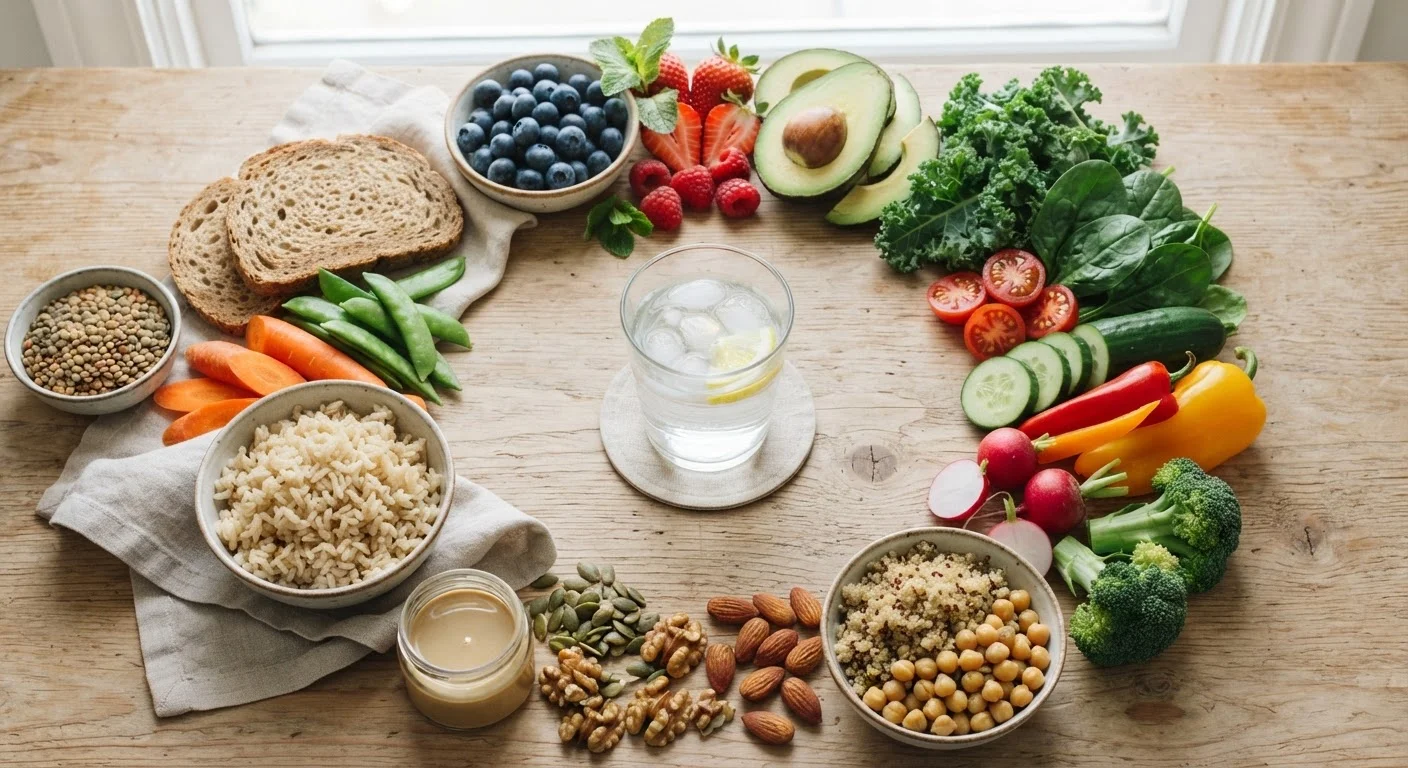
Hydration doesn't come only from what you drink. Many whole foods have a high water content that contributes meaningfully to your daily fluid balance. Cucumbers, lettuce, celery, and watermelon are among the most water-rich foods, but cooked vegetables, legumes, soups, and dairy products also contribute. This is one reason that dietary patterns built around whole foods tend to support hydration alongside nutrient intake.
Processed and packaged foods, by contrast, tend to be lower in moisture and higher in sodium - a combination that can increase fluid needs without helping meet them. This doesn't mean processed foods are off-limits, but it's a practical reason why a diet built around whole, minimally processed foods tends to be easier to stay hydrated on.
Build Hydration Into Your Meals
Starting a meal with a broth-based soup or a side salad, or finishing with fresh fruit, adds fluid alongside nutrients without requiring a separate effort. Choosing water-rich whole foods regularly is one of the most straightforward ways to support both hydration and nutrition simultaneously.
Hydration, Appetite, and Eating Patterns
There's a reasonable body of research suggesting that thirst and hunger signals can overlap, particularly with mild dehydration. Some studies have found that drinking water before or during meals is associated with lower caloric intake, though the effect sizes are modest and individual variation is considerable. This is general information about physiology - not a prescribed eating strategy.
What the evidence more clearly supports is that staying consistently hydrated helps the body's appetite-regulation systems function as intended. Chronic low-level dehydration can make it harder to read satiety cues accurately. This doesn't mean water is a weight-management solution; it means that meeting fluid needs is one part of the broader picture of how your body interprets and responds to food.
This article is for general informational purposes only and does not constitute medical or dietary advice. For guidance tailored to your individual health needs, please consult a qualified healthcare professional or registered dietitian.