

Key Takeaways
- Calorie counts are a starting point, not a complete picture of how food affects your body.
- Food quality, fiber content, and macronutrient composition all influence hunger and energy levels.
- Treating all calories as equal can undermine long-term health goals and eating habits.
- Reading nutrition labels for more than just calories provides far more useful guidance.
The Limits of the Calorie-First Mindset
Calories measure energy - specifically, the amount of heat a food releases when burned. That's a useful piece of data, but it's one variable in a much more complex system. When people reduce food choices to a single number, they often miss information that has a more direct effect on how they feel, how hungry they stay, and how their body functions day to day.
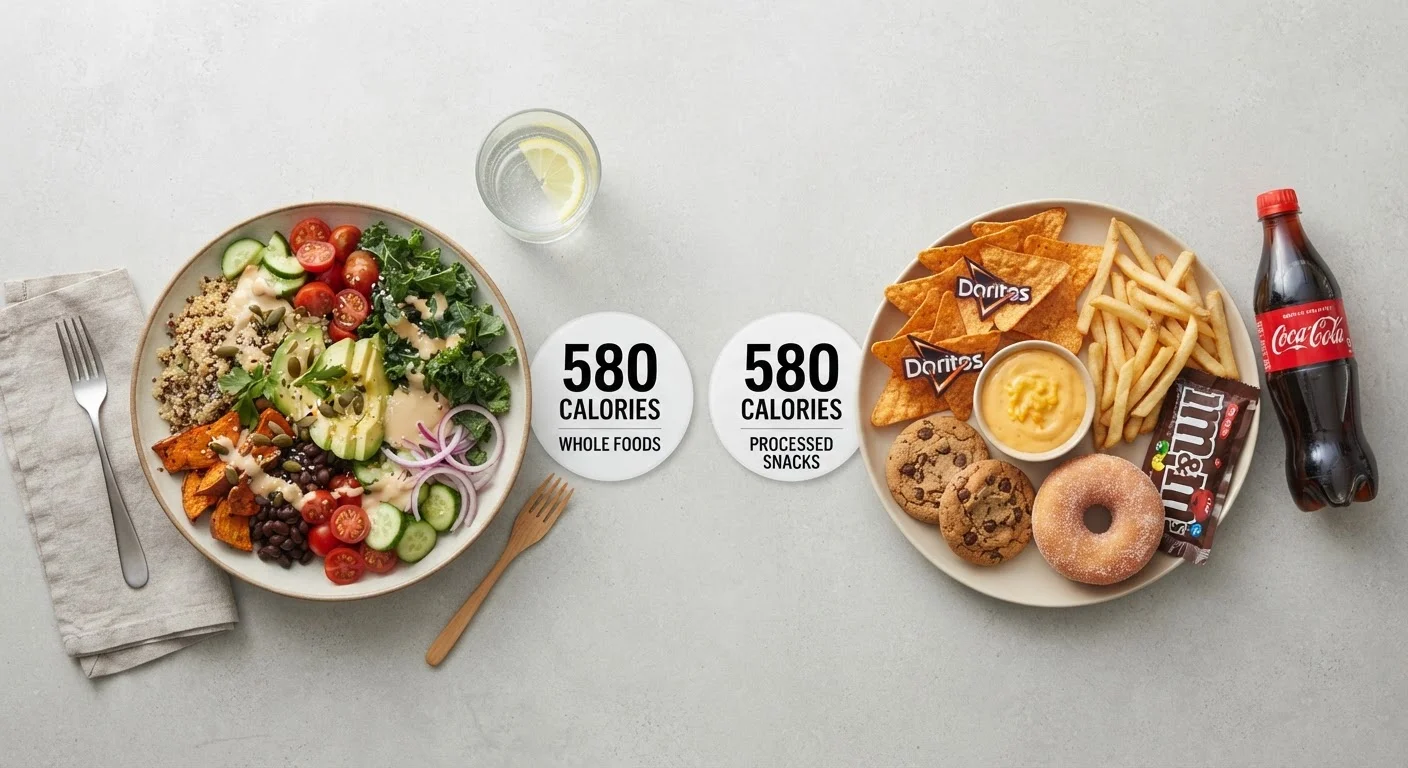
Two foods can share a calorie count while delivering entirely different amounts of fiber, protein, vitamins, and minerals. A handful of almonds and a small bag of low-fat crackers might clock in at the same number, but they interact with your metabolism, appetite hormones, and blood sugar in meaningfully different ways. Understanding those differences - rather than fixating on the number alone - is the foundation of more useful food decision-making.
This article identifies the most common mistakes people make when relying too heavily on calorie counts, and explains what to look at instead. For a practical guide to what all those label figures mean, see how to read a nutrition label without getting overwhelmed.
Treating all calories as nutritionally equivalent regardless of their source.
Why it happens: Calorie-counting apps and simplified diet rules train people to see food purely as a number, obscuring the broader nutritional profile.
Choosing low-calorie processed foods over higher-calorie whole foods.
Why it happens: Marketing around "light," "low-fat," or "diet" products exploits the assumption that fewer calories automatically means a healthier choice.
Ignoring the satiety signal differences between food types.
Why it happens: People often don't connect hunger returning quickly after a meal with the composition of what they ate - they assume they simply ate too little.
Using calorie burn estimates from exercise to justify food choices.
Why it happens: Fitness trackers and gym equipment display calorie-burn figures that are known to be rough estimates, yet people often treat them as precise offsets.
Overlooking how cooking and processing change a food's effective calorie availability.
Why it happens: Most calorie databases use standardized figures that don't fully account for how much energy your body actually extracts from cooked versus raw, or whole versus ground food.
What to Focus on Instead
Shifting away from a calorie-only framework doesn't mean ignoring portion sizes or energy intake altogether. It means adding context. Paying attention to macronutrient composition - the ratio of carbohydrates, protein, and fat - gives you a clearer picture of how a food will affect satiety and sustained energy. What carbs, protein, and fat actually do in the body is worth understanding before deciding which ones to limit.
Fiber content is particularly underrated. High-fiber foods slow digestion, blunt blood sugar spikes, and support a sense of fullness that ultra-processed foods rarely provide, even at equivalent calorie counts. Similarly, whole foods tend to retain micronutrients - vitamins and minerals - that get stripped out during heavy processing, regardless of whether the calorie numbers match.
~90%
of Americans fall short of daily fiber targets
According to the U.S. Dietary Guidelines Advisory Committee, dietary fiber intake among American adults remains well below the recommended level - a gap that calorie-focused eating often fails to address.
20-30%
of daily calories in ultra-processed foods
Research published in BMJ Open Health estimated that ultra-processed foods can account for a substantial share of total energy intake among adults, often displacing more nutrient-dense options at similar or lower calorie counts.
Eating behavior and awareness also matter. How you eat can be just as consequential as what you eat. Approaches that encourage attention to hunger and fullness cues - rather than external tracking alone - can help people develop a more sustainable relationship with food. Our overview of mindful eating versus intuitive eating explores two practical frameworks for doing that.
Calories Still Matter - Context Just Matters More
Dismissing calorie awareness entirely can lead to overconsumption, just as obsessing over it can obscure food quality. The evidence-based position is that total energy intake, food composition, eating patterns, and individual metabolic factors all interact. No single number captures that complexity. If you're managing a specific health condition or weight-related goal, work with a registered dietitian who can assess your full picture rather than applying a one-size-fits-all calorie target.
This article is for general informational and educational purposes only and is not a substitute for personalized medical or nutritional advice. Consult a qualified healthcare professional or registered dietitian before making significant changes to your diet.