

Key Takeaways
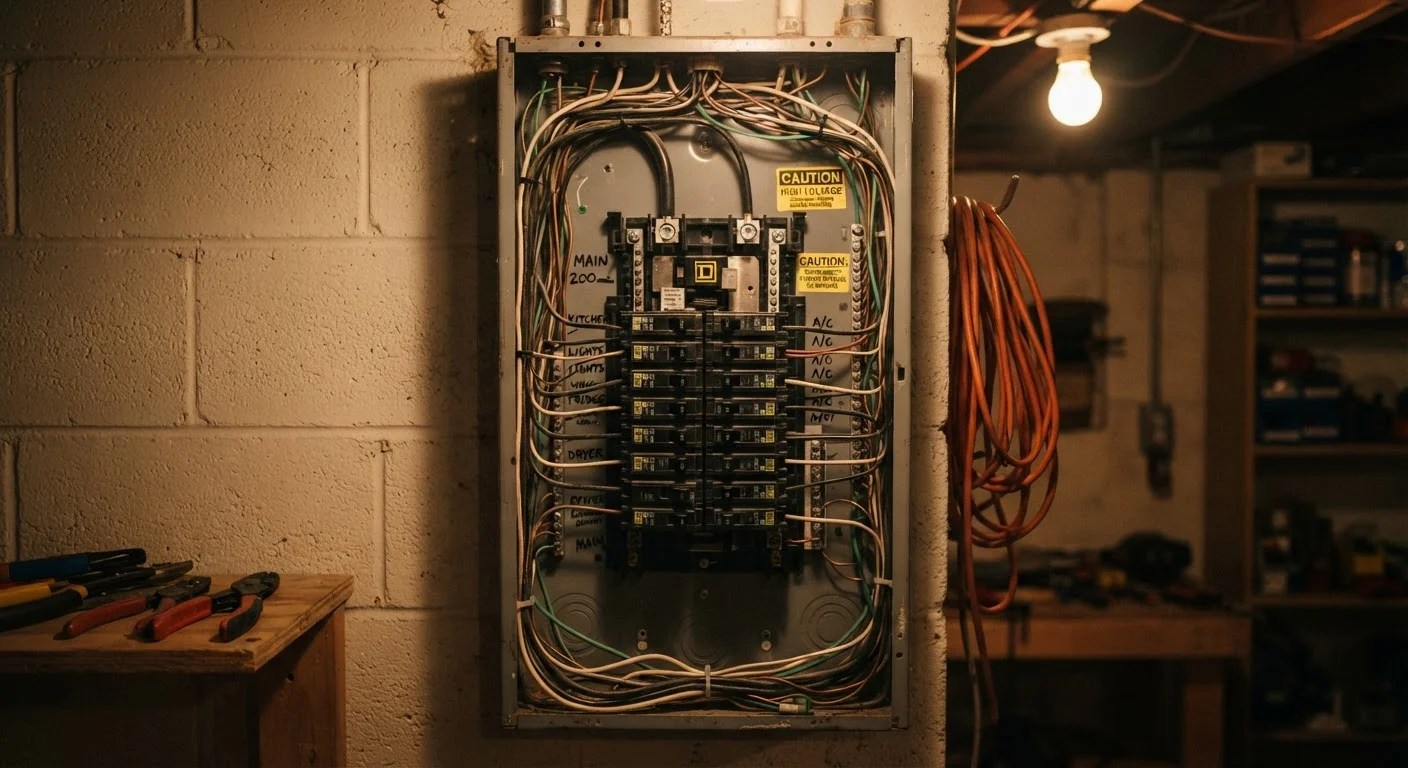
- Turning off a single breaker does not always make a circuit fully safe to work on.
- Older homes may lack grounding systems that modern codes require for safe operation.
- Overloading a circuit with a higher-amp breaker is a leading cause of house fires.
- Many electrical projects legally require a permit and inspection by a licensed professional.
- When in doubt, a licensed electrician's assessment is always the safest investment.
Why Electrical Assumptions Are Especially Dangerous
Most home improvement mistakes are recoverable - a poorly hung shelf, an uneven tile, a badly caulked window. Electrical errors rarely offer the same second chance. Miswired circuits, improper grounding, and overloaded panels don't announce themselves until a breaker trips, a device fails, or, in the worst cases, a fire starts inside a wall where no one can see it.
The myths below are not fringe beliefs. They circulate in online forums, are passed down through well-meaning family advice, and feel intuitive enough that many homeowners act on them without question. Getting these wrong puts your home, your family, and anyone who purchases your house later at real risk.
Before starting any renovation that touches electrical systems, review what homeowners should know before starting a renovation - permits and code requirements deserve the same planning attention as your project budget.
Myth
If I flip the breaker off, it's safe to touch any wire in that circuit.
Fact
Turning off a breaker removes power from one leg of a circuit, but shared neutrals, multi-wire branch circuits, and mislabeled panels can leave wires energized.
Residential panels are frequently mislabeled - a study by the Consumer Product Safety Commission found panel labeling errors to be a consistent hazard in older homes. Additionally, some circuits share a neutral wire between two breakers. If only one of those breakers is off, the shared neutral can still carry current. Always verify with a non-contact voltage tester, not just a breaker switch.
Myth
A three-prong outlet means the circuit is properly grounded.
Fact
Three-prong outlets can be installed without any ground wire behind them, giving a false sense of safety without actual protection.
This is one of the most dangerous retrofitting shortcuts in older homes. A grounded outlet requires a physical ground conductor running back to the panel. Without it, a fault condition - where current escapes a device - has nowhere safe to go, increasing shock and fire risk. A GFCI outlet can be a code-compliant alternative in some situations, but it is not a substitute for a full equipment ground. An electrician can test whether your outlets are truly grounded.
Myth
I can replace a 15-amp breaker with a 20-amp one to stop it from tripping.
Fact
Breakers are sized to protect the wiring, not the appliances. Upsizing a breaker without upgrading the wire is a fire hazard.
A 15-amp breaker trips to protect 14-gauge wire from carrying more current than it can safely handle. Replace that breaker with a 20-amp version, and the wiring can now overheat well before the breaker trips. Overheated wiring inside walls is a primary cause of residential electrical fires. The correct fix is to understand why the breaker is tripping - usually a circuit is overloaded with too many devices - and address that root cause.
Myth
Electrical tape is a reliable long-term fix for a damaged wire.
Fact
Standard electrical tape degrades over time, especially in high-heat or damp environments, and is not an approved repair for damaged insulation under the National Electrical Code.
Electrical tape is useful for temporary bundling and insulation during active work, but it is not intended as a permanent repair. The NEC requires damaged conductors to be replaced or spliced using approved wire nuts or connectors inside a covered junction box. Exposed tape repairs inside walls, attics, or crawl spaces can dry out, crack, and expose live conductors over time.
Myth
My panel has plenty of open breaker slots, so I can add circuits freely.
Fact
Open slots do not indicate available capacity. Your panel has a total amperage rating that all circuits share.
A 100-amp panel - common in homes built before the 1980s - may already be serving near its full load with existing circuits. Adding a 240-volt appliance circuit, a hot tub, or EV charger without a load calculation can push the service past its rated capacity, causing nuisance tripping at best and panel damage or fire at worst. A licensed electrician can perform a load calculation to determine what, if anything, your existing service can safely support.
Knowing When to Call a Licensed Electrician
There is a meaningful range of electrical tasks that confident homeowners can safely handle: replacing a standard outlet or switch on a verified dead circuit, swapping a light fixture, or resetting a tripped GFCI. But the threshold for calling a licensed electrician comes faster than many people expect.
Electrical Work Can Be Legally Regulated
In most U.S. jurisdictions, certain electrical work requires a permit pulled by a licensed electrician - not a homeowner. Unpermitted work can void your homeowner's insurance, complicate a home sale, and create liability if a fire or injury occurs. Always check local codes and consult your municipality before starting any significant electrical project.
Panel work, new circuit installation, subpanel additions, service upgrades, and anything involving aluminum wiring (common in homes built between the mid-1960s and mid-1970s) should be handled by a licensed professional. If you're unsure how to vet one, our guide on questions to ask before signing with a contractor covers licensing, insurance, and what a written scope of work should include.
Never Assume a Wire Is Dead
Even after flipping a breaker, use a non-contact voltage tester on every wire before touching it. Mis-labeled panels, shared neutrals, and multi-wire branch circuits mean that a 'dead' wire may still carry live voltage. Voltage testers are inexpensive and widely available at hardware stores.
The same principle that applies to knowing when to take a car to a shop instead of DIYing it holds for home electrical work: the cost of a professional is almost always lower than the cost of correcting a mistake - or filing an insurance claim. Electrical work also appears on disclosure forms during home sales, so unpermitted or substandard work can resurface as a financial liability years later.
Pairing careful seasonal inspections - such as those outlined in a seasonal home maintenance routine - with a professional electrical review every several years is a practical, preventive approach that protects both safety and home value.
~51,000
Home electrical fires per year in the U.S.
According to the Electrical Safety Foundation International (ESFI), roughly 51,000 home electrical fires occur annually, resulting in nearly 500 deaths and $1.3 billion in property damage.
~40%
Of home fires caused by electrical failure or malfunction
The ESFI estimates that electrical failures or malfunctions are a factor in approximately 40 percent of home structure fires, many of which involve wiring issues behind walls.
This article is for general informational and educational purposes only and is not a substitute for advice from a licensed electrician. Always consult a qualified professional and verify local code requirements before undertaking electrical work in your home.