

Key Takeaways
- No single insulation type works best everywhere - location, climate, and budget all shape the right choice.
- R-value measures thermal resistance; higher R-values indicate better insulating performance per inch.
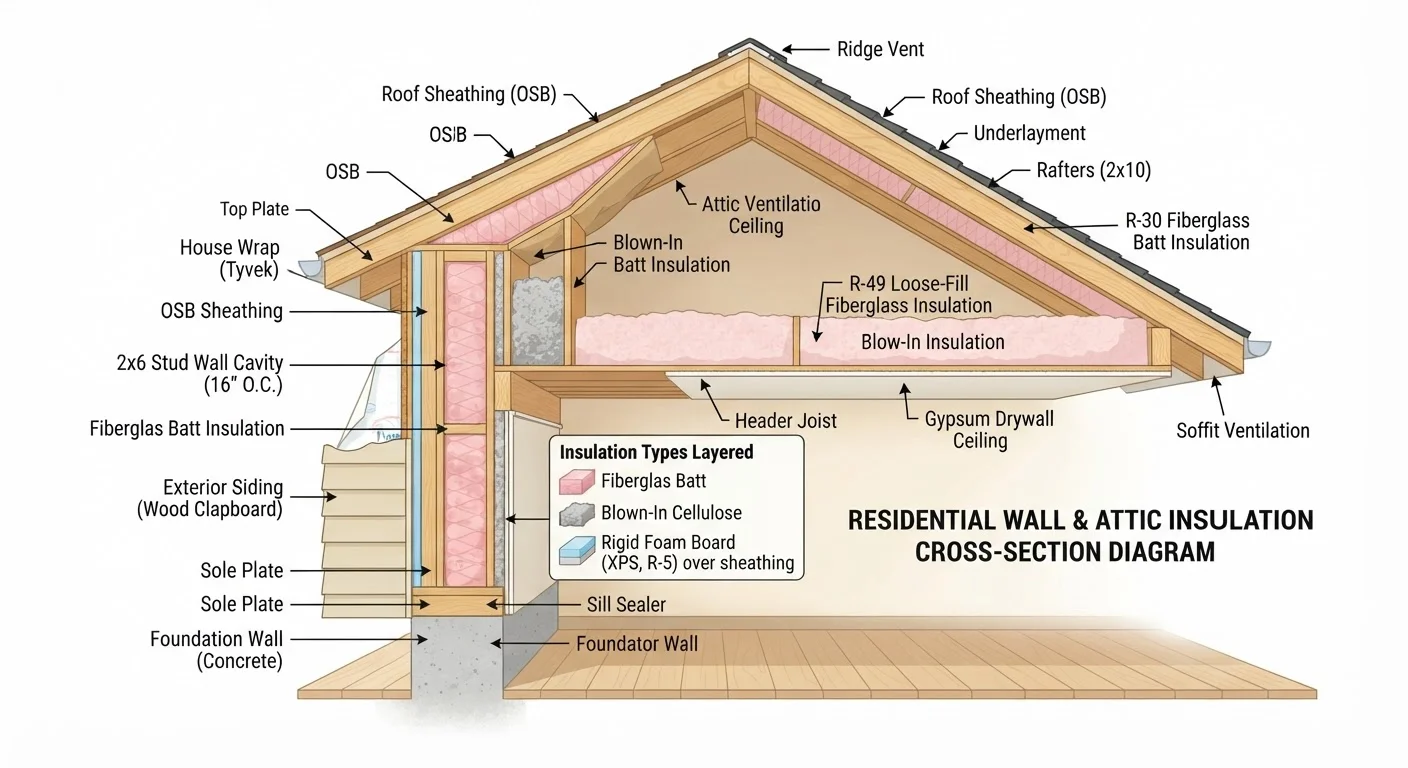
- Batt insulation suits framed walls and attic floors; spray foam excels at sealing irregular gaps and rim joists.
- Blown-in cellulose or fiberglass works well in existing attics where retrofitting batts would be disruptive.
- Rigid foam board is the go-to for basement walls and exterior sheathing where moisture resistance matters.
- Some insulation tasks are straightforward DIY; electrical, structural, or spray foam work may require a professional.
Our Verdict
Each insulation type occupies a specific niche based on where it performs best. Batts are practical for open framed cavities, blown-in fills awkward or existing spaces, rigid board handles moisture-prone areas, and spray foam locks down air leaks where sealing matters as much as thermal performance. Matching the material to the location - rather than defaulting to one product for the whole home - delivers the most effective results.
| Best for | Recommended |
|---|---|
| Open, framed wall and attic floor cavities | Fiberglass or mineral wool batt insulation |
| Existing attics or hard-to-reach enclosed spaces | Blown-in cellulose or fiberglass |
| Basement walls, crawl spaces, and exterior sheathing | Rigid foam board |
| Rim joists, irregular gaps, and conditioned crawl spaces | Spray foam (closed-cell or open-cell) |
Why Insulation Type and Location Go Hand in Hand
Choosing insulation isn't just about picking the highest R-value available. R-value - a measure of thermal resistance - matters, but so does whether the material can handle moisture, conform to irregular shapes, or be installed without opening up finished walls. The physical characteristics of each insulation type determine where it belongs in your home.
Before selecting a product, identify the area you're insulating: an open attic floor is a completely different challenge than a basement wall or an older home's already-closed exterior walls. Climate also plays a role - cold climates generally call for higher R-values in attics and crawl spaces, while hot, humid regions prioritize vapor management as much as thermal resistance.
Understanding the four main insulation categories helps you make decisions based on function rather than guesswork.
| Batt (Fiberglass/Mineral Wool) | Blown-In (Cellulose/Fiberglass) | Rigid Foam Board | Spray Foam | |
|---|---|---|---|---|
| Typical R-value per inch | R-3.1 to R-4.2 | R-2.2 to R-3.8 | R-3.8 to R-6.5 | R-3.7 to R-6.5 |
| Best location | Open framed wall & attic floor | Existing attics & closed walls | Basement walls & exterior sheathing | Rim joists & irregular gaps |
| Air sealing ability | None on its own | Minimal | Moderate (with tape/sealant) | Excellent |
| Moisture resistance | Low (fiberglass) / Moderate (mineral wool) | Low-moderate | High | High (closed-cell) |
| DIY friendliness | High | Moderate | High | Low (professional advised) |
| Relative material cost | Low | Low-moderate | Moderate-high | High |
Batt Insulation: The Standard for Framed Cavities
Batt insulation - sold in pre-cut panels sized to fit between standard wall studs and floor joists - is the most familiar type for most homeowners. It comes in fiberglass and mineral wool (also called rock wool) varieties. Fiberglass batts are lightweight and widely available; mineral wool batts are denser, more fire-resistant, and better at dampening sound.
Where batts work well: open wall cavities during a renovation or new build, attic floors between joists, and floors above unconditioned spaces like garages. Where they fall short: irregular framing, areas prone to moisture accumulation, and any space where air sealing is a priority - batts insulate but do not stop air movement on their own.
Check Coverage Before You Buy
Measure your stud or joist spacing carefully before purchasing batts. Standard widths are 15 inches (for 16-inch on-center framing) and 23 inches (for 24-inch on-center framing). Forcing an oversized batt into a narrow cavity compresses the material and reduces its effective R-value - a common and easily avoidable mistake.
For best performance, pair batt insulation with a separate air barrier - such as house wrap on exterior walls or caulk at penetrations - so thermal resistance isn't undermined by air leakage.
Blown-In Insulation: Retrofitting and Filling the Gaps
Blown-in insulation - loose-fill cellulose or fiberglass - is pneumatically blown into place using specialized equipment. Its loose form lets it settle around wiring, pipes, and framing irregularities that batts would bridge over, leaving cold pockets.
This type excels in two scenarios: topping up or replacing insulation in finished attics without tearing out drywall, and dense-packing closed wall cavities in older homes through small drilled holes. Cellulose, made largely from recycled paper, has a slightly higher R-value per inch than blown fiberglass and performs well in cold climates. Both require renting or borrowing a blower machine, though many suppliers include the equipment with material purchase.
Blown-in is generally a DIY-friendly option in open attic applications. Dense-packing closed walls, however, requires technique and pressure calibration - professional installation is often worth considering for that application.
Rigid Foam Board: Moisture Resistance Where It Counts
Rigid foam boards - available in expanded polystyrene (EPS), extruded polystyrene (XPS), and polyisocyanurate (polyiso) - deliver consistent R-value in a thin, dimensionally stable panel that resists moisture. That characteristic makes them the right choice in locations where other insulation types would absorb water and lose effectiveness.
Primary applications include basement walls (installed on the interior face of foundation walls before framing), crawl space walls, exterior wall sheathing under siding, and under concrete slabs. XPS and closed-cell polyiso both act as vapor retarders, which is an advantage in below-grade environments but something to account for in your overall wall assembly to avoid trapping moisture.
Rigid boards are cut with a utility knife or circular saw, making them straightforward to work with. When used on basement walls, local building codes commonly require a thermal barrier - typically drywall - over foam board, since exposed foam presents a fire hazard. Always check your local permit requirements before proceeding.
Spray Foam: Air Sealing and Insulation in One Step
Spray polyurethane foam comes in two forms: open-cell (softer, lower density, vapor-permeable) and closed-cell (rigid, denser, higher R-value per inch, vapor barrier). Both expand to fill cavities completely, making spray foam the most effective air-sealing insulation available.
Closed-cell spray foam is especially suited to rim joists - the framing at the top of foundation walls where significant air leakage commonly occurs - as well as crawl spaces and areas exposed to exterior conditions. Open-cell foam is used in interior applications like attic rafters in conditioned attics, where vapor permeability is preferred to allow drying.
Two-component professional spray foam systems require protective equipment, careful mixing ratios, and ideally professional application. However, small cans of single-component expanding foam (designed for gaps, not full cavity fills) are a practical DIY option for sealing around window frames, pipe penetrations, and similar small openings.
Just as choosing the right paint finish transforms how a room looks and performs - as explored in our guide to interior paint finishes - selecting the right insulation type for each specific location transforms how well your home holds temperature and manages energy use year-round.