
Capsule Closet vs. Category-Based Wardrobe: Two Approaches to Clothing Organization

Key Takeaways
- A capsule wardrobe reduces decision fatigue by limiting clothing to versatile, mix-and-match pieces.
- Category-based organization keeps your full wardrobe but structures it by clothing type for easier retrieval.
- Neither method requires buying new items - both start with editing what you already own.
- Your lifestyle, wardrobe size, and tolerance for maintenance determine which system works better.
- Hybrid approaches combining both philosophies are valid and often the most practical solution.
Our Verdict
Both approaches solve real problems, but in different ways. A capsule wardrobe suits those who want to own less and think less about getting dressed. Category-based organization suits those with larger, more varied wardrobes who need a reliable retrieval system rather than a reduced inventory.
| Best for | Recommended |
|---|---|
| Those overwhelmed by too many clothing decisions each morning | Capsule Wardrobe |
| Those with varied professional, casual, and formal clothing needs | Category-Based Organization |
| Those in shared living situations needing an agreed-upon system | Category-Based Organization |
| Those who also want a streamlined system for travel packing | Capsule Wardrobe |
What Each Method Actually Means
Before weighing tradeoffs, it helps to define both approaches clearly - because they address different problems.
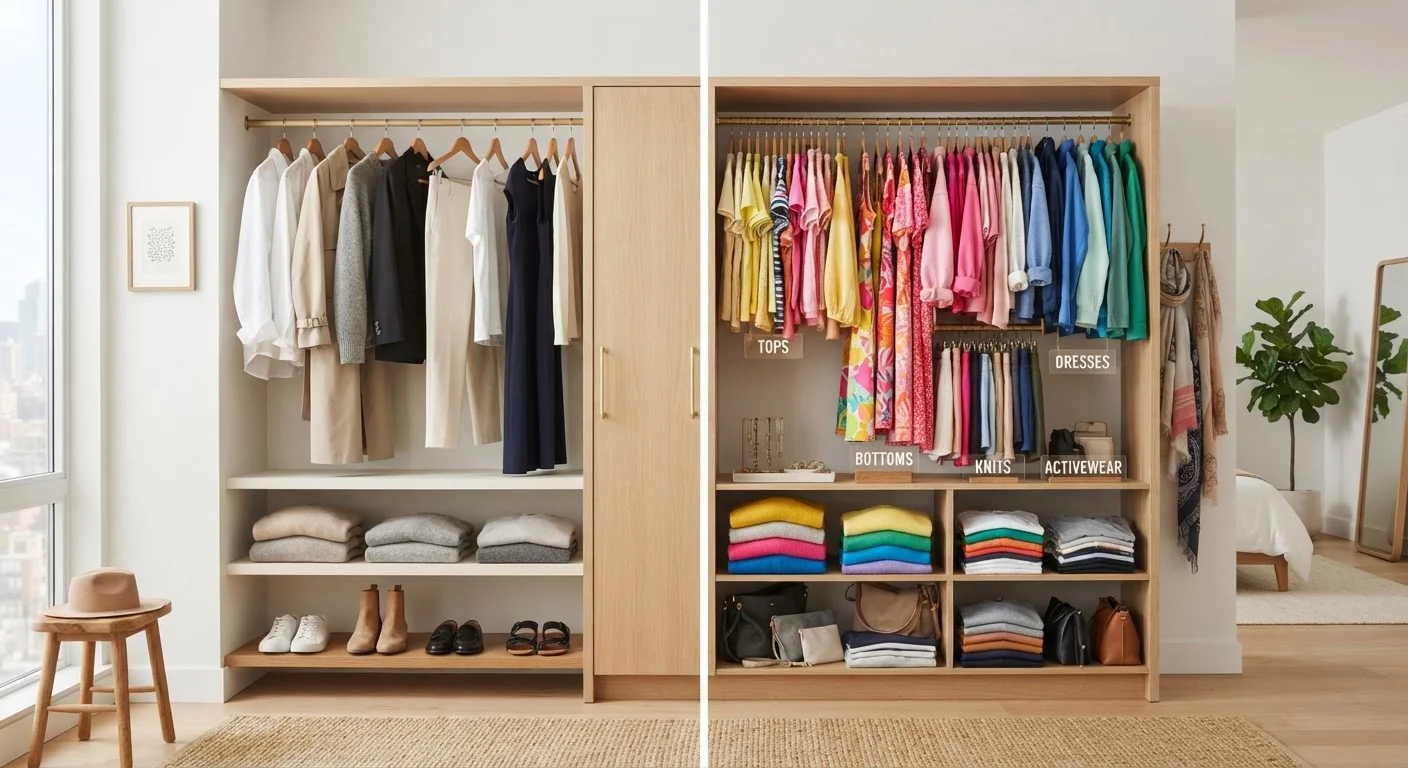
A capsule wardrobe is a curated, intentionally small collection of clothing - typically 25 to 50 items - selected to work together interchangeably. The goal is a cohesive set of pieces in compatible colors and silhouettes that produce many outfit combinations with fewer total garments. You're not just organizing what you own; you're reducing what you own as the first step.
A category-based wardrobe keeps however many clothes you currently have but organizes them into logical groupings: tops, bottoms, outerwear, workwear, activewear, and so on. The organizing unit is clothing type, not outfit potential. The emphasis is on knowing exactly where everything lives so nothing gets buried or forgotten.
The distinction matters: capsule thinking is about curation, while category thinking is about structure. Choosing between them - or combining them - depends on which problem you're actually trying to solve.
The Case for a Capsule Wardrobe
The capsule approach works well for people who feel paralyzed choosing an outfit or who routinely ignore large portions of their closet. By deliberately limiting options to pieces that coordinate with each other, the method reduces the cognitive load of getting dressed.
Practically, building a capsule wardrobe starts with a thorough edit: removing anything that doesn't fit well, isn't worn regularly, or doesn't mix with at least three other items you own. What remains should reflect your actual daily life - not an aspirational version of it.
Capsule wardrobes also translate naturally into travel packing. If your everyday closet already operates as a tight, mix-and-match set, assembling a travel bag becomes much faster. See our capsule wardrobe approach to travel clothing for how this carries into trip planning.
Start With One Week of Outfits
Before committing to either method, track what you actually wear for one week without changing your habits. The clothes you reach for instinctively form the core of any practical system. Everything else is worth questioning - whether you're building a capsule or setting up categories.
The method has real limits. If your life requires genuinely different clothing categories - formal workwear, outdoor gear, athletic apparel - a single capsule can feel restrictive. Some people maintain separate mini-capsules for each context, which adds complexity but preserves the core logic.
The Case for Category-Based Organization
Category-based organization doesn't ask you to own less - it asks you to store smarter. Grouping by type means every category has a designated zone, which makes both retrieving items and putting laundry away more reliable.
A straightforward category system might divide a closet into: everyday tops, dress shirts or blouses, pants and jeans, skirts, dresses, outerwear, and a separate drawer or shelf for folded items like knitwear and loungewear. Within each category, a secondary sort by color or formality adds another layer of visibility.
This system scales with wardrobe size in a way capsule thinking doesn't. It accommodates seasonal items, special-occasion clothing, and varying dress codes without requiring you to question whether each piece belongs. For households where multiple adults share organizational responsibility, clear categories are easier to communicate and maintain. Our article on organizing a home with multiple adults explores how agreed-upon systems reduce household friction.
| Capsule Wardrobe | Category-Based Organization | |
|---|---|---|
| Primary goal | Reduce total items owned | Structure existing inventory |
| Starting step | Significant editing and decluttering | Sort and assign zones by type |
| Works best for | Small, versatile wardrobes | Large or varied wardrobes |
| Maintenance effort | Low - fewer items to manage | Moderate - requires consistent sorting |
| Flexibility for varied dress codes | Requires multiple mini-capsules | Handles naturally via categories |
| Travel compatibility | Packing is fast and intuitive | Requires separate packing decisions |
| Shared household use | Harder to agree on jointly | Easier to communicate and maintain |
The tradeoff is that category organization doesn't address volume. A well-labeled closet stuffed with clothes that rarely get worn is organized but not necessarily functional. Pairing this system with a periodic review - see our seasonal decluttering guide - keeps it from becoming an archive rather than a working wardrobe.
Choosing the Right Fit - or Combining Both
The clearest signal that capsule thinking is right for you: you consistently wear the same 20% of your wardrobe and feel vaguely guilty about the rest. If that describes your closet, the editorial step - deciding what stays - is the work that will actually change your experience.
Category-based organization suits you better if your wardrobe is genuinely varied and serves legitimately different functions. The problem isn't that you own too much; it's that nothing has a reliable home. Structuring by type solves that without requiring you to give anything up.
Many people land on a hybrid: they apply capsule logic within each category. The workwear section stays small and cohesive; the casual section is larger but still grouped; activewear is separate and periodically edited. This approach captures the navigability of categories and the intentionality of capsule thinking without the rigidity of either in pure form.
Whichever method you choose, the most important factor is whether you can maintain it. A system that requires perfect discipline every day won't outlast a busy week. Build in enough structure to make putting things away easy, and enough flexibility to accommodate real life.