

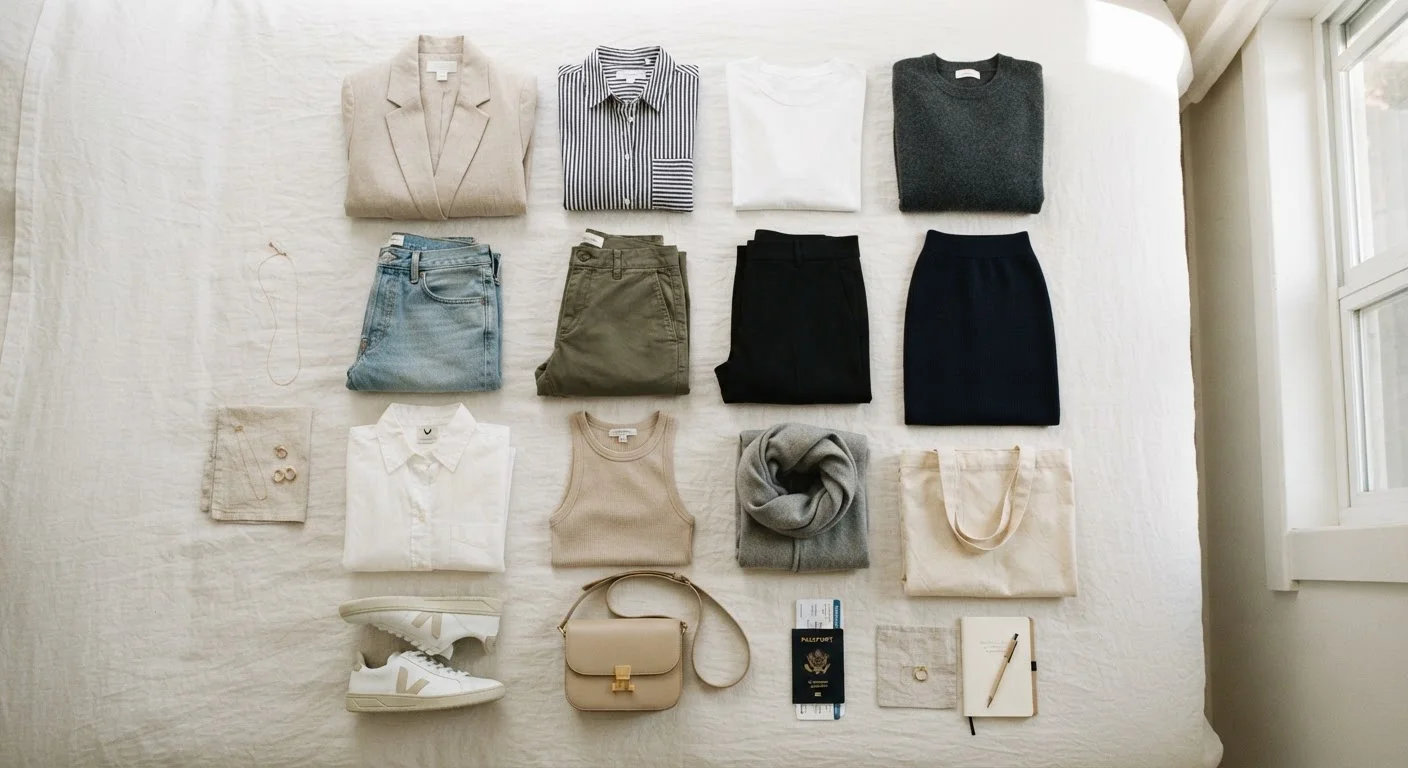
Key Takeaways
- A travel capsule wardrobe typically consists of 9–12 pieces that mix and match into 20+ outfits.
- Sticking to a unified color palette is the single most effective way to multiply outfit combinations.
- Choosing fabrics that resist wrinkles, dry quickly, and layer well eliminates the need for backup clothes.
- Building your capsule around your itinerary's most demanding dress code keeps the selection focused.
- Packing a capsule wardrobe can reduce checked bag fees and the mental load of daily outfit decisions.
What a Travel Capsule Wardrobe Actually Means
A travel capsule wardrobe is a curated set of clothing — usually between 9 and 12 pieces — where every item works with several others. The result is a compact bag that still produces a wide range of outfits. Unlike packing by occasion ("something for the nice dinner, something for the hike, something for the flight"), the capsule approach selects pieces that cross over between contexts.
This is a meaningful distinction. Packing light requires trade-offs, but a capsule wardrobe minimizes those trade-offs by making every item earn its place through versatility rather than single-use functionality. The goal isn't to bring the fewest possible clothes — it's to bring the most useful ones.
Think of it as a small, deliberate collection rather than a stripped-down one. The capsule principle is borrowed from everyday wardrobe strategy and applies equally well at home as it does on the road.
Core Practices for Building a Travel Capsule
The following practices are field-tested and grounded in how experienced travelers actually reduce pack weight without sacrificing flexibility.
Build around a unified color palette of three to four tones
When every piece shares compatible colors, any top works with any bottom — exponentially increasing outfit combinations without adding items. A typical neutral palette (navy, white, khaki, and one accent) is versatile across formal and casual contexts.
Choose fabrics that dry overnight and resist wrinkles
Quick-dry and wrinkle-resistant fabrics — such as merino wool, nylon blends, and certain polyester knits — allow you to hand-wash items in a sink and wear them the next morning. This effectively doubles a wardrobe's capacity without adding a single piece.
Identify the most demanding dress code on your itinerary and pack up to it
If your trip includes one formal dinner and five casual days, that dinner sets the ceiling for your nicest item. Everything else should serve the casual days — not the other way around. This prevents overpacking for edge cases.
Limit footwear to two pairs maximum
Shoes are the heaviest and least compressible items in a bag. Two pairs — one for walking and one for evenings or formal settings — cover nearly all travel scenarios. Choosing a walking shoe that also looks reasonably polished reduces this to one pair for many trips.
Apply the 5-4-3-2-1 formula as a starting framework
A common capsule structure for a one-week trip is five tops, four bottoms, three layers, two pairs of shoes, and one hat or accessory. This framework prevents over-selection in any single category and keeps the total item count manageable.
Getting Started: Quick Wins Before Your Next Trip
You don't need to overhaul your packing habits all at once. These actions will immediately move you toward a lighter, more functional travel kit.
For a deeper look at the cognitive and logistical advantages of traveling light, see the science behind a streamlined carry-on approach. Business travelers can also apply capsule principles directly — road warriors have refined wrinkle-free clothing strategies worth borrowing.
Climate-Proofing Your Capsule
One common concern is that a small wardrobe can't handle variable weather. In practice, fabric choice and layering solve this almost entirely. A lightweight merino base layer, a versatile mid-layer, and a packable outer shell cover an enormous range of conditions without adding significant bulk.
The key is to treat temperature range as a layering equation, not as an excuse to add items. A long-sleeve shirt worn alone works in mild weather; under a jacket, it handles cold evenings. Layering logic and fabric choices let you pack for unpredictable weather without needing a second bag.
Capsule Wardrobes Work Best When Planned Early
The capsule approach requires a bit more pre-trip thought than simply pulling clothes from your closet. Ideally, build your travel capsule a few days before departure so you have time to swap pieces if something doesn't coordinate. Last-minute packing tends to produce category-by-occasion thinking, which is the opposite of the capsule method.
Planning your full trip around a capsule strategy is part of broader smart trip planning from the start — and it can also contribute directly to spending less on every trip by eliminating checked luggage fees.