

Key Takeaways
- Carry-on-only travel eliminates checked baggage fees and saves significant time at the airport.
- A capsule wardrobe of wrinkle-resistant, mix-and-match pieces reduces decision fatigue on the road.
- Dedicated tech organization prevents tangled cables and speeds up TSA screening.
- A permanent toiletry bag kept stocked and ready cuts pre-trip prep time dramatically.
- Consistent packing systems — not memory — are what keep frequent travelers reliably prepared.
Why Business Travelers Pack Differently
Frequent business travelers board planes differently than occasional vacationers — not because they travel light by nature, but because they've refined packing into a repeatable system. When you're flying every week or two, every inefficiency compounds: the extra bag you checked costs time at baggage claim, the wrinkled shirt means an emergency iron session before a client meeting, the tangled chargers mean a frantic search at the gate.
The habits below aren't about minimalism for its own sake. They're about reducing friction at every stage of a trip so that energy stays focused on work — not logistics. If you want to understand the broader case for packing less, The Science of Packing Light lays out the cognitive and physical reasoning. But for business travel specifically, the stakes are even higher: how you arrive often shapes how you perform.
Commit to carry-on only — every trip
The single biggest time-saver frequent business travelers use is refusing to check a bag. A well-chosen carry-on that fits airline size standards eliminates baggage fees, removes the risk of lost luggage before a critical meeting, and cuts 20–40 minutes from arrival time at your destination. The constraint of a smaller bag also forces better packing decisions upstream — you stop bringing "just in case" items when there's no room for them. If you find yourself regularly struggling to fit everything, that's a signal to revisit your clothing choices, not to upgrade to a larger bag.
Refusing to check a bag can save 20–40 minutes on every single trip.
Choose wrinkle-resistant, interchangeable clothing
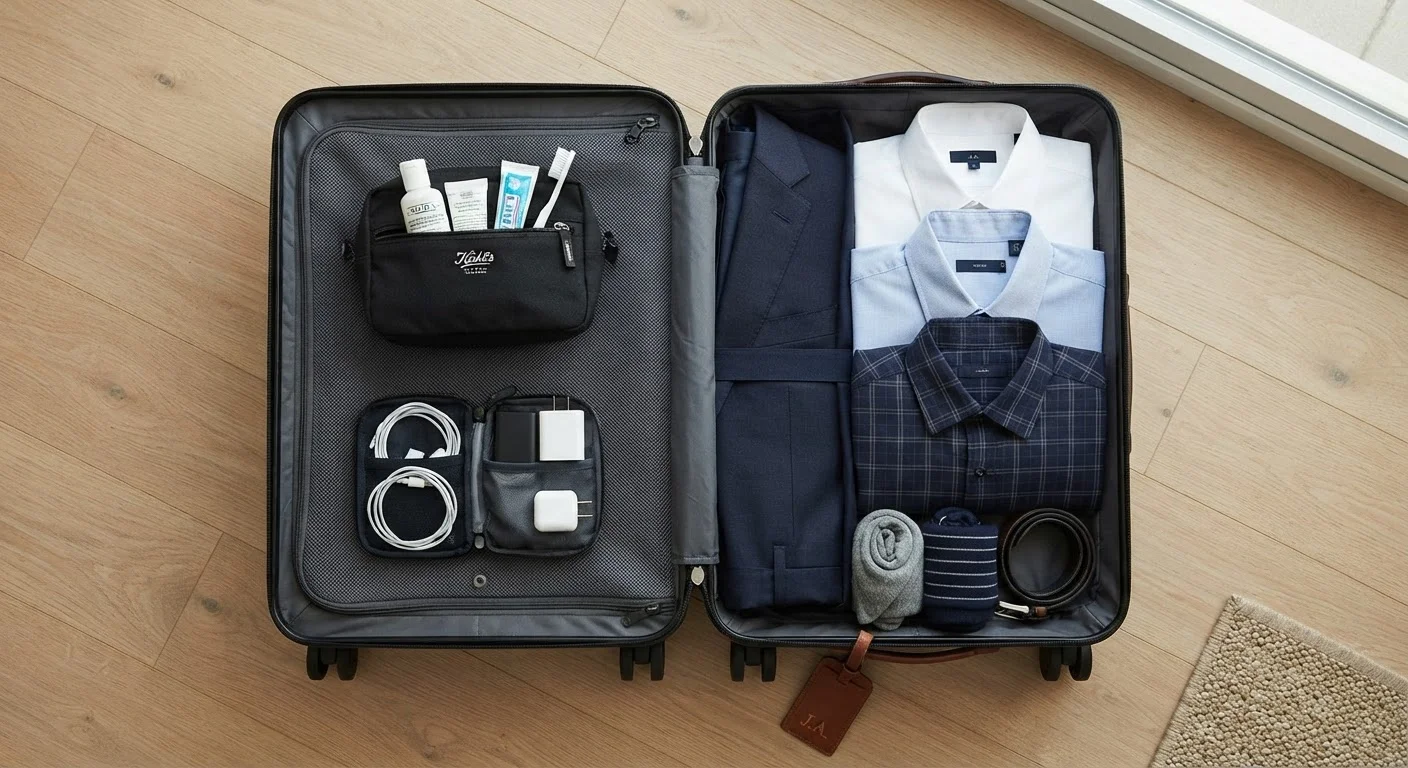
Road warriors tend to build their travel wardrobe around fabrics that recover well from compression — wool blends, certain synthetic dress fabrics, and structured knits that hold their shape. The test is simple: scrunch the fabric in your fist for 30 seconds and release. If it releases cleanly, it travels well. Beyond fabric, the emphasis is on pieces that work across multiple outfit combinations. Two dress shirts, one blazer, one pair of dark trousers, and a versatile tie can cover three or four distinct professional looks. Packing for variable climates follows similar logic: layering, not volume, is the answer to unpredictable weather.
Two shirts and one blazer can credibly cover four distinct professional looks.
Use a dedicated, always-stocked toiletry bag
One of the most consistent habits among frequent travelers is maintaining a toiletry kit that lives in the bag, not in the bathroom. Duplicates of daily-use items — travel-sized or decanted into reusable containers — stay packed between trips. This eliminates the pre-trip scramble of pulling things off the bathroom shelf and forgetting something critical. It also means the kit is TSA-compliant by default. For a full breakdown of liquid rules and what to decant versus leave behind, see Toiletries, TSA Rules, and Packing Liquids. The standing rule: if it ran out, restock it before the next trip, not during packing.
A permanently stocked toiletry kit removes one of the most common pre-trip time drains.
Organize tech with a dedicated cable pouch
Business travelers typically carry more electronics than leisure travelers — laptop, phone, earbuds, a portable charger, various cables, and often a presentation clicker or adapter. Without a system, these items become a tangled, hard-to-screen mess. A compact organizer or cable roll — with dedicated slots or elastic loops for each item — keeps everything visible and accessible. Beyond convenience, a well-organized tech pouch speeds up TSA screening: you know exactly where everything is, and electronics are easy to remove and replace quickly. Label cables with small adhesive tags if you carry multiples; it sounds minor until you're hunting for the right charger in a dim hotel room at 11 p.m.
Organized tech gear speeds up both TSA screening and late-night hotel searches.
Pack using a master checklist, not memory
Even the most experienced road warriors rely on a packing checklist rather than trusting memory. The checklist gets refined over time — items get added when they're forgotten, removed when they're consistently unused — until it reflects exactly what a given type of trip requires. Many travelers maintain separate lists for short domestic trips versus longer international ones. The key discipline is running the list every time, even when the trip feels routine. Routine is precisely when something gets skipped. Overpacking traps are often rooted in anxiety-driven additions that a checklist, reviewed calmly in advance, naturally prevents.
A checklist refined over dozens of trips is worth more than any packing hack.
Separate and protect your most essential items
Frequent travelers keep their highest-stakes items — passport or ID, boarding passes, hotel confirmation, laptop, phone charger — in one predictable, always-accessible location, typically a front pocket or top compartment. This isn't just about convenience; it's about reducing cognitive load during rushed transitions. Knowing exactly where your ID is when the TSA agent asks means one less mental task during an already demanding travel day. Some travelers use a slim document organizer; others rely on a consistent jacket pocket. The method matters less than the consistency. Whatever system you use, it should work the same way on every trip without thinking.
Knowing exactly where your ID lives means one less mental task at a crowded checkpoint.
Building Your Own Road Warrior System
The goal isn't to copy anyone else's exact kit — it's to build a system that runs on autopilot. Start by auditing your last three business trips: what did you pack that you never touched? Those items are the first candidates for removal. From there, apply the habits above one at a time rather than overhauling everything at once.
Run a Post-Trip Audit Before You Unpack
Before emptying your bag after a trip, note what you never touched. Pull those items out and set them aside. If three consecutive trips go by without using something, it leaves the travel kit permanently. This habit, practiced consistently, gradually compresses your pack into exactly what you actually use — nothing more.
For clothing strategy, the capsule wardrobe approach translates exceptionally well to business travel — a small set of coordinated, professional pieces that mix and match across multiple days. Pair that with what you know about common packing myths and you'll stop second-guessing every item you pull from the closet. Consistency is the point: the road warrior advantage isn't superior gear, it's a system practiced often enough that packing feels effortless.