

Key Takeaways
- Overpacking creates measurable physical strain and contributes to travel decision fatigue.
- A carry-on-only approach eliminates checked baggage fees and airport wait times.
- Versatile, mix-and-match clothing is the foundation of effective light packing.
- Most travellers report using fewer than 60% of what they bring on any given trip.
- Packing light is a learnable skill, not a personality trait.
Packing Light
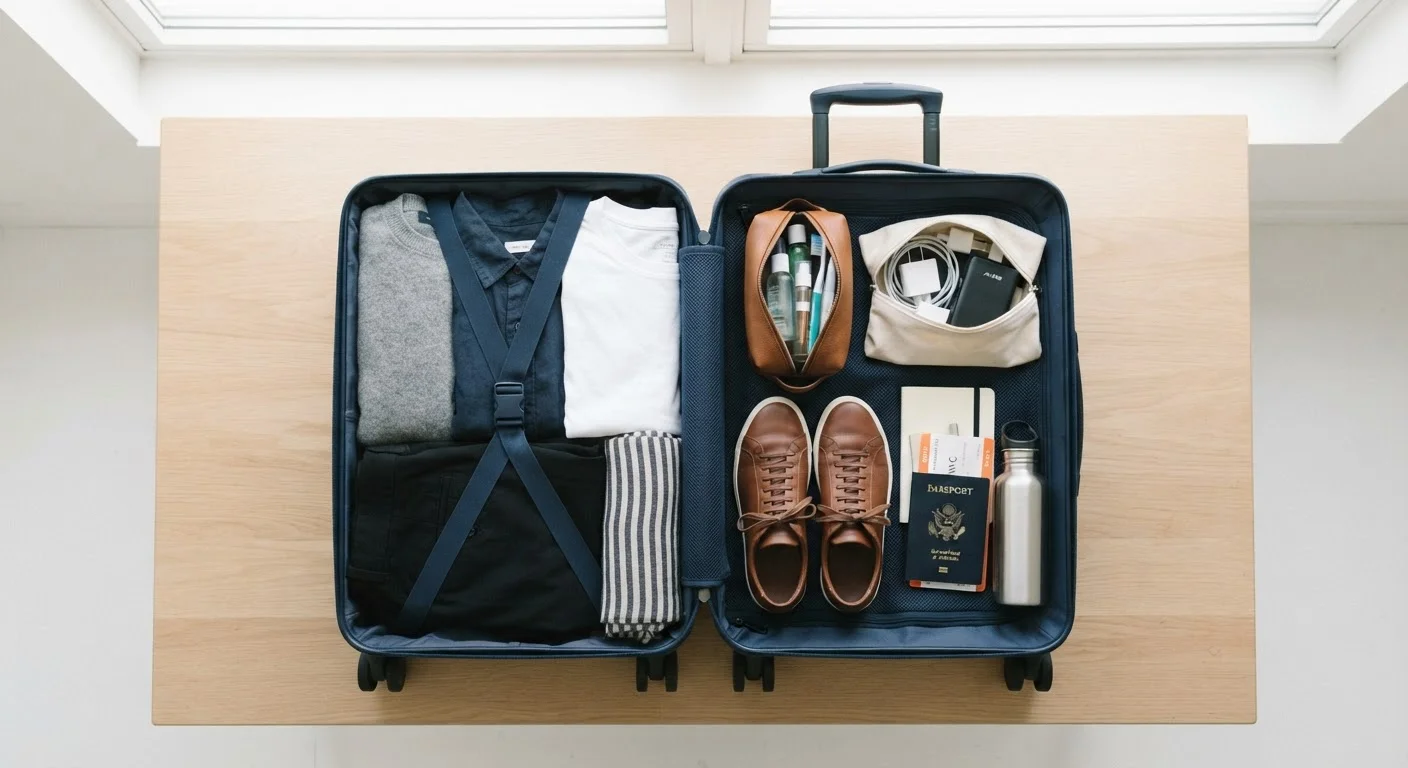
Packing light is the deliberate practice of travelling with only the essentials — typically fitting everything into a carry-on bag or smaller. It's built on the idea that most travellers pack far more than they actually use, and that reducing gear reduces both physical and mental load. The goal isn't deprivation; it's intentionality.
In behavioral research, the burden of excess possessions is sometimes linked to 'choice overload' — the cognitive friction caused by managing too many options. Packing light directly counters this by narrowing the decision set.
Why Overpacking Is the Default — and Why It Costs You
Most travellers overpack for the same reason: anticipatory anxiety. The brain naturally runs 'what if' scenarios before a trip — what if it rains, what if there's a formal dinner, what if I need that third pair of shoes? Each scenario feels plausible in advance, which is why bags fill up with gear that never gets used.
The physical cost is obvious: a heavy bag causes fatigue, slows your pace, and limits your options for public transit, narrow staircases, or spontaneous detours. But the cognitive cost is subtler and equally real. Managing excess gear — tracking, lifting, repacking, and worrying about checked bag delays — consumes mental energy that could go toward actually experiencing a destination.
Research in cognitive psychology suggests that managing more possessions increases the number of small decisions we have to make, which in turn depletes focus. While that research wasn't conducted specifically on travel, the principle translates directly: fewer items means fewer micro-decisions each morning, and more mental bandwidth for the trip itself.
“The weight of your bag is inversely proportional to the quality of your trip. Every pound you don't carry is a pound of freedom.”
— Rolf Potts, Travel writer and author known for writing on minimalist and long-term travel
For a practical look at how these 'what if' assumptions play out in the real world, the common packing myths article examines which preparation beliefs hold up — and which don't.
The Logic Behind Carry-On Only Travel
Fitting everything into a carry-on isn't a stunt — it's a deliberate system that pays dividends at every stage of a trip. You skip check-in lines, move directly to security, board without hunting for overhead space if you arrive early, and walk straight out of the arrival terminal without a baggage claim stop. On tight connections, this difference can be significant.
~50%
Clothes travellers pack but never wear
Travel behaviour surveys consistently find that travellers use roughly half or fewer of the clothing items they bring, regardless of trip length.
30–60 min
Average time saved skipping baggage claim
Estimated time savings vary by airport and airline, but avoiding checked luggage commonly saves 30 to 60 minutes per arrival — more at busy international terminals.
22 lbs
Comfort threshold cited by frequent travellers
Many experienced travellers set a personal weight limit around 22 pounds (10 kg) for carry-on bags to avoid fatigue and overhead bin strain on longer travel days.
The financial case is also real, particularly on carriers that charge per checked bag. While fees vary and change over time, avoiding them consistently over multiple trips adds up. Our travel on a budget resources cover this within a broader cost-saving framework.
There are genuine trade-offs, of course. Carry-on travel requires planning around laundry, makes bringing back large souvenirs difficult, and may not suit every itinerary — particularly trips involving formal occasions or extreme weather gear. Packing light versus packing for every scenario explores how to make this judgment call honestly for your specific trip.
Building a Smarter Packing System
Light packing isn't about owning less — it's about selecting intentionally for each specific trip. That process starts with clothing, which typically occupies the most space in any bag.
The most effective approach is a capsule wardrobe: a small set of pieces that share a colour palette and layer together logically, so that 7 items produce far more than 7 outfits. Our guide to the capsule wardrobe approach to travel clothing explains the selection logic in detail.
The Packing Test Worth Running
Before your next trip, pack your bag as usual — then remove one-third of the clothing. Take only what remains. Most travellers who try this find they manage perfectly well, often without noticing what was left behind. It's a simple way to recalibrate your sense of what's genuinely necessary versus what feels necessary in advance.
Beyond clothing, the principles are consistent: choose multi-use items over single-purpose ones, use travel-size toiletries or plan to purchase essentials at your destination, and apply a ruthless 'one in, one out' test to anything borderline. If you genuinely can't decide whether to bring something, that hesitation is usually a signal to leave it behind.
Organisation tools like packing cubes can help maintain structure within a bag and speed up unpacking at each destination — though they don't automatically create more space. The honest guide to packing cubes clarifies when they're worth using and when they're just extra weight.
Frequent travellers — particularly those who travel for work — often develop repeatable systems that remove the guesswork entirely. The habits of experienced road warriors offer a useful template, even for leisure trips. The underlying principle is the same: a system that's been tested and refined is faster and lighter than one built from scratch each time.
For a broader planning framework that integrates packing strategy with itinerary and logistics decisions, the trip planning hub is a practical starting point.