

Key Takeaways
- Packing cubes improve organization and accessibility but do not inherently create extra space in a bag.
- Compression cubes can reduce clothing volume, though the weight of your items stays the same.
- Using cubes by category or outfit makes unpacking and repacking at multiple destinations significantly faster.
- Cubes work best when you've already edited your packing list down to essentials.
- Mesh-top cubes allow security screeners to see contents without unpacking your entire bag.
Packing Cubes
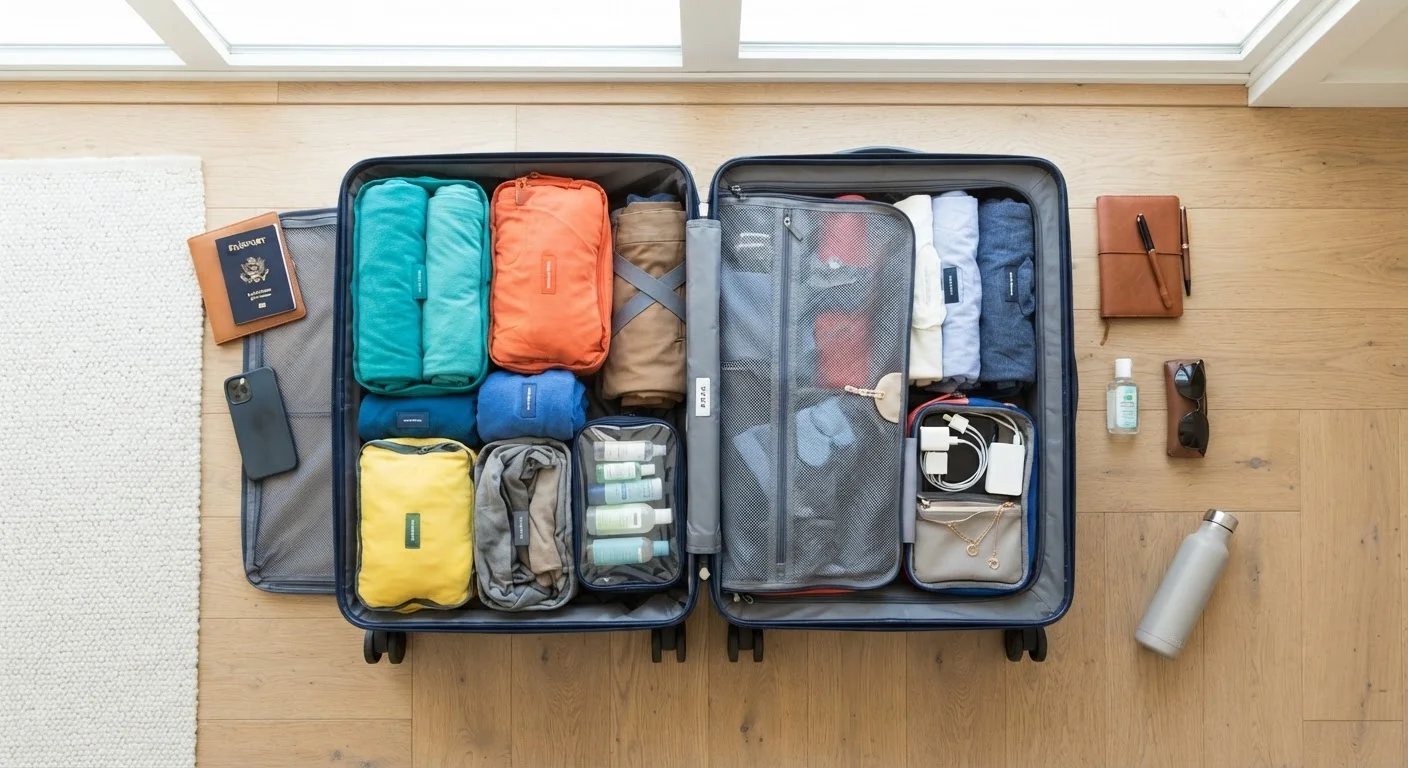
Packing cubes are lightweight, zippered fabric compartments that fit inside a suitcase or bag to organize clothing and gear into separate, stackable sections. They come in multiple sizes — typically small, medium, and large — and are designed to group items by category, outfit, or travel day. Rather than digging through a loose pile of clothes, travelers can pull out a single cube and find exactly what they need.
Most packing cubes are made from nylon or polyester mesh and add minimal weight (typically 1–3 oz per cube). Compression cubes include a secondary zip that squeezes air out of the contents, reducing volume but not reducing actual clothing mass.
What Packing Cubes Actually Do (and Don't Do)
Packing cubes are one of travel's most discussed accessories — and also one of the most misunderstood. The core promise is organization, not magic compression. Standard cubes give every category of clothing a defined home inside your bag, which means less rummaging, faster repacking, and a cleaner hotel room floor. What they do not do is shrink your clothes or give you more cubic inches than your bag already holds.
This distinction matters because travelers who buy cubes expecting to suddenly fit more often feel disappointed. The real payoff is efficiency: when your shirts live in one cube and your bottoms in another, you can pull out exactly what you need without disturbing the rest of your bag. That benefit compounds over a multi-stop trip, where repacking every other day becomes genuinely tedious without a system.
Cubes Don't Replace a Tight Packing List
Packing cubes organize what you bring — they don't compensate for overpacking. If your bag won't close before you add cubes, it won't close after. The most effective use of cubes begins with a disciplined packing list. Consider common packing myths that lead travelers to bring more than they need before investing in any organizational system.
If your goal is to travel with less overall, cubes work best after you've already trimmed your packing list. They organize what you bring — they don't compensate for overpacking. See our guide to packing light for strategies on reducing what you bring in the first place.
When Compression Cubes Are Worth the Upgrade
Compression cubes operate on a different principle. They include a secondary zip that flattens the cube after you've loaded it, pushing trapped air out of bulky fabrics like fleece, knitwear, and down layers. For a winter trip where a single heavy sweater might eat half a carry-on, a compression cube can meaningfully reduce that item's footprint.
The tradeoff is weight and cost — compression cubes are heavier than standard cubes and typically more expensive. They're most valuable when you're carrying thick, air-trapping fabrics and need to hit a strict bag-size limit. For a summer trip of lightweight clothing, standard cubes are likely sufficient and simpler to use.
Use Compression Cubes Selectively
Reserve compression cubes for your bulkiest items — think fleece pullovers, sweaters, or a light down jacket — rather than applying them to every category. Using them for thin fabrics like T-shirts provides little benefit and adds unnecessary handling steps. A mixed approach (compression for bulk, standard for everything else) keeps your system efficient without overcomplicating it.
Practical Ways to Organize Your Cubes
The two most common organizational strategies are by category and by outfit or day. Category packing — tops in one cube, bottoms in another, undergarments in a small cube — works well for longer trips where you'll mix and match clothing. It keeps your bag intuitive and makes laundry sorting easier.
Outfit-based packing — everything for Tuesday in one cube, Wednesday in another — suits fast-moving itineraries where you're changing hotels frequently. You unzip the right cube for the day and don't have to think further. The downside is that this approach uses more cubes and leaves less flexibility for changing plans.
For business travelers, a hybrid often works well: a cube for core clothing items and a separate small cube dedicated to cables, adapters, and tech accessories. Our business travel packing guide explores this in more detail. Whatever system you choose, consistency is more important than perfection — use the same logic every trip and packing becomes automatic.
Carry-On Travel and the Cube Advantage
Packing cubes deliver outsized value for carry-on-only travelers. When every cubic inch counts and checked bag fees are a real concern, a well-structured cube system helps you confirm at a glance that your bag closes without force. Mesh-top cubes have an added bonus at airport security: screeners can often see contents without asking you to unpack everything.
The carry-on vs. checked luggage tradeoffs are real, but cubes make the carry-on approach more manageable by keeping your bag genuinely organized rather than just theoretically possible. Paired with a thoughtful packing list — informed by the kind of thinking in our packing light vs. packing for every scenario guide — cubes help make the carry-on commitment stick beyond the first trip.
70%
Travelers who report better packing efficiency with cubes
A survey by a major luggage retailer found roughly 70% of cube users said they felt more organized and repacked faster compared to packing without a system.
1–3 oz
Typical weight of a single standard packing cube
Most nylon or mesh packing cubes weigh between one and three ounces each, making a set of five cubes a minor weight addition of under a pound.
20–30%
Volume reduction possible with compression cubes
Travel gear reviewers generally estimate compression cubes can reduce the bulk of thick fabrics by 20–30%, though results vary by material and fill.