

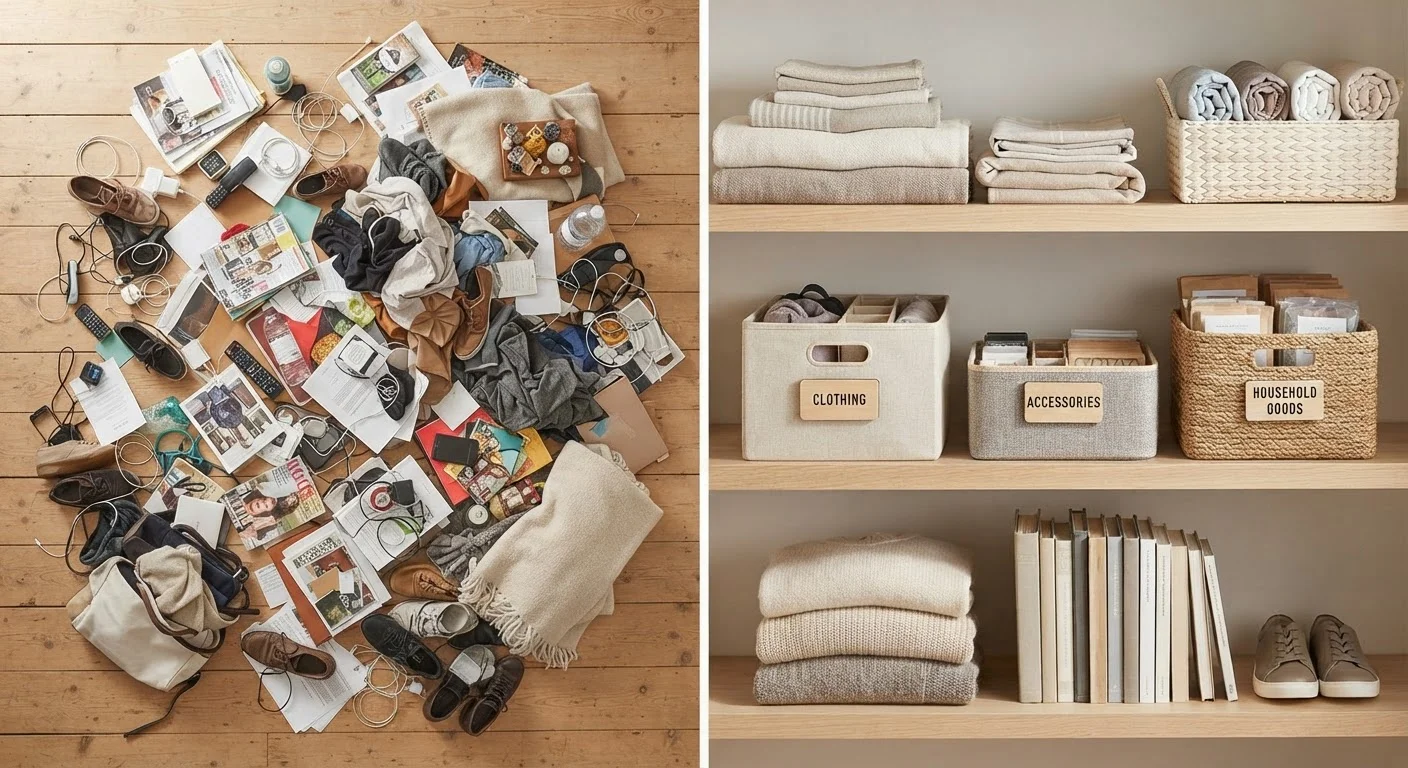
Key Takeaways
- Decluttering means deciding what to keep; organizing means deciding where kept items live.
- Organizing before decluttering wastes time - you end up creating systems for things you'll eventually discard.
- Chaos that keeps returning is often a sign the decluttering step was skipped or incomplete.
- Both steps are necessary, but sequence determines whether your results last.
- Even well-organized spaces need periodic decluttering as possessions and needs change over time.
Option A
Decluttering
The essential first step - removing what doesn't belong.
Best for: Homeowners who feel overwhelmed by volume and need to reduce before they can create lasting order.
Option B
Organizing
The structural layer - giving everything a defined home.
Best for: Homeowners who have already edited their possessions and need systems to keep things findable and functional.
If your home feels visually overwhelming and you can barely find clear surfaces
Decluttering
Volume is the core problem here. Reducing what you own creates breathing room before any organizing system can take hold.
If you know what you own but can never find it when you need it
Organizing
When possessions are already at a manageable level, the missing piece is a clear, consistent system for where things belong.
If your organized spaces keep sliding back into chaos within weeks
Decluttering
Recurring disorder usually signals that too many items are competing for too little space - the root issue is excess, not system design.
If you're setting up a new home or freshly emptied room
Organizing
A clean slate calls for thoughtful structure first: define zones and systems before belongings move in, so habits form around order from day one.
Two Words People Use Interchangeably - But Shouldn't
Walk into most home improvement conversations and you'll hear "decluttering" and "organizing" used as near-synonyms. They aren't. Treating them as the same concept is one of the most common reasons a tidy weekend effort dissolves into chaos by the following month.
Decluttering is an editorial process. You go through what you own and make decisions: keep, donate, discard, or relocate. The goal is reduction - ending up with fewer items than you started with.
Organizing is a structural process. Once you know what you're keeping, you assign every item a specific, logical home and create a system for returning it there consistently.
Neither step alone is sufficient. But the sequence matters enormously. If you organize first - buying bins, installing shelves, labeling everything - and then realize half of what you organized shouldn't have stayed in the first place, you've built a system around the wrong inventory. You'll likely reorganize again after the inevitable purge. That's a significant amount of duplicated effort. For a deeper look at why physical disorder takes such a toll in the first place, see the cognitive research behind clutter.
How to Tell Which Step You Actually Need Right Now
Before touching a single drawer, it helps to honestly assess where your household stands. The two problems have different symptoms.
| Criterion | Decluttering | Organizing |
|---|---|---|
| Core question | Should I keep this? | Where does this live? |
| Primary action | Remove, reduce, edit | Assign, structure, label |
| Correct sequence position | Always first | Always second |
| Main risk if skipped | Systems built for wrong inventory | Items never have a reliable home |
| Result when done well | Less to manage overall | Everything findable and returnable |
| Tools needed | Boxes, bags, decision criteria | Containers, labels, defined zones |
| Frequency | Periodic - as needs change | Set up once, maintain regularly |
Signs you need to declutter first: You frequently can't find surfaces to work on. Storage areas are full but you still feel like you don't have enough room. You've organized the same space multiple times and it never sticks. If that pattern sounds familiar, learn why organized spaces revert to chaos - excess volume is usually the culprit.
Signs you're ready to organize: You feel comfortable with what you own but things are scattered, hard to find, or returned to random spots. The problem isn't how much you have - it's that nothing has a reliable home.
1 in 4
US households with a garage too cluttered to park in
According to the U.S. Department of Energy, approximately one in four American households cannot use their garage for vehicles due to accumulated items.
~10 min/day
Average time spent searching for misplaced items
Research cited by the National Association of Professional Organizers suggests Americans spend roughly 10 minutes per day searching for misplaced belongings.
The Right Sequence - And Why It Holds
The reliable order is always: declutter first, then organize. Here's why this sequence works structurally.
When you declutter first, you're working with your real inventory - the items that will actually live in your home long-term. Any organizing system you build afterward is sized and designed for that true set of possessions, not an inflated one. Containers fit. Shelves don't overflow. Categories stay coherent.
Skipping or rushing the decluttering step is the most common design flaw in home organization. You may create a beautiful system, but if it's holding 40% more than it should, the system degrades under its own weight. That's a structural problem, not a willpower problem.
There's also a practical benefit to this order: decluttering surfaces space you didn't know you had. Clearing out a closet before organizing it often reveals you need fewer bins than you thought - saving both money and effort.
Once your decluttering pass is complete - and for larger homes, this is worth doing room by room rather than all at once - organizing becomes a straightforward design exercise. Assign zones. Group like items. Choose containers that fit the actual volume. Label where it helps. The complete home organization overview walks through this full progression from mindset through maintenance.
Finally, note that neither step is a one-time event. Possessions change. Life changes. Building a habit of periodic decluttering - perhaps aligned with seasons - keeps the system from drifting. Seasonal decluttering guidance can help you decide which areas to revisit and when. And don't overlook the digital side of the equation: digital clutter creates the same mental load as physical disorder and deserves the same sequenced approach.