
Envelope Budgeting vs. Digital Spending Trackers: Old-School vs. App-Based Money Management

Key Takeaways
- Envelope budgeting uses physical cash divided into labeled categories to enforce hard spending limits.
- Digital trackers sync automatically with bank accounts and cards, categorizing transactions in real time.
- The envelope method reduces overspending through friction; apps reduce overspending through awareness.
- Neither system is universally superior — effectiveness depends heavily on your spending habits and lifestyle.
- Hybrid approaches, such as cash envelopes for problem categories with app tracking elsewhere, are a viable middle ground.
Option A
Envelope Budgeting
The tactile, cash-first method that makes limits impossible to ignore.
Best for: People who overspend on discretionary categories and want a physical boundary that stops them cold.
Option B
Digital Spending Trackers
The automated, data-rich approach that works around a cashless lifestyle.
Best for: People who rarely use cash and want real-time visibility into spending patterns across accounts.
If you consistently overspend on groceries, dining, or entertainment
Envelope Budgeting
Physical cash creates a hard stop the moment the envelope is empty — no overdraft, no rationalization, no 'I'll catch up next month.'
If you rarely carry cash and rely on cards or mobile payments
Digital Spending Trackers
Tracking works best when it matches how you actually spend. Forcing cash withdrawal adds friction that makes the system harder to maintain.
If you're managing a household budget with a partner
Digital Spending Trackers
Apps that sync across devices give both people real-time visibility without requiring physical coordination. See our guide to budgeting as a household for more.
If you're new to budgeting and want to build the habit from scratch
Envelope Budgeting
The simplicity and tangibility of cash envelopes make the learning curve gentle — no apps to configure, no bank connections to troubleshoot.
If you want detailed data to analyze spending trends over time
Digital Spending Trackers
Apps store months of transaction history, generate category breakdowns, and surface patterns that manual cash systems can't replicate.
How Each Method Actually Works
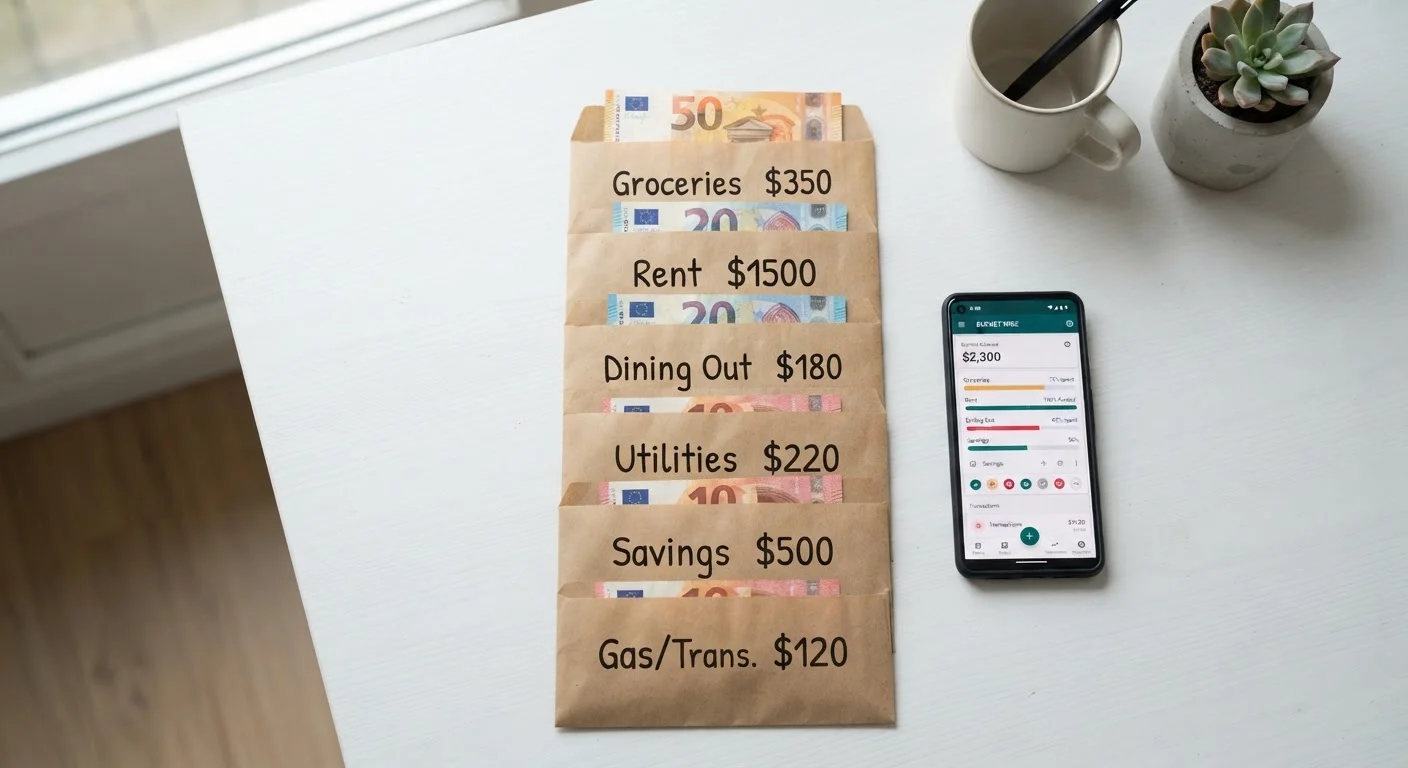
The envelope method is straightforward: at the start of each budget period, you withdraw cash and distribute it into labeled envelopes — one for groceries, one for gas, one for dining out, and so on. When an envelope is empty, spending in that category stops. No borrowing from next month, no exceptions. That constraint is the whole point.
The concept has been around for decades and gained renewed attention through personal finance educators who emphasize behavior over spreadsheets. Its strength is psychological: handling physical money activates a sense of loss that swiping a card simply doesn't trigger.
Digital spending trackers work differently. Most connect directly to your bank accounts and credit cards via secure bank-linking technology, automatically pulling in every transaction and sorting it into categories. You set budget limits per category inside the app, and the software alerts you as you approach or exceed them. Some apps require manual entry, which adds a layer of mindfulness similar to the envelope method but without cash.
Both systems aim to answer the same question — where is my money going — but they answer it through completely different mechanisms: one through physical constraint, the other through digital awareness. If you're weighing other structural approaches, comparing zero-based and percentage-based budgeting can also help clarify which framework fits your life.
Side-by-Side: Key Differences at a Glance
Before diving into trade-offs, here's a direct comparison across the criteria that matter most for daily use.
| Criterion | Envelope Budgeting | Digital Spending Trackers |
|---|---|---|
| Setup effort | Low — cash and envelopes only | Moderate — account linking, category setup |
| Works with cashless spending | No — cash only | Yes — cards, accounts, subscriptions |
| Spending enforcement | Hard limit (empty envelope = stop) | Soft limit (alerts, not barriers) |
| Spending awareness | Real-time by feel | Real-time with data and history |
| Multi-person households | Difficult to coordinate | Easy with shared app access |
| Privacy / security risk | Low (no data shared) | Higher (bank connection required) |
| Works for online purchases | No | Yes |
| Historical trend analysis | Manual or none | Automatic, months of data |
Where Each Method Falls Short
The envelope system has real limitations in a world that has largely moved away from cash. Subscription services, online purchases, and automatic bill payments don't accommodate physical envelopes at all. You also carry the risk of losing cash — there's no fraud protection and no record if an envelope goes missing. For people in households with multiple spenders, coordinating who has which envelope adds logistical friction.
Digital trackers have their own blind spots. Automatic categorization is imperfect: apps frequently miscategorize transactions, and correcting them manually can be tedious. More importantly, seeing your spending data doesn't automatically change your behavior. Research in behavioral economics consistently suggests that awareness alone is a weak motivator without accompanying commitment mechanisms. An app that tells you that you overspent on dining last month doesn't stop you from doing it again this month.
Security is also a legitimate concern with apps that require bank credentials or use open-banking connections. While reputable services use encryption and read-only access, connecting financial accounts to third-party platforms carries inherent risk that cash envelopes do not.
A Note on App Security
Many digital tracking apps use read-only connections to your bank, meaning they can view transactions but cannot move money. Even so, connecting financial accounts to any third-party service involves data-sharing that carries some risk. Review each app's privacy policy and understand how your credentials and transaction data are stored or shared before linking accounts.
Whichever method you use, pairing it with a regular review habit strengthens results. Our monthly budget audit checklist gives you a structured way to catch drift and reset priorities before it compounds.
Choosing the Right Fit — or Combining Both
The honest answer is that the best budgeting system is the one you'll actually stick with. That said, a few signals point clearly in one direction or the other.
If you find yourself swiping a card without thinking and only realizing the damage at month-end, the friction of physical cash may be exactly what you need — at least for the categories where you tend to overspend. If your life runs on autopay, online shopping, and mobile payments, forcing yourself into a cash-only system creates barriers that make consistency harder, not easier.
Many people find that a hybrid approach works well: cash envelopes for two or three high-risk spending categories (dining, entertainment, personal spending money), with a digital tracker handling everything else — bills, subscriptions, savings contributions. This captures the behavioral brake of cash where it matters most while keeping the convenience of digital for the rest.
The decision between tracking every dollar and setting a loose spending cap is a related choice worth thinking through alongside this one — both comparisons shape how tightly structured your overall money management feels day to day.
This article is for general informational and educational purposes only and does not constitute personalized financial advice. Consider consulting a licensed financial professional for guidance tailored to your specific situation.