

Key Takeaways
- A written budget — even a simple one — gives you measurable control over where money goes.
- Paying yourself first by automating savings removes reliance on willpower.
- An emergency fund covering three to six months of expenses is the financial safety net most Americans lack.
- Most budgets fail not because of math but because of unrealistic expectations and inconsistency.
- Free tools and basic spreadsheets are often sufficient — you don't need an expensive app.
Why Budgeting Actually Matters
Most Americans know they should budget. Fewer actually do it consistently. According to a 2023 Gallup survey, only about one in three U.S. households follows a detailed monthly budget. That gap between intention and action has real consequences — it's one reason so many people feel financially stuck even when income rises.
A budget isn't a punishment or a restriction. It's simply a plan for your money written down before you spend it. Without one, spending tends to expand to fill whatever's available, a pattern sometimes called lifestyle creep. With one, you can make deliberate trade-offs: prioritize what matters, cut what doesn't, and build toward goals instead of just surviving until the next paycheck.
~33%
U.S. households with a detailed monthly budget
According to a 2023 Gallup survey, only about one in three American households follows a formal monthly budget.
~57%
Americans without enough savings for a $1,000 emergency
A Bankrate survey found a majority of U.S. adults could not cover a $1,000 unexpected expense from savings alone.
3–6 months
Recommended emergency fund coverage
Most financial planning resources broadly recommend keeping three to six months of essential expenses in an accessible account.
If you're new to personal finance or feel like you're starting from behind, our guide for getting started with personal finance covers the foundation before the spreadsheets.
This article is general financial information and education, not personalized financial advice. For guidance tailored to your situation, consult a licensed financial professional.
How to Build a Budget That Works for You
There's no single right budgeting method. The best one is the one you'll actually use. Here are three widely recognized frameworks:
- 50/30/20 rule: Allocate roughly 50% of after-tax income to needs (rent, utilities, groceries), 30% to wants (dining out, entertainment), and 20% to savings and debt repayment. It's a useful starting point, though exact percentages vary by cost of living and income.
- Zero-based budgeting: Assign every dollar a job so income minus expenses equals zero. This works well for people who want to track spending closely.
- Envelope method: Divide cash (or digital equivalents) into categories. When a category's envelope is empty, spending in that area stops. Effective for those who tend to overspend on discretionary items.
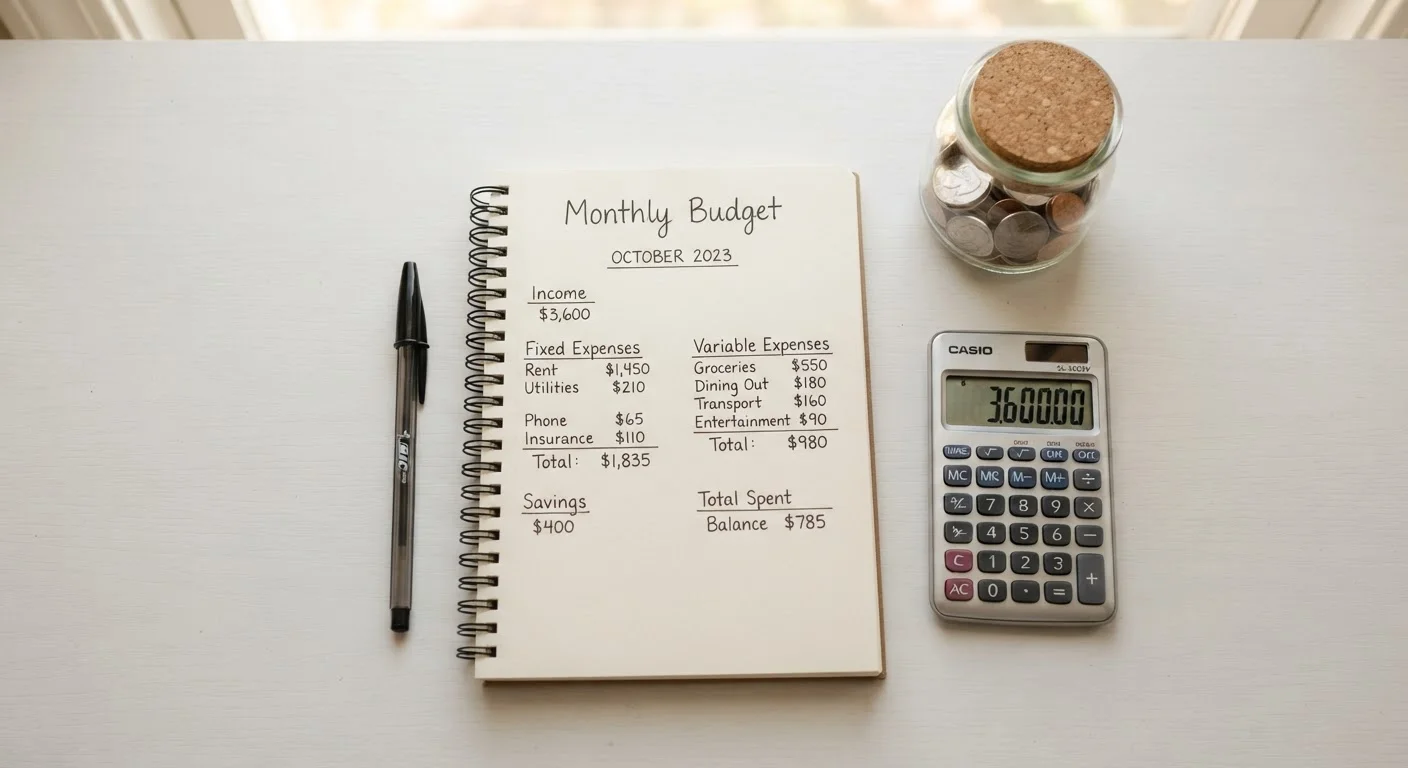
Whichever framework you choose, the mechanics are the same: list your income, list your fixed and variable expenses, compare the two, and adjust until they balance.
For a hands-on walkthrough with no prior system required, see our step-by-step guide to building your first monthly budget.
Before you categorize a single expense, spend two weeks simply recording what you actually spend — no judgment, no changes. Most people are surprised by where the money actually goes, and that honest baseline makes the budget far more realistic.
Budgets built on assumed spending rather than real spending are routinely too optimistic, which is a leading reason they're abandoned in the first month.
Set your savings transfer to hit the same day your paycheck clears. Waiting even a day dramatically increases the chance that money will get absorbed into discretionary spending instead.
Behavioral finance research consistently shows that automating a financial behavior removes the friction that otherwise prevents follow-through.
Core Savings Strategies Worth Knowing
Budgeting tells you where money goes. Saving is what you do with the difference. A few principles hold up across almost every financial situation:
Pay yourself first
Transfer a set amount to savings the moment your paycheck arrives — before discretionary spending happens. Automating this transfer eliminates the need for willpower. Even a small consistent amount compounds meaningfully over time.
Build an emergency fund first
Financial planners broadly recommend keeping three to six months of essential living expenses in a liquid, accessible account. This isn't an investment; it's insurance against job loss, medical bills, or unexpected repairs. Without it, a single setback can derail an otherwise solid budget.
Use separate accounts for separate goals
Keeping your emergency fund, vacation savings, and down payment fund in separate accounts makes it harder to raid one for the other and clearer how close you are to each goal.
For plain-language definitions of terms like liquidity, discretionary spending, and net income that come up in savings conversations, our budgeting and savings glossary is a quick reference worth bookmarking.
Common Budgeting Pitfalls — and How to Dodge Them
Most budgets don't fail because of bad math. They fail because of habits and expectations. The most common traps:
- Forgetting irregular expenses: Annual subscriptions, car registration, holiday gifts — these feel like surprises but aren't. Build a "sinking fund" by dividing predictable irregular costs by 12 and setting that amount aside monthly.
- Making the budget too tight: A budget with zero breathing room collapses the first time something goes wrong. Build in a small buffer for the unexpected.
- Tracking spending only once a month: By the time you review, the damage is done. A quick weekly check-in — even five minutes — catches overspending while you can still course-correct.
- Giving up after one bad month: Consistency over time matters more than perfection in any single month. A budget is a habit, not a test you pass or fail.
Our article on why budgets fall apart and the habits that keep them intact goes deeper on the behavioral side of this problem.
Practical Tools and Next Steps
You don't need sophisticated software to budget effectively. A notebook, a spreadsheet, or a free budgeting app all work — the right choice is the one that fits how you actually think and spend. Most people benefit from trying the simplest version first and adding complexity only if needed.
Whatever tool you use, the process is the same: set up your budget, track your spending, review weekly, and adjust monthly. Give yourself at least three months before judging whether a system works — habits take time to form.
If your finances extend to travel spending, the principles here apply directly. Our Travel On a Budget hub covers how to stretch a budget further when planning trips. For broader daily money habits, explore the Everyday Money Moves hub.
Consumer Financial Protection Bureau (CFPB) Budget Worksheet
A free, downloadable budget worksheet from the federal CFPB. Straightforward and requires no account or software.
MyMoney.gov
The U.S. government's official financial literacy site, covering budgeting, saving, credit, and more in plain language.
Google Sheets Budget Templates
Free, customizable spreadsheet templates for monthly budgeting — accessible from any device with a Google account, no cost required.
This article provides general financial education and is not a substitute for personalized advice from a qualified financial adviser, accountant, or other licensed professional.