
Interleaving vs. Blocked Practice: The Counterintuitive Way Experts Recommend Organizing Your Study Time

Key Takeaways
- Blocked practice feels productive but often produces shallow retention that fades quickly.
- Interleaving — mixing different topics or problem types — forces deeper cognitive processing.
- Research consistently shows interleaving advantages for long-term retention and skill transfer.
- The initial difficulty of interleaving is a feature, not a bug: struggle signals deeper encoding.
- Blocked practice still has a role when you are encountering genuinely new material for the first time.
Our Verdict
Interleaving is generally the stronger strategy for long-term retention and the ability to apply what you have learned in new contexts. However, blocked practice is a reasonable starting point when material is completely unfamiliar. For most adult learners pursuing durable skills, a shift toward interleaved sessions — after an initial blocked introduction — tends to produce the best results.
| Best for | Recommended |
|---|---|
| Learners studying for high-stakes exams or skill application | Interleaving |
| Those encountering brand-new concepts for the very first time | Blocked Practice |
| Adults building transferable, job-ready skills over time | Interleaving |
| Learners who need an initial confidence boost before deeper practice | Blocked Practice transitioning to Interleaving |
What These Two Approaches Actually Mean
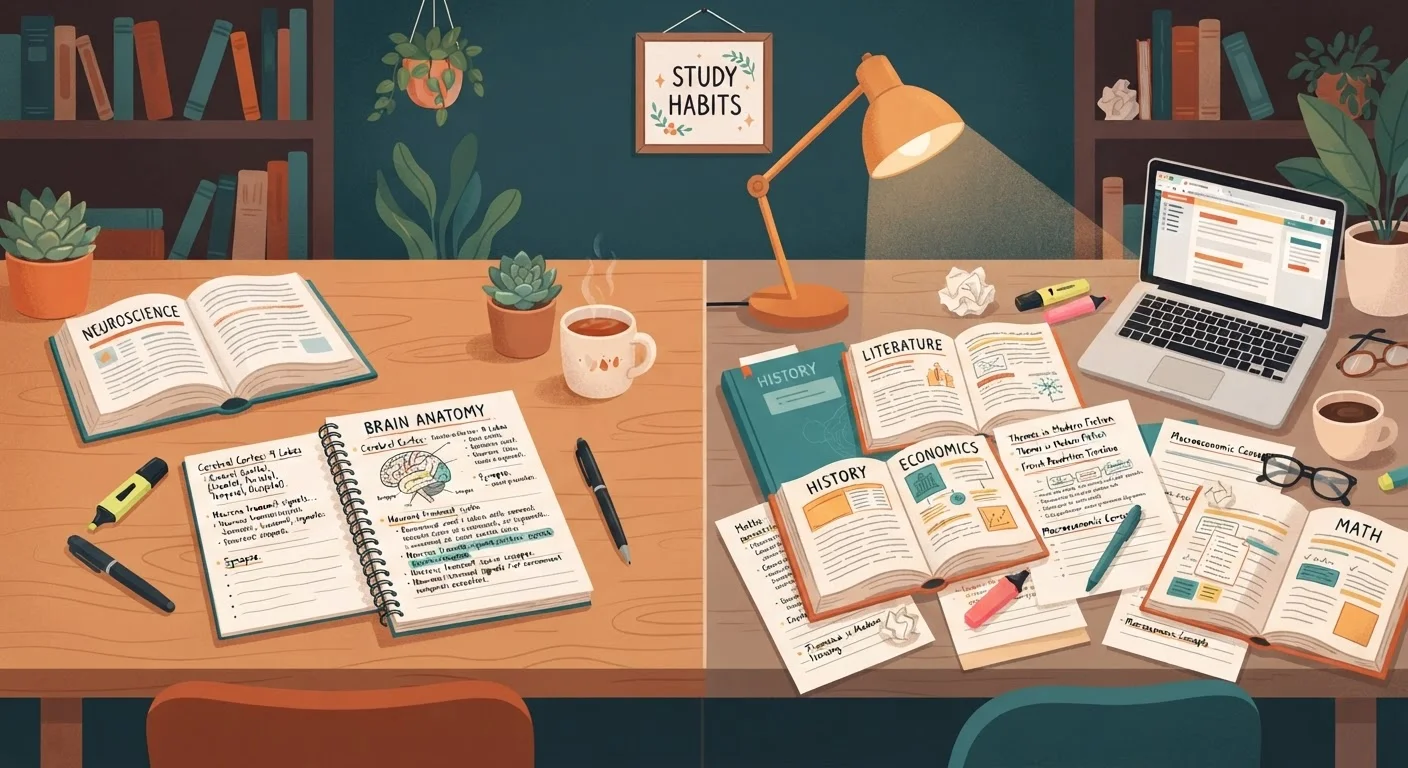
Blocked practice means studying one topic, skill, or problem type in a concentrated block before moving to the next. For example, a language learner might spend an entire session on verb conjugations, then a separate session on vocabulary. It feels organized because it is — everything is grouped neatly.
Interleaving means deliberately mixing different topics or problem types within a single session. That same language learner would alternate between conjugation drills, vocabulary exercises, and reading comprehension in the same sitting. It feels messier, and that discomfort is exactly the point.
Both methods are ways of organizing what you practice, as distinct from when you practice — a separate dimension covered in depth in our guide to spaced repetition.
Why Blocked Practice Feels Right but Often Falls Short
Blocked practice dominates traditional schooling because it produces immediate performance gains. After 30 minutes of solving the same type of algebra problem, you will solve those problems faster — a measurable, satisfying signal of progress.
The problem is that this fluency is largely illusory. Because every problem in a block shares the same structure, your brain never has to identify which approach to use — it just applies the same routine on autopilot. Researchers sometimes call this the "fluency illusion": performance during practice outpaces actual learning.
When the same learner later encounters a mixed problem set — the kind found on real exams or in real work — accuracy tends to drop sharply. The brain learned how to execute a procedure but not when to reach for it.
| Blocked Practice | Interleaving | |
|---|---|---|
| Session feel | Smooth and organized | Challenging and uncertain |
| Short-term performance | High — rapid visible gains | Lower — progress feels slower |
| Long-term retention | Weaker — fades faster | Stronger — more durable |
| Skill transfer to new contexts | Limited | Substantially better |
| Best stage to use | First exposure to new material | After basic familiarity is established |
| Cognitive demand | Lower — routine application | Higher — requires type identification |
The Evidence for Interleaving
Cognitive scientists Robert Bjork and Elizabeth Bjork have described interleaving as one of several "desirable difficulties" — conditions that slow immediate performance but accelerate long-term learning. Studies across mathematics, music, medicine, and sport have found that interleaved practice typically produces better retention and transfer than blocked practice, even when learners feel they are learning less during the session.
A widely cited study by Doug Rohrer and colleagues found that students who practiced math problems in interleaved sets outperformed blocked-practice students on a delayed test by a substantial margin, despite similar performance immediately after practice. The mechanism appears to involve two processes: learners must identify the problem type before solving it, and frequent topic-switching strengthens the memory traces for each concept.
~215%
Interleaving advantage on delayed tests
Research by Rohrer and colleagues found interleaved math practice led to roughly double the accuracy of blocked practice on tests given one month after study.
~70%
Learners who prefer blocked practice
Studies on metacognition suggest most learners rate blocked practice as more effective despite evidence pointing the other way, reflecting the fluency illusion.
Interleaving pairs particularly well with the formats discussed in our comparison of online courses and self-directed learning, since self-directed learners have the flexibility to design their own mixed sessions.
How to Put Interleaving Into Practice
Switching to interleaved study does not require a complete overhaul of your schedule. A few practical approaches:
- Mix problem types within a single session. If you are studying statistics, alternate between calculating means, interpreting graphs, and writing probability statements rather than exhausting one type before moving on.
- Rotate subjects across days. Instead of dedicating Monday entirely to Topic A, cycle through A, B, and C each day in shorter blocks. This also functions as built-in spaced practice — see our side-by-side look at spaced repetition vs. massed practice for how the two strategies complement each other.
- Use a brief blocked introduction for new material. When a concept is genuinely unfamiliar, a short blocked orientation — perhaps one focused session — can reduce cognitive overload before interleaving begins.
- Embrace the difficulty signal. Feeling uncertain about which approach to apply is not a sign that interleaving is failing; it is the mechanism through which deeper encoding occurs.
For learners with limited time, these methods fit naturally into short daily sessions — a topic explored in our guide to micro-learning for busy adults.