
The Science of Spaced Repetition: Why Spreading Out Study Sessions Beats Cramming

Key Takeaways
- Reviewing material at increasing intervals dramatically improves long-term retention compared to cramming.
- The spacing effect is one of the most replicated findings in cognitive psychology.
- Forgetting a little before reviewing actually strengthens memory more than re-reading while the content is still fresh.
- Spaced repetition works for language learning, professional concepts, and almost any factual knowledge.
- Even simple paper-based flashcard systems can capture most of the benefit without specialized software.
Spaced Repetition
Spaced repetition is a learning strategy in which you review material at gradually increasing intervals over time, rather than all at once. Instead of studying something repeatedly in a single session, you revisit it after a day, then a few days later, then a week, and so on. This approach works with how your brain naturally consolidates memories, making information easier to retain long-term.
The method is grounded in the 'spacing effect,' first documented by Hermann Ebbinghaus in the 1880s and since replicated extensively in cognitive psychology research. Modern implementations often use algorithms to calculate optimal review intervals based on how well a learner recalls each item.
Why Your Brain Forgets — and Why That's Actually Useful
In 1885, German psychologist Hermann Ebbinghaus charted what he called the forgetting curve — a graph showing how quickly newly learned information fades without reinforcement. His core finding: without any review, people forget roughly half of new material within a day or two. This sounds discouraging, but Ebbinghaus also discovered the antidote. Each time you successfully retrieve a memory just before it fully fades, you reset and strengthen it.
Modern neuroscience has refined this picture. Memory consolidation — the process by which short-term memories become stable, long-term ones — depends heavily on sleep and repeated neural activation over time. When you encounter a piece of information and then revisit it later, your brain rebuilds the neural pathway associated with it, making it more durable. The slight struggle of retrieval, sometimes called desirable difficulty, is precisely what produces stronger encoding.
This is why forgetting a little before you review is not a problem — it is, counterintuitively, part of the mechanism. A memory that requires mild effort to reconstruct gets encoded more deeply than one that is simply re-read while still fresh.
The forgetting curve is not fixed
Ebbinghaus documented the forgetting curve using meaningless syllables, which fade faster than meaningful, well-connected information. In practice, material that you understand conceptually and connect to existing knowledge will persist longer than isolated facts. This means building background knowledge in a subject also makes spaced repetition more effective over time.
The Spacing Effect: What the Research Shows
The spacing effect — the finding that distributed practice produces better long-term retention than massed practice — is one of the most consistently replicated results in cognitive psychology. Studies across decades and subject areas confirm that learners who space their reviews outperform those who cram, particularly when tested days or weeks later rather than immediately after studying.
A frequently cited body of research by psychologists Robert Bjork and Elizabeth Bjork distinguishes between storage strength (how well something is encoded in memory) and retrieval strength (how easily it comes to mind right now). Cramming boosts retrieval strength temporarily but does little for storage strength. Spaced repetition builds both over time.
~50%
Information forgotten within two days without review
Ebbinghaus's forgetting curve research, replicated across multiple studies, suggests roughly half of new material is lost within 48 hours without any reinforcement.
Up to 2x
Retention advantage of spaced over massed practice
Multiple laboratory studies in cognitive psychology have found that spaced practice can approximately double long-term retention compared to equivalent time spent in a single massed session.
For a deeper look at how retrieval itself affects memory, see our article on active recall vs. passive review. Spaced repetition pairs especially well with active recall — testing yourself rather than simply re-reading — because it combines optimal timing with optimal effort.
How to Apply Spaced Repetition in Practice
The core principle is straightforward: after learning something new, schedule a review before you forget it completely, then extend the gap with each successful recall. Here is a practical framework:
- Day 1: Learn the material. At the end of your session, briefly test yourself without looking at your notes.
- Day 2: Review the material. Correct anything you missed, then note which items felt easy and which felt hard.
- Day 5–7: Review again. Prioritize items that were difficult in the previous session.
- Day 14–21: A final review before the gap extends to a month or longer.
Items you recall easily get pushed further out in the schedule. Items you struggle with get reviewed sooner. This self-adjusting loop is what makes the system efficient — you spend the most time on what you know least.
If you are time-pressed, spaced repetition pairs naturally with short, frequent study windows. Our guide on micro-learning for busy adults explains how to structure these sessions so they compound into meaningful retention over weeks.
Start with just three review dates
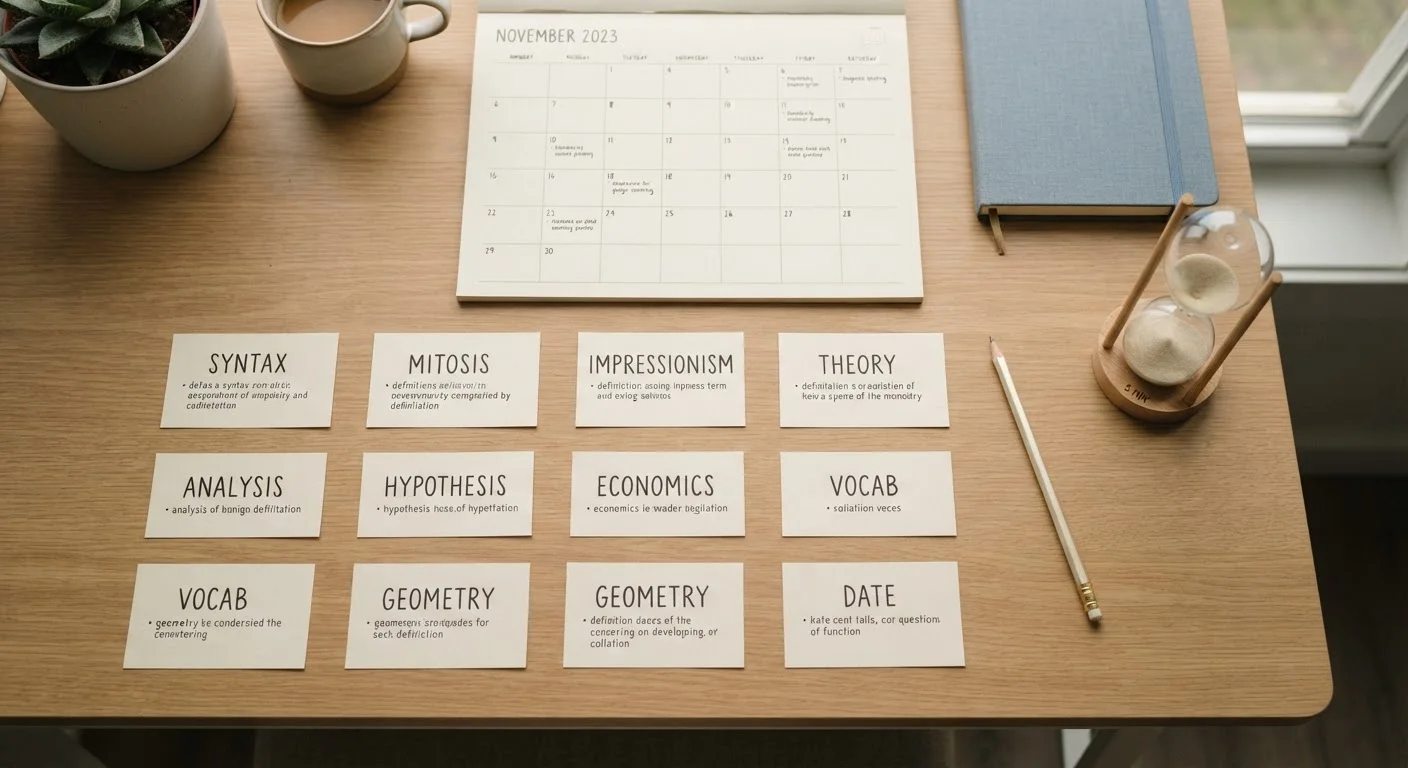
If a full spaced repetition schedule feels complicated, start small: when you learn something new, write down three future review dates — tomorrow, one week from now, and one month from now. This captures the most important intervals without requiring any special system or software. Once the habit feels natural, you can refine the spacing from there.
Where Spaced Repetition Fits Into a Broader Learning Strategy
Spaced repetition is powerful, but it works best as one part of a broader approach to learning. It is particularly effective for building a stable knowledge base — facts, vocabulary, formulas, concepts — that you then apply in practice. For skills that require procedural fluency or creative thinking, other strategies complement it well.
For example, consider how you organize topics within each study session. Our article on interleaving vs. blocked practice explores why mixing subjects within a session can deepen learning, even when it feels harder. Combining interleaved sessions with a spaced schedule gives you both the retrieval benefits of spacing and the discrimination benefits of variety.
It is also worth noting that how well your brain consolidates memories is influenced by factors outside the study session itself. Sleep, in particular, plays a documented role in memory consolidation — a point covered in more detail in our piece on how lifestyle factors shape your capacity to learn. Spacing your sessions across days naturally allows sleep cycles to do consolidation work that a single late-night cram session cannot replicate.
The bottom line: spaced repetition is not a silver bullet, but it is among the most evidence-supported habits a learner can build. Applied consistently and combined with active retrieval and healthy lifestyle foundations, it gives your memory the conditions it needs to hold onto what you work hard to learn.