

Key Takeaways
- Eating affordably while traveling is about strategy, not sacrifice — quality food is often cheap at local markets and neighborhood spots.
- Shifting your main meal to midday can cut costs significantly, since lunch menus are typically priced lower than dinner equivalents.
- Booking accommodations with kitchen access lets you prepare simple meals and dramatically reduces your daily food spend.
- Avoiding tourist-district restaurants is one of the highest-impact changes you can make to your travel food budget.
- A modest daily food budget established before departure helps you make smarter, less impulsive choices on the road.
What you will need
Why Food Costs Are Worth Planning Carefully
For most travelers, food ends up being the second- or third-largest trip expense after transportation and lodging. Unlike flights or hotels — which are booked in advance with clear costs — food spending happens in dozens of small, unconsidered decisions throughout each day. That pattern makes it easy to overspend without noticing until you check your account at the end of the trip.
The good news is that food is also one of the most flexible budget categories. Unlike a flight you've already booked, you can adjust your food strategy in real time. A few deliberate habits — where you eat, when you eat your largest meal, and how much you prepare yourself — can meaningfully change what you spend without changing the quality of the experience. In fact, the most affordable options are frequently the most authentic ones.
This is especially relevant for travelers exploring destinations where currency and purchasing power differ from the US. Understanding how purchasing power parity works can help you identify destinations where your food dollar genuinely stretches further.
Use Lunch as Your Main Event
In many countries and US cities alike, the same dish served at dinner costs noticeably more than at lunch. Many restaurants offer a fixed-price lunch menu — sometimes called a 'prix fixe' or 'menu del día' — that includes multiple courses at a fraction of the dinner price. Making lunch your largest meal of the day is one of the most consistent ways to eat well for less.
Common Pitfalls That Inflate Food Spending on the Road
Most travel food overspending follows predictable patterns. The first is convenience eating — grabbing food wherever you happen to be when you're hungry, which typically means tourist-area cafés or airport-adjacent spots with premium pricing. The second is beverage spending, particularly alcohol and single-serve bottled drinks, which can quietly double a meal bill. The third is skipping breakfast at the accommodation and buying it out every morning, which adds a full restaurant meal cost to each day.
Recognizing these patterns in advance lets you build simple countermeasures into your trip. Pack snacks for transit days. Front-load your eating at midday. Step away from the main square before sitting down. These aren't deprivations — they're the same strategies that frequent travelers use to keep food expenses reasonable without eating less well.
Tourist Areas Carry a Significant Price Premium
Restaurants within a block or two of major landmarks often charge 30–50% more than comparable places a short walk away. The food quality is not necessarily better — you're paying for foot traffic and location. Walking even five minutes off the main drag frequently reveals the spots where locals actually eat, at prices that reflect it.
For a broader look at what budget travel actually involves — versus common misconceptions — our budget travel myths article is worth reading before your next trip.
Research Food Safety Before You Go
Eating local street food and market fare is generally safe and enjoyable, but food safety standards vary by destination. Before traveling abroad, check official government travel advisories for guidance on tap water, raw produce, and food handling practices. When in doubt, choose vendors with high turnover and visibly prepared food — and always verify entry and health requirements with official sources before departure.
How to Follow These Steps in Practice
The steps below are designed to work together, not in isolation. You don't need to apply every one on every day of your trip. Instead, think of them as a toolkit: use the market strategy on quieter days, shift to a fixed-price lunch on days with more activity, and reserve restaurant dinners for occasions worth the spend.
What you will need
Offline maps app
Navigate to local markets and neighborhood restaurants without relying on expensive data roaming.
Small cooler bag or insulated tote
Store market purchases, leftovers, or packed snacks during day trips to avoid impulse food spending.
Accommodation with kitchen or kitchenette
Enables you to prepare simple breakfasts and light dinners, significantly reducing daily food costs.
Set a realistic daily food budget before you leave
Food costs are one of the most variable — and underestimated — categories in any travel budget. Before departure, research the average meal prices at your destination: a quick search for typical restaurant costs in your target city gives you a workable baseline. Then set a per-day food target and track against it. Without this anchor, spending tends to drift upward each day. For broader budget framing, see our guide to building a realistic travel budget.
Prioritize local markets over restaurants for breakfast and snacks
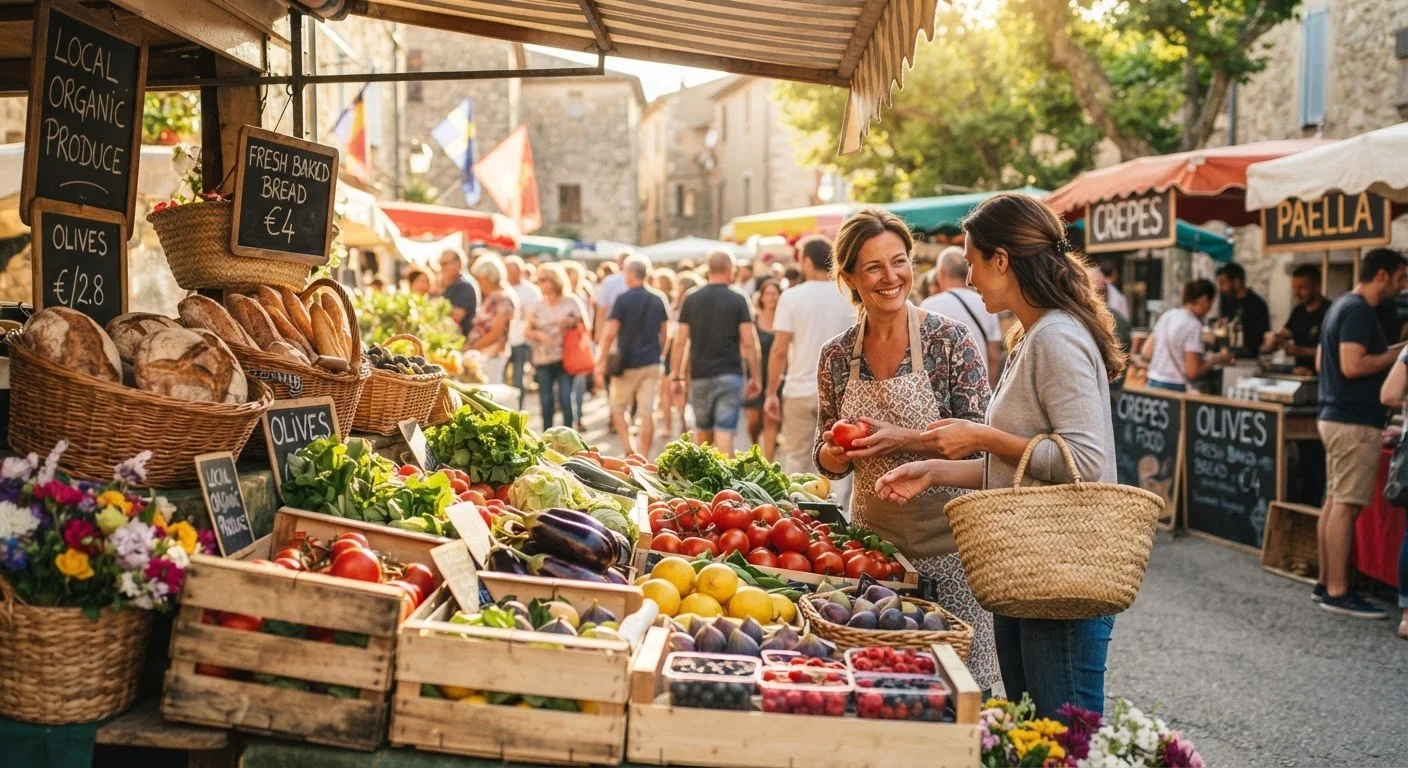
Public markets — whether a permanent indoor food hall or a weekly farmers market — are consistently the most affordable place to eat like a local. Pick up fresh fruit, bread, local cheeses, or prepared foods for a fraction of café prices. This approach also puts you in direct contact with the food culture of a place, which is often the most memorable part of travel anyway.
Make lunch your largest and most deliberate meal
Midday dining is almost always less expensive than the equivalent dinner at the same type of restaurant. Seek out fixed-price lunch specials, which are common in European, Latin American, and many Asian restaurant cultures. Eating a satisfying, full midday meal means you can get by with a lighter — and cheaper — dinner, such as market leftovers or a simple prepared snack.
Seek out neighborhoods where locals actually eat
Foot traffic around tourist attractions drives up prices without improving quality. Identify one or two residential neighborhoods in your destination — areas with grocery stores, local bakeries, and small family restaurants. Spending time in these areas naturally shifts your food spending toward lower-cost, higher-authenticity options. This pairs well with the strategies in our guide to experiencing a city like a local.
Use self-catering for at least one meal per day when possible
If your accommodation has a kitchen, a mini-fridge, or even a reliable microwave, you have the infrastructure to prepare at least one simple meal per day. A breakfast of local yogurt, fruit, and bread bought at a nearby market costs a fraction of a café breakfast. Over a week-long trip, one self-catered meal per day can save a meaningful amount — money that goes toward experiences instead.
Stay hydrated without buying bottled water repeatedly
Beverage costs add up faster than most travelers expect. A reusable bottle that you refill from safe tap sources — or from filtered water stations increasingly common in airports and city centers — eliminates a recurring daily expense. Where tap water isn't safe, purchasing large-format bottles at a grocery store is substantially cheaper per liter than buying individual bottles at restaurants or tourist shops.
If you're planning a domestic road trip, these same principles apply — our budget road trip planning guide covers how to build a realistic daily food allowance into an overland itinerary.