

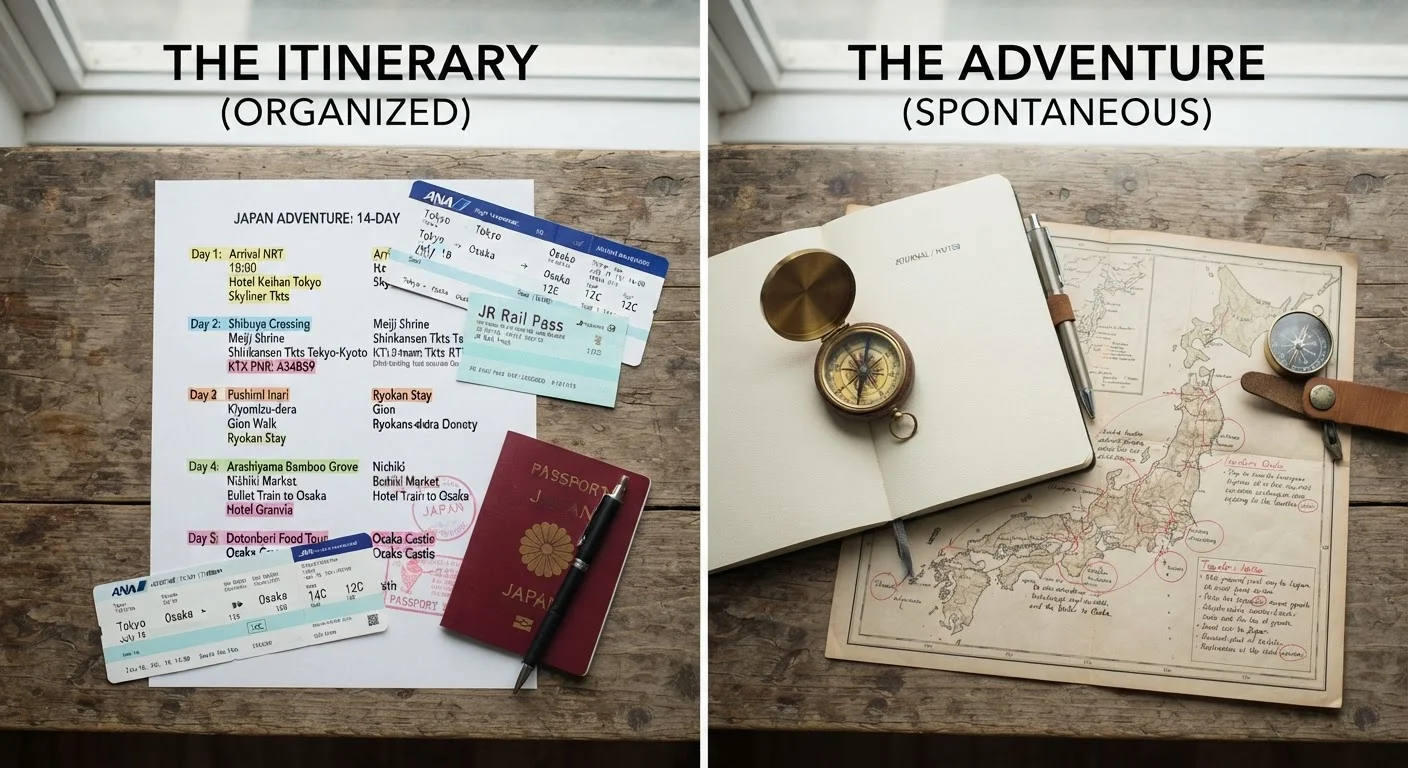
Key Takeaways
- Fixed itineraries reduce decision fatigue and secure access to high-demand attractions well in advance.
- Flexible itineraries allow you to respond to weather, local tips, and unexpected opportunities as they arise.
- Trip length, destination type, and group size are the strongest predictors of which style will serve you better.
- A hybrid approach — anchoring key logistics while leaving daily plans open — works well for many travelers.
- Neither style is inherently superior; the right choice depends on your specific trip context and personal travel preferences.
Option A
Fixed Itinerary
The structured, pre-planned approach to travel.
Best for: Travelers with limited time, complex logistics, or high-demand destinations who want certainty and maximum efficiency.
Option B
Flexible Itinerary
The open-ended, adapt-as-you-go travel style.
Best for: Travelers who prioritize discovery, spontaneity, and the freedom to follow local recommendations in real time.
If you're visiting a major city with must-see, timed-entry attractions
Fixed Itinerary
Popular museums, national parks, and landmark sites often require advance reservations. A fixed schedule ensures you don't miss out due to sold-out slots.
If you're exploring a region with multiple possible routes and no hard deadlines
Flexible Itinerary
Open destinations — rural areas, scenic drives, small coastal towns — reward spontaneity. Staying an extra night or changing direction adds real value.
If you're traveling with a group of three or more people
Fixed Itinerary
Coordinating preferences across a group is significantly easier when core logistics are agreed and locked in before departure.
If you're a solo traveler on an extended trip of two or more weeks
Flexible Itinerary
Long trips benefit from adaptability — energy levels shift, you discover places worth lingering, and rigid schedules can create unnecessary pressure.
If you're a first-time visitor to an unfamiliar or logistically complex destination
Fixed Itinerary
Pre-planning removes the cognitive load of figuring out transportation and accommodation on the ground, letting you focus on the experience itself.
What Each Planning Style Actually Means
A fixed itinerary is a day-by-day schedule created before you depart — with accommodation booked, attractions reserved, and transportation arranged in sequence. Every night, you know exactly where you'll sleep and what's on the agenda the next morning. A flexible itinerary, by contrast, might include a flight in and a flight out, with the days in between left largely open for real-time decisions.
In practice, most travelers sit somewhere between these two extremes. Understanding what each approach delivers — and where each creates friction — helps you calibrate before you pack. For a broader look at how planning layers fit together, see The Anatomy of a Well-Planned Trip.
| Criterion | Fixed Itinerary | Flexible Itinerary |
|---|---|---|
| Planning effort | High upfront | Low upfront, ongoing |
| Accommodation security | Booked in advance | Booked day-of or short notice |
| Responsiveness to change | Low — changes disrupt chain | High — built-in adaptability |
| Best for group travel | Yes — reduces negotiation | Challenging with larger groups |
| Budget predictability | High — costs known in advance | Variable — costs emerge en route |
| Suits short trips | Yes — maximizes limited time | Less efficient for short windows |
| Suits long trips | Can feel rigid over many weeks | Yes — allows natural rhythm |
| Discovery potential | Limited by schedule | High — unplanned moments possible |
The Case for Committing to a Schedule
Fixed itineraries deliver measurable advantages in specific contexts. When a destination has limited access — think permit-required wilderness areas, timed museum entry, or peak-season accommodation that books months out — pre-planning is less a preference and more a practical necessity.
There's also a cognitive benefit. Research consistently shows that decision fatigue is real: the more choices you make in a day, the lower the quality of later decisions. A pre-set schedule eliminates daily logistics debates, which matters especially when traveling with others. See Organizing a Group Trip Without the Chaos for strategies on keeping shared decisions manageable.
Fixed planning also supports tighter budgets. When you know your accommodation and transport costs in advance, you can set realistic daily spending limits without guessing. This connects directly to the principles covered in Travel On a Budget.
62%
Travelers who book accommodation before departure
According to Statista consumer travel surveys, the majority of leisure travelers secure lodging in advance, reflecting the enduring pull of planning certainty.
2–3x
Higher likelihood of attraction sell-outs at peak season
Travel industry reporting consistently notes that timed-entry slots at top-tier sites can sell out weeks or months ahead during peak travel periods.
The Case for Leaving Room to Wander
Flexible itineraries unlock a different kind of travel value: the ability to stay somewhere longer when it surprises you, leave sooner when it doesn't, and follow a local's recommendation without rearranging a cascade of bookings. This responsiveness is particularly valuable on longer trips, where rigid schedules can start to feel like obligations rather than opportunities.
Weather is a powerful argument for flexibility. A heavily booked outdoor itinerary in a region with unpredictable conditions is a recipe for frustration. Open days act as natural buffers. The same logic applies to physical recovery — travel is tiring, and rest days are easier to absorb when nothing is pre-booked around them.
Flexible travel also tends to reduce the pressure of "optimizing" every hour, which is a common source of post-trip disappointment. Many experienced travelers report that unplanned moments — a market stumbled upon, a conversation that turned into an invitation — are what they remember most.
How to Choose — and How to Blend Both
Three questions help clarify which approach fits your specific trip:
- How time-constrained are you? A five-day trip to a bucket-list city warrants more structure than a two-week open-ended journey.
- How demand-sensitive is your destination? High-traffic destinations with limited capacity (major national parks, iconic museums) reward advance booking. Lesser-visited places are far more forgiving.
- What's your group configuration? Solo travelers can pivot on a whim; groups of four need consensus, and consensus is easier on a fixed framework.
The practical middle ground — sometimes called a semi-structured itinerary — involves booking the non-negotiables (flights, the first and last nights of accommodation, any timed reservations) while leaving daily activities and intermediate nights deliberately open. This approach captures the security of a fixed plan without surrendering the adaptability of a flexible one.
Digital tools can help you manage whichever approach you choose. Trip-Planning Tools Worth Understanding breaks down itinerary builders, map apps, and other categories worth knowing about before you start organizing. And just as your itinerary style should match your trip, your luggage choice should match your travel habits — flexibility in one area often pairs naturally with flexibility in another.