

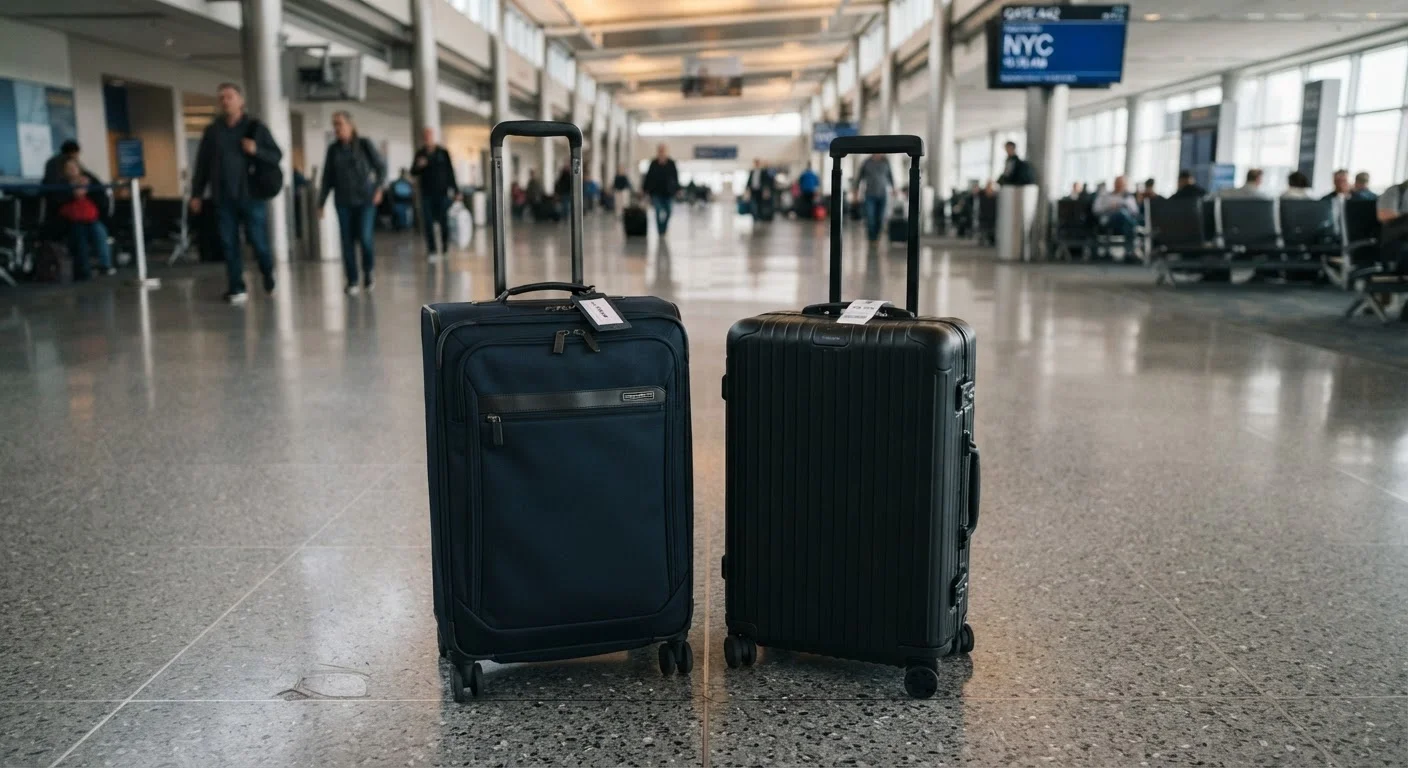
Key Takeaways
- Soft-sided bags are generally lighter and more compressible, making them better for carry-on travel.
- Hard-shell cases offer superior protection for fragile contents and resist water penetration more effectively.
- Hard shells tend to weigh more, which can eat into checked baggage allowances.
- Soft-sided bags usually offer exterior pockets for quick access; hard shells typically do not.
- Neither construction is universally superior — the right choice depends on your specific trip type and packing habits.
Option A
Soft-Sided Luggage
The flexible, lightweight workhorse.
Best for: Travelers who need to squeeze bags into tight overhead bins, overstuff occasionally, or move frequently between destinations.
Option B
Hard-Shell Luggage
The structured, protective choice.
Best for: Travelers carrying fragile items, checked bags regularly, or anyone who prioritizes a secure, weather-resistant shell.
If you primarily travel carry-on only
Soft-Sided Luggage
Soft bags flex to fit irregular overhead bin shapes and can be compressed to meet tight size restrictions more easily than rigid shells.
If you regularly check your luggage
Hard-Shell Luggage
Hard shells resist crushing, rough handling, and moisture during baggage handling far better than fabric constructions.
If you're packing fragile or valuable items
Hard-Shell Luggage
The rigid exterior provides a consistent protective barrier that soft fabric simply cannot match under pressure or impact.
If you're traveling to multiple destinations with varied transit
Soft-Sided Luggage
Lightweight construction and flexible storage make soft bags easier to maneuver across trains, buses, and smaller accommodations.
If organization and quick access matter most
Soft-Sided Luggage
External zippered pockets let you retrieve documents, chargers, or snacks without opening the main compartment.
Construction Basics: What You're Actually Choosing Between
Soft-sided luggage is typically made from nylon, polyester, or ballistic fabric stretched over an internal frame — or no rigid frame at all. Hard-shell cases use molded polycarbonate, ABS plastic, or aluminum to create a fully rigid exterior. Both constructions have evolved significantly, so the real differences come down to performance trade-offs rather than quality.
Understanding those trade-offs starts with how each construction responds to stress. Soft bags absorb impact by flexing; hard shells deflect it by maintaining shape. That single distinction flows through nearly every practical difference between the two.
If you're still deciding between a rolling suitcase and a backpack format altogether, see our comparison of rolling suitcases and backpacks before settling on construction type.
| Criterion | Soft-Sided Luggage | Hard-Shell Luggage |
|---|---|---|
| Typical empty weight | Lighter (often 6–7 lbs carry-on) | Heavier (often 8–10 lbs carry-on) |
| Flexibility / compressibility | Flexes to fit tight spaces | Fixed rigid volume |
| Impact protection | Moderate — absorbs by flexing | High — deflects and holds shape |
| Weather resistance | Limited — water-resistant coatings vary | Better — shell repels surface moisture |
| External pockets | Usually multiple external pockets | Rarely any external pockets |
| Security options | External zipper locks (add-on) | Integrated TSA-approved locks common |
| Overhead bin fit | Can compress to fit | Fixed dimensions — less forgiving |
| Durability over years | Fabric can fray or tear | Shell can crack under severe impact |
Weight, Flexibility, and Packing Capacity
Soft-sided bags consistently come out lighter than comparable hard-shell cases. A typical carry-on soft bag might weigh 6–7 lbs empty, while a similarly sized hard-shell polycarbonate case often runs 8–10 lbs. That difference adds up quickly when airlines enforce strict checked-bag weight limits.
Fabric construction also means soft bags can be overpacked slightly — the exterior stretches to accommodate an extra layer or a bulky souvenir. Hard shells have a fixed interior volume; once the shell is closed, that's your limit. On the upside, hard shells with spinner wheels are easier to roll on smooth surfaces and tend to maintain their shape over thousands of miles.
For travelers committed to carry-on-only strategies, the flexibility of a soft bag is often decisive. Our carry-on vs. checked luggage guide explains how your bag choice interacts with airline policies and trip length.
~2–4 lbs
Typical weight difference per bag size
Industry comparisons consistently show hard-shell cases run heavier than soft-sided equivalents in the same volume category, based on manufacturer specifications.
50 lbs
Standard checked bag weight limit (most US carriers)
A heavier hard-shell bag can meaningfully reduce the clothing and gear you can pack before hitting airline weight limits.
~22×14×9 in
Typical carry-on size limit (US domestic airlines)
Soft bags can flex slightly below this threshold; hard shells that measure right at the limit may be gate-checked if bins are full.
Durability, Security, and Weather Resistance
Hard-shell cases have a clear advantage in protection. Molded polycarbonate resists crushing under heavy baggage loads and keeps contents intact during rough cargo handling. Most hard shells also include a TSA-approved lock integrated into the zipper or latch system, offering a modest deterrent against opportunistic theft.
Soft-sided bags are more vulnerable to cuts or punctures, but high-denier nylon and reinforced stitching close much of the gap for everyday travel. Where soft bags genuinely lag is weather resistance. While some use water-resistant coatings, a hard shell handles rain on tarmacs and wet cargo holds considerably better.
Neither construction is truly waterproof — most zippers on any luggage type will let moisture in under sustained exposure. If you're heading somewhere with heavy rainfall or unpredictable weather, consider packing essentials in dry bags inside either case.
Choosing Based on Your Travel Patterns
The most practical question isn't which construction is objectively better — it's which one matches the trips you actually take. Frequent business travelers making short domestic hops with carry-ons tend to favor soft-sided bags for their lighter weight and overhead bin flexibility. Travelers who check bags for longer international trips often prefer hard shells for the peace of mind they provide during extended cargo handling.
Your packing habits matter too. If you tend to pack items that don't need much protection and you value the ability to slip an extra jacket in at the last minute, soft-sided gives you room to adapt. If you travel with a laptop, camera gear, or fragile gifts, a hard shell's rigid protection is worth the weight penalty.
Pairing the right construction with a smart packing strategy compounds the benefit. Our guide to packing light vs. packing for every scenario can help you determine what you actually need to bring before you choose a bag to put it all in.
Polycarbonate vs. ABS: A Quick Note
Within hard-shell luggage, polycarbonate is generally considered more durable and flexible than ABS plastic — it absorbs impact rather than cracking outright. ABS shells tend to be more affordable but can split under heavy stress. Aluminum hard shells are the most durable option but also the heaviest, typically reserved for professional or long-haul use.