

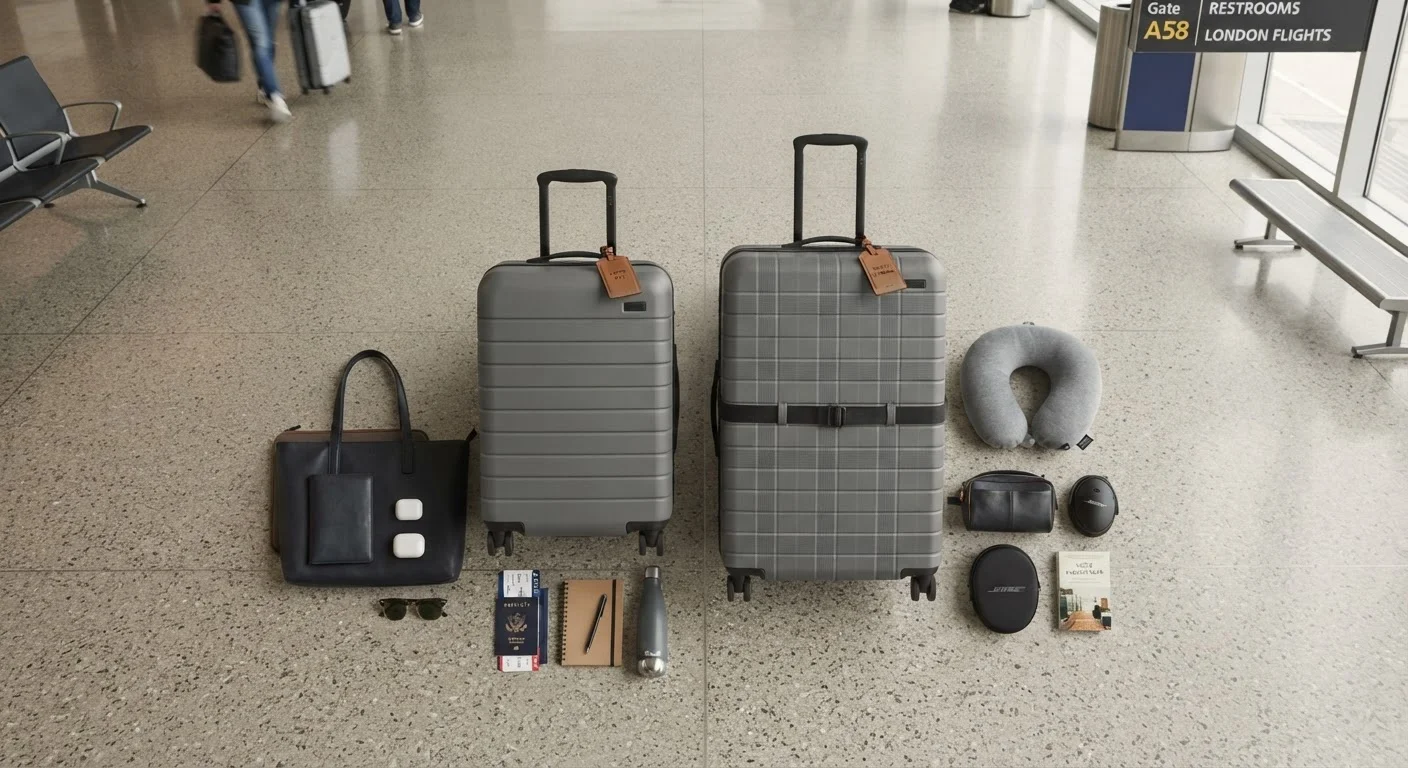
Key Takeaways
- Carry-on bags eliminate checked bag fees and reduce time spent at baggage claim.
- Checked luggage is essential when packing bulky, sharp, or liquid-heavy items restricted in cabin bags.
- Trip length, destination type, and airline rules are the three biggest factors in choosing your bag strategy.
- Many travelers benefit from a hybrid approach: one carry-on plus a personal item, or a carry-on checked at the gate.
- Overpacking a carry-on creates its own costs — gate-check fees, overhead bin scrambles, and physical strain.
Option A
Carry-On Luggage
The agile, fee-free option for streamlined travelers.
Best for: Short trips, frequent flyers, and anyone who prioritizes speed and flexibility at the airport.
Option B
Checked Luggage
The spacious, versatile choice for longer or more complex journeys.
Best for: Extended trips, specialty gear, or destinations requiring formal attire and a wider range of clothing.
If you're taking a weekend trip or a short domestic flight
Carry-On Luggage
A well-packed carry-on covers 2–4 days comfortably while saving you bag fees and time at the airport.
If you're traveling internationally for two or more weeks
Checked Luggage
Longer trips typically demand outfit variety, formal wear, or souvenirs — space that a carry-on simply can't provide.
If your trip involves outdoor activities or specialty equipment
Checked Luggage
Hiking gear, ski equipment, snorkeling fins, or camping supplies won't fit in a cabin bag and often require dedicated checked cases.
If you're a frequent business traveler bouncing between cities
Carry-On Luggage
Speed matters on multi-leg trips; a carry-on keeps you moving without waiting at carousels or risking delayed bags.
If your itinerary mixes urban hotels with rural or remote stays
Carry-On Luggage
Smaller bags are easier to manage across varying transport modes — trains, taxis, and cobblestone streets included.
The Real Cost Difference Beyond Bag Fees
Most travelers frame the carry-on vs. checked luggage debate around fees, and for good reason. Many domestic carriers charge per checked bag each way, and those costs add up fast on multi-leg itineraries. But the financial picture is more nuanced than a single line item.
Consider time as a cost. Checking a bag typically adds 15–30 minutes at check-in and another 15–30 minutes at baggage claim on arrival. On a packed travel day, that's an hour of your trip absorbed by logistics. Frequent travelers often report that reclaiming their time at the airport is worth as much as any fee savings.
On the flip side, overstuffing a carry-on creates its own financial exposure. Gate-check fees — charged when overhead bin space runs out — can rival standard checked bag prices, and they're paid at the gate with no time to rethink your packing strategy. See our honest cost breakdown for budget travelers for a fuller look at how these trade-offs play out by trip type.
| Criterion | Carry-On Luggage | Checked Luggage |
|---|---|---|
| Typical bag fees | Usually none (cabin bag) | Varies by airline and route |
| Time at airport | Faster check-in and exit | Adds time at check-in and claim |
| Packing capacity | Limited — suits 1–6 days | High — suits extended trips |
| Liquids flexibility | Restricted by TSA 3-1-1 rule | Full-size liquids permitted |
| Sporting or bulky gear | Not feasible for most gear | Accommodates specialty items |
| Risk of lost/delayed bag | None — bag stays with you | Small but real risk |
| Mobility between transports | Easy on trains, buses, metros | Bulkier in transit situations |
What You Can and Can't Pack in Each
The TSA's 3-1-1 liquids rule — containers of 3.4 oz (100ml) or less, in a single quart-sized bag — is the constraint most carry-on travelers hit first. It limits toiletry flexibility significantly, which matters on trips longer than a week or to destinations where resupply is inconvenient.
Checked bags eliminate that constraint but introduce a different one: prohibited items shift by category. Lithium batteries above a certain wattage, spare lithium-ion battery packs, and certain electronics must travel in the cabin, not below. Before finalizing any packing list, verify current TSA and airline guidelines directly, as rules can change.
Sharp tools, sporting equipment, full-size liquids, and pressurized containers are examples of items that travel better — or can only travel — in checked bags. If your destination involves diving gear, ski equipment, or a bicycle, a checked bag isn't a luxury; it's a requirement. For guidance on evaluating what each piece of gear actually contributes to your trip, see Travel Gear Essentials.
~1 in 170
Checked bags mishandled per passenger
According to SITA's Baggage IT Insights report, airline baggage mishandling rates have declined significantly, but delays and losses remain a measurable risk for checked bag travelers.
45+ min
Average time saved per trip with carry-on only
Travel logistics analysts estimate that avoiding bag check and baggage claim can save the average traveler 30–60 minutes per round trip, depending on airport and airline.
3.4 oz
Max liquid container size in carry-on (TSA rule)
The TSA's 3-1-1 liquids rule limits each carry-on liquid to containers no larger than 3.4 oz (100ml), a restriction that significantly shapes toiletry packing strategies.
Matching Your Bag Strategy to Your Trip
Trip length is the most reliable guide. As a general rule, most travelers can manage up to five or six days in a well-organized carry-on, especially if the destination allows for laundry access. Beyond that, checked luggage starts to make practical sense — not because you must pack more, but because outfit flexibility, weather unpredictability, and the physical toll of wearing the same rotation become real factors.
Destination type matters just as much. A city-hopping European trip with metro stations and budget airlines often punishes oversized bags with surcharges and logistical friction. A resort vacation or a rural outdoor itinerary, by contrast, may have limited luggage handling challenges but higher gear demands.
Travel style rounds out the equation. If you're the type who researches packing lists weeks in advance and genuinely enjoys the discipline of packing light, carry-on travel rewards that mindset. If you prefer not to think about clothing choices mid-trip or you're traveling with children, the extra space of a checked bag reduces day-to-day friction. Our guide to packing light vs. packing for every scenario walks through how to assess your own packing style honestly.
One underused strategy: the hybrid approach. A carry-on paired with a maximized personal item (laptop bag, tote, or daypack) often closes the volume gap without the overhead bin risk. This works especially well on trips where you'll carry a daypack at the destination anyway. For bag format comparisons, the backpack vs. rolling suitcase breakdown is a useful companion read.
Always Verify Airline Size and Weight Limits
Carry-on size allowances vary meaningfully by airline. A bag accepted as a standard carry-on on a major US carrier may be too large for a budget airline's cabin or a regional connector flight. Before travel, confirm your specific airline's current carry-on dimensions and weight limits on their official website. This is especially important on international itineraries where code-share partners may apply different rules.