

The Core Question Behind Every Packing Decision
Most packing mistakes don't happen because travelers don't know what gear exists — they happen because the decision framework is wrong. The default question is "Should I bring this just in case?" A more useful question is: "What's the realistic cost of not having this, and can I solve for it on the road?"
Travel gear falls into a handful of functional categories. Understanding what each category actually does — and where it tends to add bulk without proportional value — helps you make faster, smarter calls before you zip the bag. For a broader look at the strategic trade-offs, see Packing Light vs. Packing for Every Scenario.
The Main Gear Categories: What They Do and What to Ask
Luggage and bag systems. The container shapes everything else. A carry-on-sized bag forces discipline; a large checked bag invites filling. Key questions: Does this trip require gear that physically can't fit in a carry-on? What are the airline's actual size and weight limits? For a direct comparison of strategies, Carry-On vs. Checked Luggage walks through the real trade-offs.
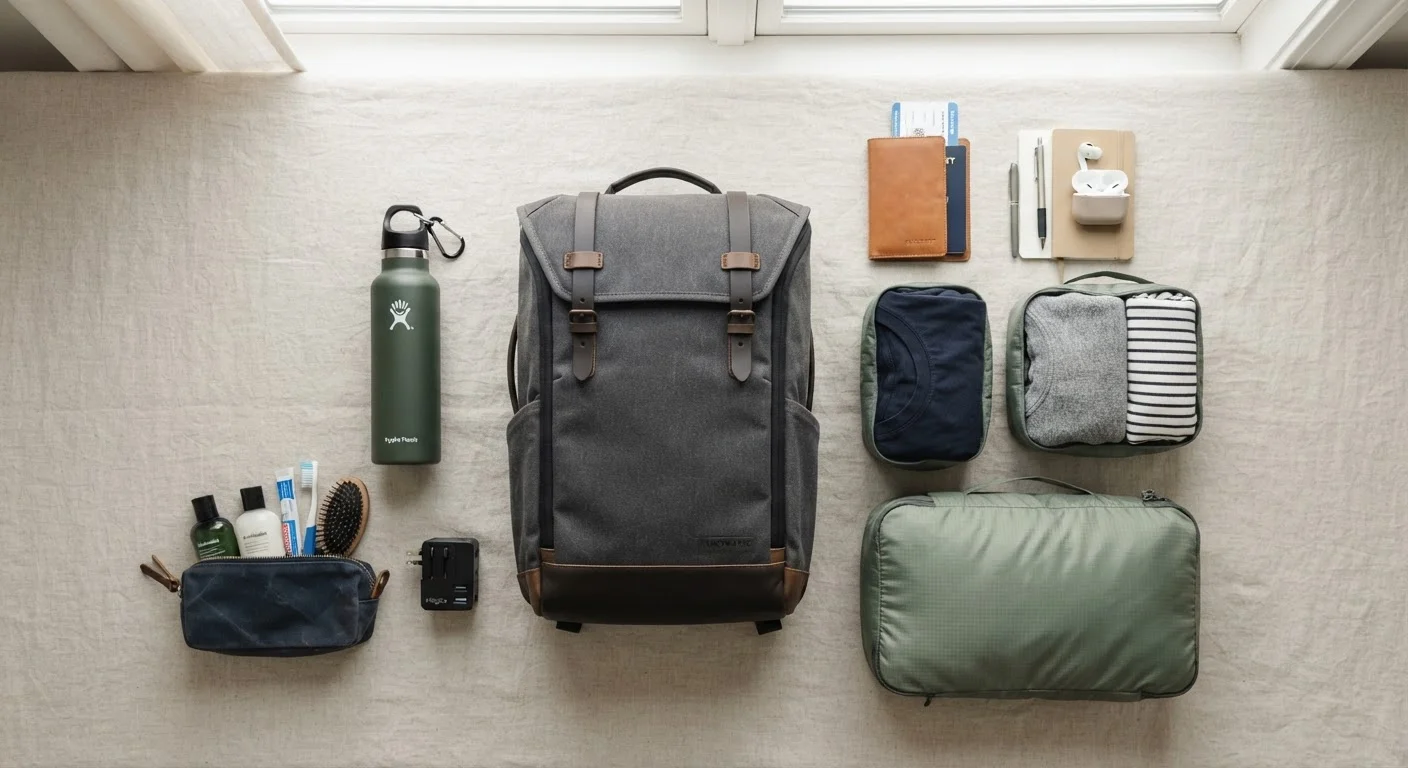
Organization systems. Packing cubes, compression sacks, and pouches reduce chaos and speed up security. They add a small amount of weight but generally return that cost in time and sanity. The practical rule: use them to separate categories (clothing, cables, toiletries), not to carry more stuff.
Clothing layers. The highest-impact category for most travelers. Merino wool and synthetic fabrics dry fast and resist odor, meaning fewer items cover more days. The trap is bringing full outfit sets rather than mixing components. A capsule approach — items that combine with each other — consistently outperforms a "one outfit per day" strategy on trips longer than three days.
Electronics and power. A universal adapter, a portable battery pack, and a single multi-port charging cable cover most needs. The weight culprits here are redundancy (two cameras, a tablet, and a laptop) and cables for every device individually. If international travel is involved, Packing for International Travel covers adapter requirements and customs considerations in detail.
Toiletries and liquids. The category most governed by external rules. TSA's 3-1-1 liquid rule applies to carry-ons, and many products can be decanted into reusable containers at significant weight savings. Solid alternatives (shampoo bars, solid sunscreen) sidestep liquid restrictions entirely. For the full breakdown, see Toiletries, TSA Rules, and the Realities of Packing Liquids.
Health and safety items. A compact first-aid kit, any prescription medications with documentation, and destination-specific items (water purification tablets for remote areas, for example) are high-value and low-weight. Over-the-counter medications available at your destination rarely need to travel with you. Always verify health entry requirements with official government sources before departure — requirements change and are not guaranteed to remain accurate at time of travel.
Packing cubes
Lightweight fabric organizers used to compartmentalize clothing and accessories inside a bag. They reduce re-packing time and help keep categories separate without adding significant weight.
3-1-1 rule
A TSA security policy requiring carry-on liquids to be in containers of 3.4 oz (100ml) or less, all fitting inside one quart-sized clear zip-top bag, with one bag per passenger.
Capsule wardrobe
A travel clothing strategy in which a small number of versatile, mix-and-match pieces replace a larger set of single-purpose outfits. Reduces total clothing volume while maintaining outfit variety.
Universal adapter
A single electrical adapter that accepts multiple plug types and fits outlets in several countries or regions. Replaces the need to carry multiple country-specific adapters.
Carry-on limit
The maximum size and weight a bag may be to qualify as a carry-on item aboard an aircraft. Limits vary by airline and aircraft type and should always be verified before travel.
Gear That Earns Its Weight vs. Gear That Doesn't
A reliable test for any item: use-to-weight ratio. If you'd use something daily, even a heavier version may justify its place. If you'd use it once — and that scenario is genuinely rare — leave it. Most travelers who've overpacked before identify the same culprits: formal attire for events that didn't materialize, full-size toiletries that could have been decanted, and "just in case" electronics that never left the bag.
The other factor is replaceability. Prescription glasses, medications, and critical documents are irreplaceable on the road — they should be protected and carried on your person. A travel-sized shampoo? Available at any pharmacy in most destinations. Calibrating these two axes — replaceability and daily utility — accounts for the vast majority of smart packing decisions.
For a deeper look at why carrying less consistently improves the travel experience, The Science of Packing Light covers the cognitive and logistical reasoning in full. And if you're building a comprehensive gear strategy across different trip types, The Complete Guide to Packing and Gear is the natural next step.