

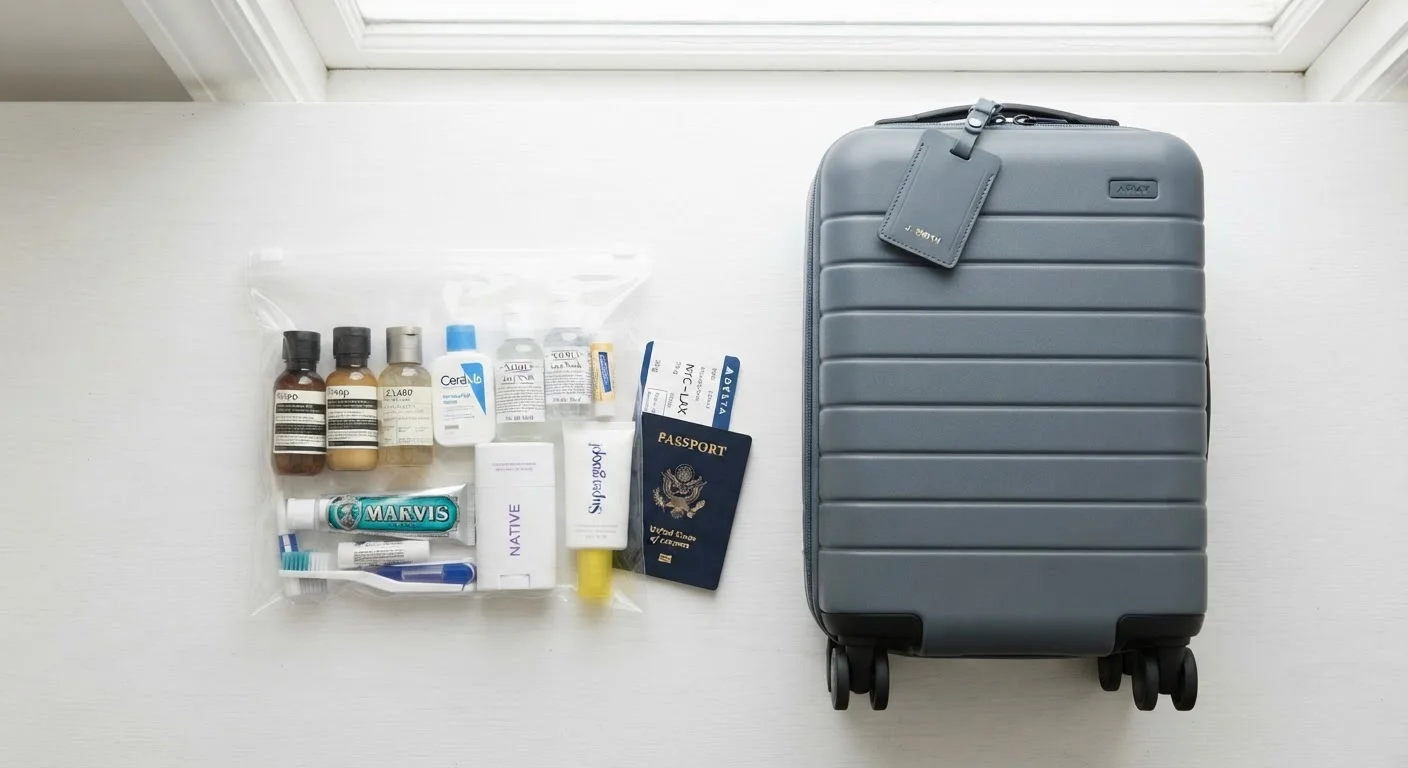
Key Takeaways
- Containers must be 3.4 oz or smaller — even if they're not full.
- Everything liquid, gel, or cream goes into one quart-sized clear bag per passenger.
- Decanting into reusable travel bottles is an effective way to bring your preferred products.
- Solid alternatives (shampoo bars, solid deodorant) bypass the liquids rule entirely.
- Medications and baby formula are exempt but may require additional screening.
- Checked baggage has no liquid volume limit per container, though airline rules vary.
TSA 3-1-1 Liquids Rule
The TSA's 3-1-1 rule limits each passenger to liquids, gels, aerosols, creams, and pastes in containers of 3.4 ounces (100 milliliters) or less, all fitting inside one quart-sized clear zip-top bag, with one bag allowed per traveler in carry-on luggage. Items exceeding these limits must go in checked baggage or be left behind. The rule applies at all U.S. airport security checkpoints.
The 3.4 oz (100 ml) limit refers to the container's labeled capacity, not how full it is — a 6 oz bottle filled halfway still violates the rule.
What the 3-1-1 Rule Actually Means in Practice
Most travelers have heard of the 3-1-1 rule, but the details trip people up regularly. Here's the precise breakdown as set by the Transportation Security Administration (TSA):
- 3.4 oz (100 ml) or less per individual container
- 1 quart-sized clear, resealable zip-top bag
- 1 bag per passenger, placed in the screening bin separately
The rule covers anything that qualifies as a liquid, gel, aerosol, cream, or paste. That includes shampoo, conditioner, toothpaste, face wash, lotion, perfume, hairspray, lip gloss, and even peanut butter. The container size is what matters — not how full it is. A 5 oz bottle of conditioner that's 80% empty still won't pass.
Understanding this upfront saves you from surprises at the checkpoint and makes packing light a much more achievable goal.
Pack Your Quart Bag Last, Access It First
Place your liquids bag near the top of your carry-on so it's easy to pull out at the checkpoint without unpacking everything else. This small habit eliminates one of the most common sources of security-line delays. If you use a personal item like a daypack, keeping the liquids bag in an outer pocket makes the process even smoother.
Decanting: What Works and What Doesn't
Reusable travel bottles let you bring your preferred products in compliant quantities. Silicone squeeze bottles, screw-top jars, and disc-cap containers are widely available and easy to refill. A few practical guidelines:
- Label your bottles — unlabeled containers can slow down screening if an officer needs to identify the contents.
- Don't overfill. Leave a small air gap to prevent leaks caused by cabin pressure changes during flight.
- Test bottles before travel. Some cheaper silicone containers leak under pressure, particularly with thinner liquids like toner or micellar water.
Not every product decants well. Pressurized products — dry shampoo, aerosol hairspray, sunscreen spray — can't be transferred to a standard travel bottle. For those, buy travel-sized aerosols or switch to a non-aerosol alternative for the trip. Similarly, products with pumps (certain foundations, serums) may require a pump-specific travel container to stay functional.
If you're planning a frequent business travel routine, pre-loaded travel bottles you keep packed and ready will save significant time across multiple trips.
Solid Alternatives That Bypass the Rules Entirely
The simplest way to stop worrying about liquids is to reduce how many you carry. Solid-format toiletries have expanded significantly and now include genuinely effective options:
- Shampoo and conditioner bars — compact, long-lasting, and zero-liquid
- Solid sunscreen sticks — SPF-rated and checkpoint-friendly
- Solid or gel deodorant — gel deodorant is subject to the 3-1-1 rule; solid stick is not
- Sheet face masks and toner pads — pre-soaked pads technically fall under the liquid rule if heavily saturated, so check TSA's guidance if uncertain
- Toothpaste tablets — a growing alternative to travel-sized paste tubes
Switching even a few products to solid format frees up valuable space in your quart bag for items that have no solid equivalent. This matters especially when flying carry-on only, where every cubic inch counts. See our carry-on vs. checked bag comparison for a fuller look at the trade-offs.
~80%
Of liquid violations are container size issues
TSA checkpoint data consistently shows oversized containers — not missing bags — as the leading reason liquids are confiscated from carry-ons.
1 quart
Maximum liquid bag volume allowed per passenger
A standard quart-sized zip-top bag holds roughly 8–10 small travel containers, making product selection important for carry-on-only travelers.
3.4 oz
Maximum individual container size (carry-on)
This equals 100 milliliters — the international standard adopted by most aviation security agencies worldwide.
How Security Screening Actually Plays Out
Knowing the rules is half the equation. Understanding how officers apply them helps you move through lines faster and avoid unnecessary delays.
Your quart bag must be removed from your carry-on and placed in a separate bin — even with TSA PreCheck, the liquid rule itself still applies; you just don't have to remove the bag from your luggage. Standard screening passengers who leave the bag buried in their suitcase are the most common cause of bag-check holdups at the X-ray conveyor.
Exemptions worth knowing:
- Medications: Liquid medications in any quantity are permitted but must be declared. TSA may swab containers or conduct additional checks.
- Baby formula, breast milk, and juice for infants: Exempt from size limits; inform the officer at the start of screening.
- Ice packs and gel packs: These are gels and subject to the rule unless they are completely frozen solid when presented for screening.
If you're uncertain whether a specific product is permitted, TSA's "What Can I Bring?" search tool on their official website provides item-by-item guidance. Always verify entry requirements, security rules, and any destination-specific regulations through official government sources before you travel, as policies can change.
For a broader look at what you actually need to bring, the travel gear essentials guide offers a useful framework for evaluating every item in your bag — toiletries included.
“The biggest mistake travelers make with liquids isn't ignorance of the rules — it's assuming the rules won't apply to their specific item. When in doubt, check the official list or put it in your checked bag.”
— Travel Smarter Editorial Team, Travel planning and packing strategy researchers