

Key Takeaways
- Plan your packing around activities and weather, not generic checklists.
- A universal gear framework — clothing, documents, electronics, toiletries — adapts to any trip type.
- Choosing the right bag shape matters as much as what you put inside it.
- Packing cubes and compression systems reduce volume without sacrificing access.
- A pre-departure checklist prevents the most common and costly packing mistakes.
Start With a Packing Strategy, Not a Packing List
Most packing mistakes happen before a single item enters the bag. Travelers reach for a generic checklist and end up overpacking for things they won't do, while under-packing for what the destination actually demands. A smarter approach starts with three questions: What will I do each day? What are the weather extremes I'll face? How will I be moving between locations?
Map your trip by activity type — business meetings, hiking, beach days, formal dinners — and pack to cover each category with as much overlap as possible. Versatile pieces that work across multiple contexts (a merino wool layer, dark trousers that dress up or down) eliminate duplicates and cut weight significantly.
For a deeper look at the trade-offs between traveling lean versus covering all scenarios, see our guide to packing light vs. packing for every scenario. And if you're coordinating packing alongside the rest of your pre-trip prep, the trip-planning checklist covers every stage from booking to departure.
Before finalizing your packing list, lay every item on a bed and ask: 'If I had to carry this for two miles, would I still take it?' That single filter eliminates most excess weight.
Physical fatigue from an overloaded bag is one of the most common and preventable causes of poor travel experiences, particularly on trips with significant walking or transit.
Pack your shoes first, against the back panel or base of the bag, then build your clothing layers around them. Shoes are the densest items and anchor the load closest to your center of gravity.
Proper weight distribution within a bag reduces strain and keeps the bag from feeling heavier than its actual weight — a consistent recommendation from experienced long-haul travelers and ergonomics guidance on load-carrying.
The Universal Gear Framework
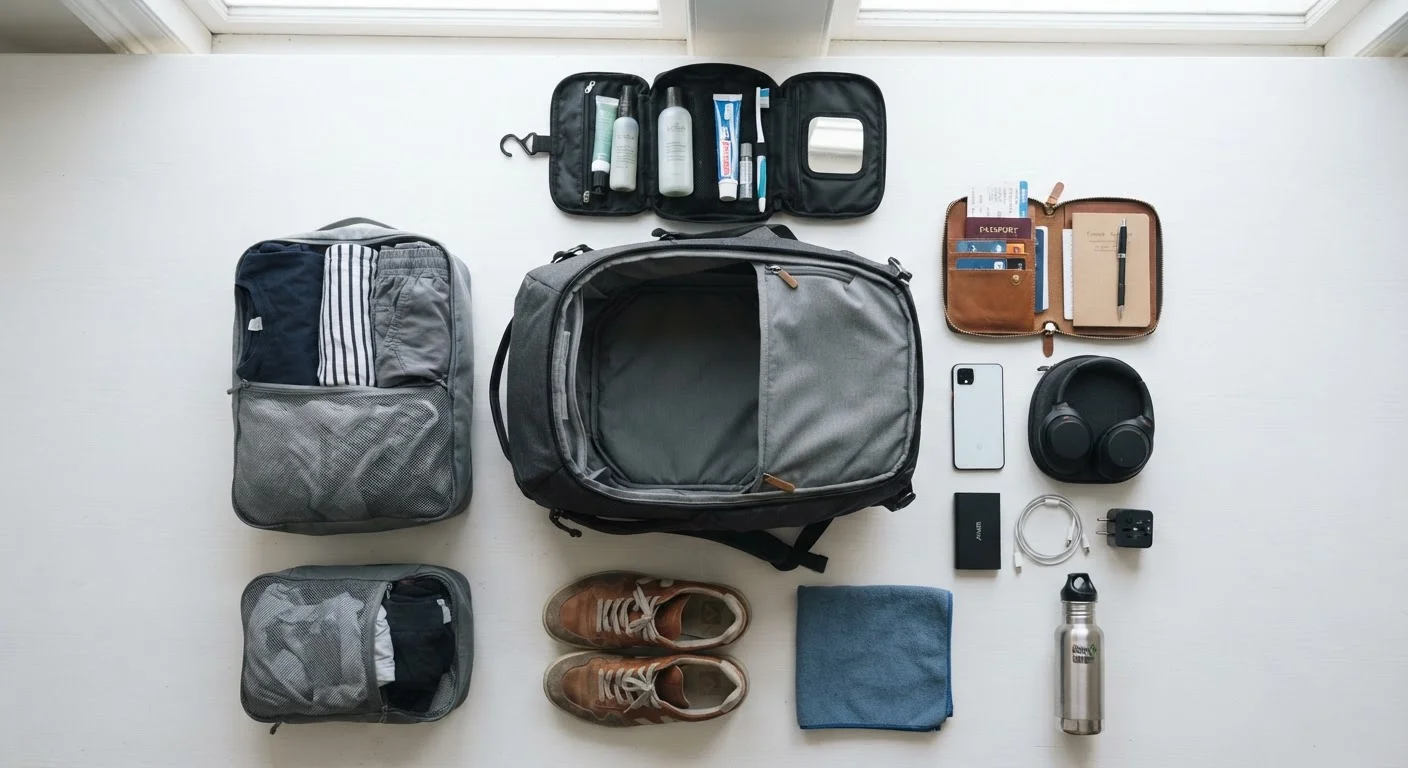
Regardless of destination, every trip draws from the same five categories. Build your list from these pillars, then adjust quantities and specifics for the trip at hand.
- Clothing: Base layers, mid-layers, and one outer shell — scaled to trip length and climate. Aim for pieces that can be hand-washed and dried overnight.
- Documents and finance: Passport, visa printouts (where required), insurance cards, copies stored separately from originals, and at least two payment methods.
- Electronics and power: Phone, chargers, a universal adapter, and a portable battery. Keep cables consolidated in one small pouch.
- Toiletries: Solid or travel-size formats to stay within carry-on liquid limits. Only bring what you genuinely use every day.
- Health and safety: Prescription medications in original labeled containers, a basic first-aid kit, and any destination-specific items (water purification, sun protection, insect repellent).
Our gear essentials reference guide walks through each category in detail, including the practical questions to ask before adding any item to your bag.
~50%
Travelers who repack before their return flight
Travel industry surveys consistently find that roughly half of travelers bring items they never use on a trip, leading to repacking or abandoning items abroad.
7 lbs
Average weight added by non-essential items
Packing research and traveler audits suggest that casual packers typically carry an estimated 5–10 pounds of items that go unused during a standard one-week trip.
Packing by Trip Type
The framework stays constant; the contents shift. Here's how to calibrate for the most common trip types:
Weekend City Break (1–3 nights)
A carry-on bag or large daypack is sufficient. Pack two to three outfits with mix-and-match pieces, a single pair of versatile shoes, and minimal toiletries. Prioritize the ability to move quickly — you'll likely be navigating transit and walking significant distances.
Beach or Resort Trip (4–7 nights)
Swimwear takes priority, but don't sacrifice evening layers. Beach destinations often have air-conditioned interiors that can get cold. Reef-safe sunscreen, a cover-up that doubles as a layer, and a dry bag for wet items are practical additions.
Outdoor or Adventure Travel
Technical gear earns its weight here — moisture-wicking base layers, a rain shell, broken-in hiking footwear, and a headlamp. Resist packing backup gear for scenarios unlikely to occur; instead focus on redundancy for truly essential items like navigation tools and emergency supplies.
International or Multi-Week Travel
Plan to do laundry. Packing for a two-week trip should look very similar to packing for one week when laundry access is factored in. First-time international travelers should also review our international travel packing primer for guidance on adapters, customs rules, and airline luggage restrictions.
Luggage Selection: Bag Shapes and When to Use Them
Choosing the right bag format before you start packing is one of the highest-leverage decisions you'll make. No organizational system compensates for a bag that's the wrong shape for your trip.
- Rolling carry-on suitcase: Best for urban trips with smooth transit — airports, hotels, paved city streets. Hard-shell formats protect fragile items; soft-shell versions compress more easily into overhead bins.
- Travel backpack (30–45L): Ideal for trips mixing transport types — trains, buses, walking. Look for a clamshell opening (opens flat like a suitcase) for easy packing access and an internal frame for back support on longer carries.
- Checked duffel or large suitcase: Appropriate for extended trips, group gear (sports equipment, camping supplies), or destinations where you won't be moving your bag frequently.
- Personal item / daypack: Always bring a packable daypack or use your personal item bag as one. It holds what you need in transit and during day excursions without pulling out your main luggage.
For travelers trying to stay within carry-on limits — which can translate directly to savings — our travel on a budget hub covers how baggage choices connect to overall trip costs.
Organization Systems That Actually Work
The goal of any organization system is to find items quickly without unpacking everything. Two methods consistently outperform the others:
Packing Cubes
Dedicate one cube per category (tops, bottoms, underlayers) rather than per outfit. This makes individual items accessible without disturbing the rest of the bag. Compression cubes add extra volume reduction, though they work best with soft fabrics rather than structured items.
The Bundle Method
Wrapping clothes around a central core object reduces creasing on delicate fabrics and creates a single compact unit. It works particularly well for business travelers packing dress shirts or blazers where wrinkle prevention matters.
Whichever system you choose, apply it consistently on every trip until it becomes automatic. Efficiency in packing comes from habit, not from switching methods each time.
Don't Rely on Vacation Mode to Justify Overpacking
It's tempting to pack for 'just in case' scenarios that rarely materialize — a formal dinner, extreme cold, a spontaneous hike. Each of these adds weight you'll carry through airports and on every transit leg. If a scenario isn't on your actual itinerary, leave the gear for it behind. Most destinations have stores where genuine gaps can be filled locally.
Final Checks Before You Leave
Run through these checks 24 hours before departure — not the morning of, when there's no time to course-correct:
- Weight and size: Weigh your bag against your airline's carry-on or checked allowance. Measure dimensions if you're flying a carrier known for strict enforcement.
- Document accessibility: Passports, boarding passes, and insurance cards should be reachable without digging through your bag — ideally in a dedicated top pocket or travel wallet.
- Medications and health items: Confirm prescriptions are adequately stocked for the trip length, plus a few days' buffer for delays.
- Electronics charged: Start the trip with all devices and portable batteries at full charge.
- Valuables removed: Remove anything from your bag you don't actually need on this trip. Each item left behind is weight you won't carry.
Consistent, structured trip planning is what separates confident travelers from stressed ones. For a broader planning framework, the Trip Planning hub offers strategies that extend well beyond what goes in your bag.