

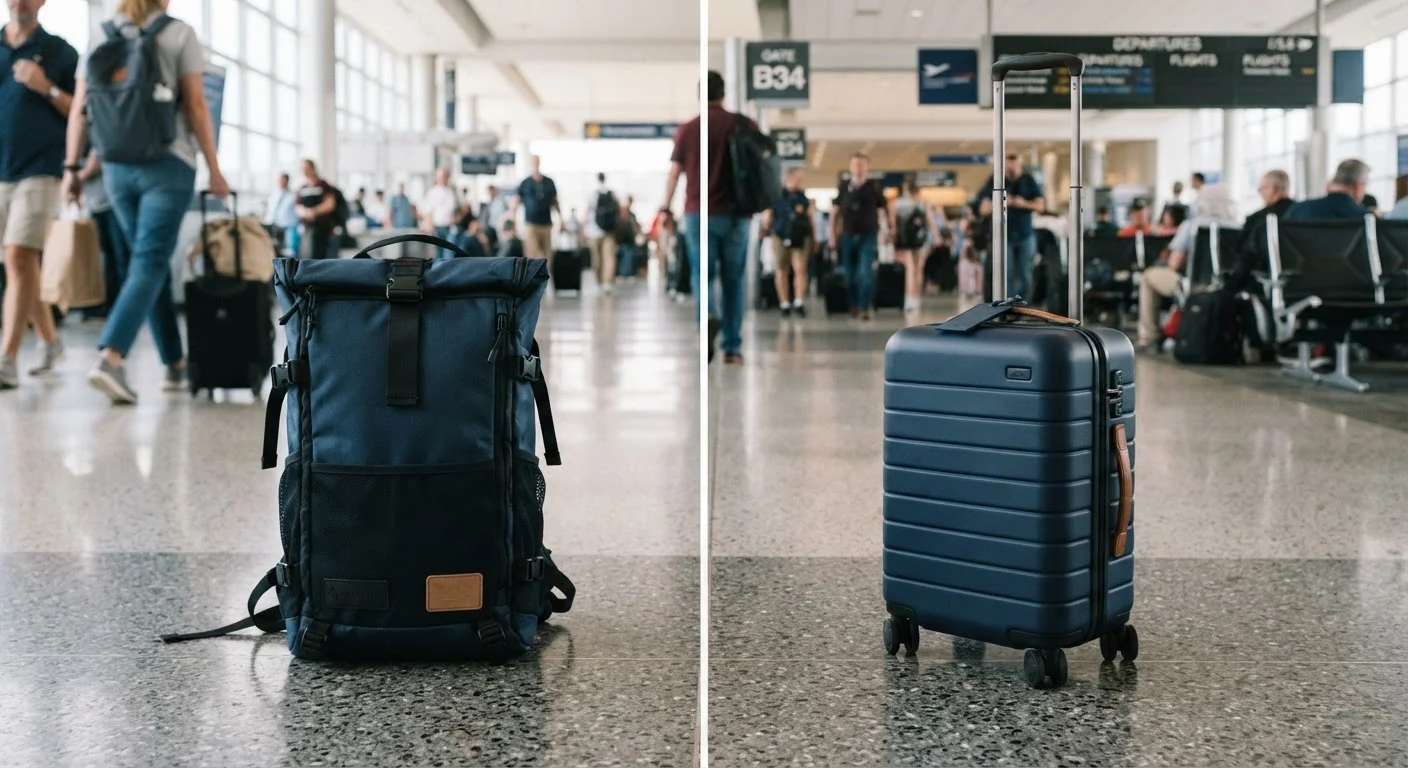
Key Takeaways
- Backpacks offer hands-free mobility and easier navigation over uneven terrain.
- Rolling suitcases reduce physical strain on flat surfaces like airport terminals and hotel lobbies.
- Airline carry-on compliance is easier to verify with a suitcase than with a travel backpack.
- Trip type — urban vs. adventure, short vs. long — is the strongest predictor of which format serves you better.
- Neither format is universally superior; your itinerary should drive the decision.
Our Verdict
For city-hopping on smooth surfaces and longer trips with more gear, a rolling suitcase generally reduces physical strain and makes organization easier. For multi-destination adventures, mixed terrain, or trips where you need to move quickly and hands-free, a backpack wins on agility. Most frequent travelers find that owning one of each — and choosing deliberately per trip — is the most practical long-term strategy.
| Best for | Recommended |
|---|---|
| Urban travelers on business or leisure trips with flat terrain | Rolling suitcase |
| Adventure, hiking, or multi-stop trips with varied terrain | Backpack |
| Budget travelers avoiding checked-bag fees on short trips | Backpack |
| Travelers with back or shoulder issues seeking ergonomic support | Rolling suitcase |
The Core Trade-Off: Mobility vs. Convenience
The backpack versus rolling suitcase debate isn't about which bag looks better or costs more — it's about how each format interacts with the realities of your trip. The two designs solve different problems, and choosing the wrong one can make a smooth trip feel exhausting.
A rolling suitcase excels at protecting contents, keeping clothes organized, and minimizing physical effort on smooth, flat surfaces. Pull it effortlessly through an airport terminal or a hotel corridor, and you'll appreciate why it dominates leisure and business travel alike. But encounter a cobblestone street in Lisbon or a steep staircase in a Roman metro station, and that same bag becomes a burden.
A backpack distributes weight across your body — ideally via a padded hip belt — and leaves your hands free. It scales staircases, fits into tight bus overhead compartments, and makes you more agile in crowded markets. The trade-off is that poor fit or overloading can put real strain on your lumbar region and shoulders. For more on how to think through what your specific trip actually demands, see packing light versus packing for every scenario.
| Backpack | Rolling Suitcase | |
|---|---|---|
| Terrain adaptability | Handles stairs, cobblestones, uneven ground | Best on smooth, flat surfaces |
| Physical strain | Distributes load (if properly fitted) | Low effort on wheels; awkward to lift |
| Airline carry-on compliance | Variable; soft shell can compress unpredictably | Easier to verify exact dimensions |
| Organization | Top-loading limits mid-trip access | Clamshell opening keeps everything visible |
| Hands-free mobility | Yes — full hands-free movement | No — requires one hand at all times |
| Best trip type | Adventure, multi-destination, mixed terrain | Business, urban, leisure with flat routes |
Airport Logistics and Airline Policies
At the airport, the two formats behave differently at almost every stage of your journey. Rolling suitcases — especially hard-shell models — are purpose-built for airline travel. Manufacturers publish exact dimensions, and it's straightforward to confirm compliance with a tape measure before you leave home. Many travel backpacks are marketed as carry-on compatible, but their flexible construction means they can be compressed or expanded inconsistently, sometimes triggering gate-check requests at a busy boarding door.
If you're committed to carry-on only travel to avoid checked-bag fees, understanding the real trade-offs is worth doing carefully. Our guide to carry-on only versus checked luggage on a budget trip breaks down the financial and logistical angles honestly.
One practical advantage backpacks hold at security is that they're easier to hoist onto the conveyor belt and back off again quickly. A rolling suitcase with a hard shell often requires more maneuvering in cramped security lanes. Neither advantage is decisive on its own, but over a trip with multiple connections, the cumulative difference adds up.
Test Your Bag Before You Travel
Whether you choose a backpack or a rolling suitcase, pack it fully and carry or roll it for at least 15 minutes before your trip. This reveals fit issues, wheel wobble, and strap pressure points while you still have time to adjust your packing list or swap bags. Don't discover a problem at the departure gate.
Physical Strain and Ergonomics
One of the most underappreciated dimensions of this debate is what each format does to your body over the course of a trip. Rolling a suitcase on smooth pavement is genuinely low-effort — you're pulling a fraction of the bag's weight rather than bearing it. This matters for travelers who deal with shoulder tension, lower back sensitivity, or fatigue on long travel days.
However, the ergonomic calculus shifts the moment terrain becomes irregular. On stairs, gravel, or packed buses, a rolling bag must be lifted repeatedly, often at awkward angles. A properly fitted backpack — with the hip belt carrying 70–80% of the load — distributes weight more efficiently during active movement, even if it still adds heat and some spinal compression.
The key phrase here is properly fitted. An ill-adjusted backpack worn exclusively on the shoulders can cause more strain than pulling a suitcase over a long airport. If you're committing to a travel backpack for a longer trip, taking time to adjust the torso length and hip belt before departure is not optional — it's essential.
Organization, Capacity, and Packing Style
Rolling suitcases — particularly those with a clamshell opening — make packing cubes, folded layers, and category-based organization intuitive. Everything lies flat, visible, and accessible. Compression panels help keep clothes in place during transit. This structure rewards methodical packers who bring a variety of items and want to find things quickly.
Backpacks load top-to-bottom and front-to-back, which means items at the bottom of the main compartment can be harder to reach mid-trip. Travel backpacks with a full-zip panel opening mitigate this, but the cylindrical or tapered shape still favors travelers who pack fewer, more versatile items. If you're working on trimming what you bring, common packing myths that lead to overstuffed bags is a useful reference for questioning what actually needs to come along.
For questions about which construction type best supports your packing style, soft-sided versus hard-shell luggage covers the structural trade-offs in detail. And if your decision also hinges on whether to check a bag at all, the broader framework in carry-on vs. checked luggage applies directly to both formats.