

Key Takeaways
- Homes built before roughly 1950 almost always have plaster walls; newer homes typically have drywall.
- Plaster is harder, heavier, and more crack-prone than drywall but also more soundproof and thermally dense.
- Drywall patches are straightforward; plaster repairs require multi-coat technique and more patience.
- Drilling into plaster without the right bit can cause significant cracking around the hole.
- Both wall types accept paint, but plaster may need a bonding primer first to prevent peeling.
Option A
Drywall
The modern, accessible standard for residential walls.
Best for: Homeowners in houses built after the 1950s who need straightforward patching, painting, or renovation.
Option B
Plaster
The durable, time-tested system found in older homes.
Best for: Owners of pre-1950s homes who want to preserve historic character and handle period-appropriate repairs.
If you're patching holes or damage after a renovation
Drywall
Drywall patching is a well-documented, beginner-friendly process using joint compound and mesh tape. Matching existing drywall texture is relatively simple.
If you want superior sound and thermal insulation from your walls
Plaster
Plaster's density and multi-coat depth give it naturally better acoustic and insulating properties than standard half-inch drywall.
If you're hanging heavy artwork or shelving
Drywall
Drywall anchors and stud-finding techniques are well-established; drilling into plaster risks cracking the surface if done without proper masonry bits and slow drill speeds.
If you own a historic or pre-1950 home and want period-appropriate results
Plaster
Preserving original plaster maintains the character, thermal mass, and structural continuity that historic homes were designed around.
If you're doing a full gut renovation and starting from scratch
Drywall
Drywall is faster to install, easier to finish, and more practical for modern wiring and insulation upgrades during a full renovation.
How to Tell Which Wall System You Have
Before you drill a single hole or mix any patching compound, knowing your wall type saves time and prevents damage. There are several reliable ways to identify drywall versus plaster without any specialized tools.
The Knock Test
Rap your knuckles firmly against the wall. Drywall produces a hollow sound, while plaster sounds denser and more solid - there's less resonance because of its mass and the wood lath or metal mesh behind it.
Check the Age of the Home
As a general rule, homes built before approximately 1950 were constructed with plaster walls. Drywall (also called gypsum board or sheetrock) became the dominant wall system in residential construction during the post-war building boom of the 1950s and beyond. If your home predates that era, assume plaster until you confirm otherwise.
Look at Unfinished Areas
Basements, attics, closets, and utility rooms often reveal the wall structure clearly. Drywall shows clean, uniform gray or cream-colored panels with visible seams. Plaster over wood lath reveals narrow horizontal strips of wood behind multiple coats of hardened material. Plaster over metal lath has a mesh-like backing visible from the unfinished side.
The Nail or Pin Test
Press a thumbtack or pin into an inconspicuous spot. It will sink easily into drywall with light pressure. In plaster, it will either stop at the surface or require real force - the cured lime or gypsum-based compound is significantly harder than drywall's gypsum core.
Once you've confirmed your wall type, you can make smarter decisions about drilling, patching, and painting. If you're planning something larger, see our guide to pre-renovation planning before anything comes down.
Key Differences Between Drywall and Plaster
These two systems share the same basic job - creating a smooth, paintable interior wall - but they differ substantially in construction, weight, durability, and how they respond to everyday wear and repair work.
| Criterion | Drywall | Plaster |
|---|---|---|
| Typical era | 1950s to present | Pre-1950s construction |
| Installation method | Pre-made panels, screwed to studs | Multi-coat, hand-applied wet |
| Wall thickness | ½ inch typical | ¾-1 inch or more |
| Surface hardness | Softer, dents on impact | Harder, more impact-resistant |
| Crack tendency | Flexes; fewer cracks over time | Rigid; prone to hairline cracks |
| Sound insulation | Moderate | Better due to mass and density |
| DIY patch difficulty | Beginner-friendly | Requires more skill and patience |
| Paint compatibility | Any latex primer and paint | May need alkali-resistant primer |
Construction and Composition
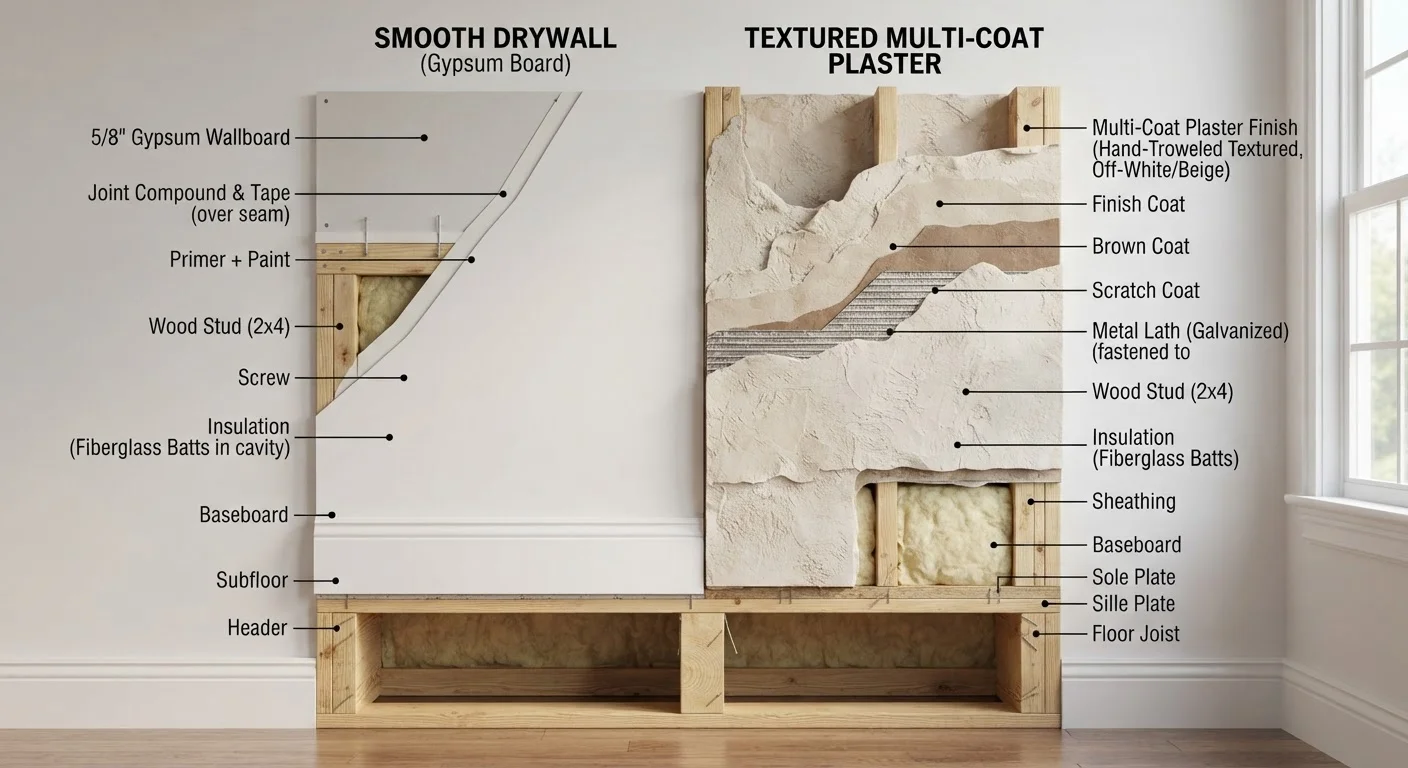
Drywall is a manufactured panel: a gypsum plaster core pressed between two sheets of paper. It comes in standard sizes (typically 4×8 feet) and is screwed or nailed to wall studs, then finished with joint compound and tape at the seams. The whole system can be installed quickly by a skilled crew.
Plaster is a site-applied coating built up in layers - typically a scratch coat, a brown coat, and a finish coat - applied wet over a backing of wood lath strips or metal mesh. Each coat must cure before the next is applied, making installation slow and labor-intensive by modern standards. The finished wall is dense, hard, and monolithic.
Durability and Feel
Plaster walls are harder and more impact-resistant surface-to-surface, but their rigidity makes them prone to cracking as a house settles over decades. Drywall is softer and dents more easily from impacts, but it flexes slightly with seasonal movement, which means fewer cracks over time. Plaster also provides better sound dampening and thermal mass - qualities worth preserving if they're already present in your home.
~1"
Typical plaster wall depth
A three-coat plaster system over lath commonly reaches ¾ to 1 inch thick, compared to the ½ inch standard for drywall panels.
1950s
Decade drywall became dominant
The post-World War II housing boom accelerated drywall adoption as builders sought faster, lower-cost wall systems for new residential construction.
3 coats
Traditional plaster application layers
A traditional plaster wall is built from a scratch coat, a brown coat, and a smooth finish coat - each requiring curing time before the next is applied.
Painting Considerations
Both surfaces accept interior paint, but plaster - especially older plaster - may have a high pH from the lime content. Applying latex paint directly without a bonding or alkali-resistant primer can cause adhesion failures and peeling. Our breakdown of interior paint finishes covers which sheens work best on each surface type.
Repairing Drywall vs. Plaster: What to Expect
Repair complexity is one of the biggest practical differences between these two wall systems, and it matters whether you're tackling the work yourself or hiring someone.
Drywall Repairs
Small holes from nails or screws can be filled with lightweight spackle and sanded smooth in a single session. Larger holes - up to a few inches - can be addressed with self-adhesive mesh patches and joint compound applied in two or three thin coats, each allowed to dry before sanding. For more detail, our step-by-step drywall patching guide walks through every size of repair.
Plaster Repairs
Hairline cracks in plaster can be filled with a flexible, paintable caulk or a setting-type compound, but the underlying cause - usually house settlement - should be monitored. Larger areas of damage, especially where the plaster has lost its key (the bond to the lath behind it), require removing the failed section and rebuilding with either a multi-coat plaster mix or a compatible patching compound. Drilling into plaster requires a masonry bit and low drill speed to avoid radiating cracks outward from the hole.
When to Call a Professional Plasterer
If tapping produces a hollow sound across a broad area, the plaster has likely lost its mechanical bond to the lath beneath - a condition called 'key failure.' Repairs in this situation go beyond surface patching and often require removing and rebuilding the affected section. A licensed plasterer can assess whether the surrounding area is stable before work begins. Attempting to patch over failed plaster typically leads to the new material failing as well within a short time.
Significant plaster damage - particularly where large sections feel hollow when tapped, or where cracks are accompanied by bulging - is generally a job for a professional plasterer. Attempting to skim over failed plaster without addressing the key usually results in the patch failing as well.