
Kitchen Cabinet Refacing vs. Full Replacement: How to Think Through the Decision

Key Takeaways
- Refacing typically costs significantly less than full replacement and causes far less household disruption.
- Cabinet boxes must be structurally sound and square for refacing to be a viable option.
- Full replacement is the only path if you need to change your kitchen's layout or add new cabinet locations.
- Both approaches can meaningfully update a kitchen's appearance when paired with new hardware and countertops.
- Local permit requirements and resale value considerations should factor into your decision before committing.
Option A
Cabinet Refacing
The cost-conscious refresh that works within your existing footprint.
Best for: Homeowners whose cabinet boxes are structurally sound and who want a updated look without a major renovation.
Option B
Full Cabinet Replacement
The comprehensive overhaul that resets your kitchen's layout and function.
Best for: Homeowners who need a new layout, have damaged boxes, or want to significantly change storage configuration.
If your cabinet boxes are solid and your layout works well
Cabinet Refacing
Refacing delivers a fresh appearance at lower cost and shorter timeline without disturbing your kitchen's functional footprint.
If you need to move, add, or remove cabinets
Full Cabinet Replacement
Only full replacement allows you to reconfigure where cabinets sit, add an island, or change the kitchen's structural flow.
If your cabinet boxes show water damage, warping, or pest damage
Full Cabinet Replacement
Applying new doors and veneer over compromised boxes is a cosmetic fix that won't address underlying structural problems.
If you're planning to sell within one to three years
Cabinet Refacing
Refacing can meaningfully freshen a kitchen's appearance at a fraction of full replacement cost, which may offer a better return on renovation spend.
What Each Approach Actually Involves
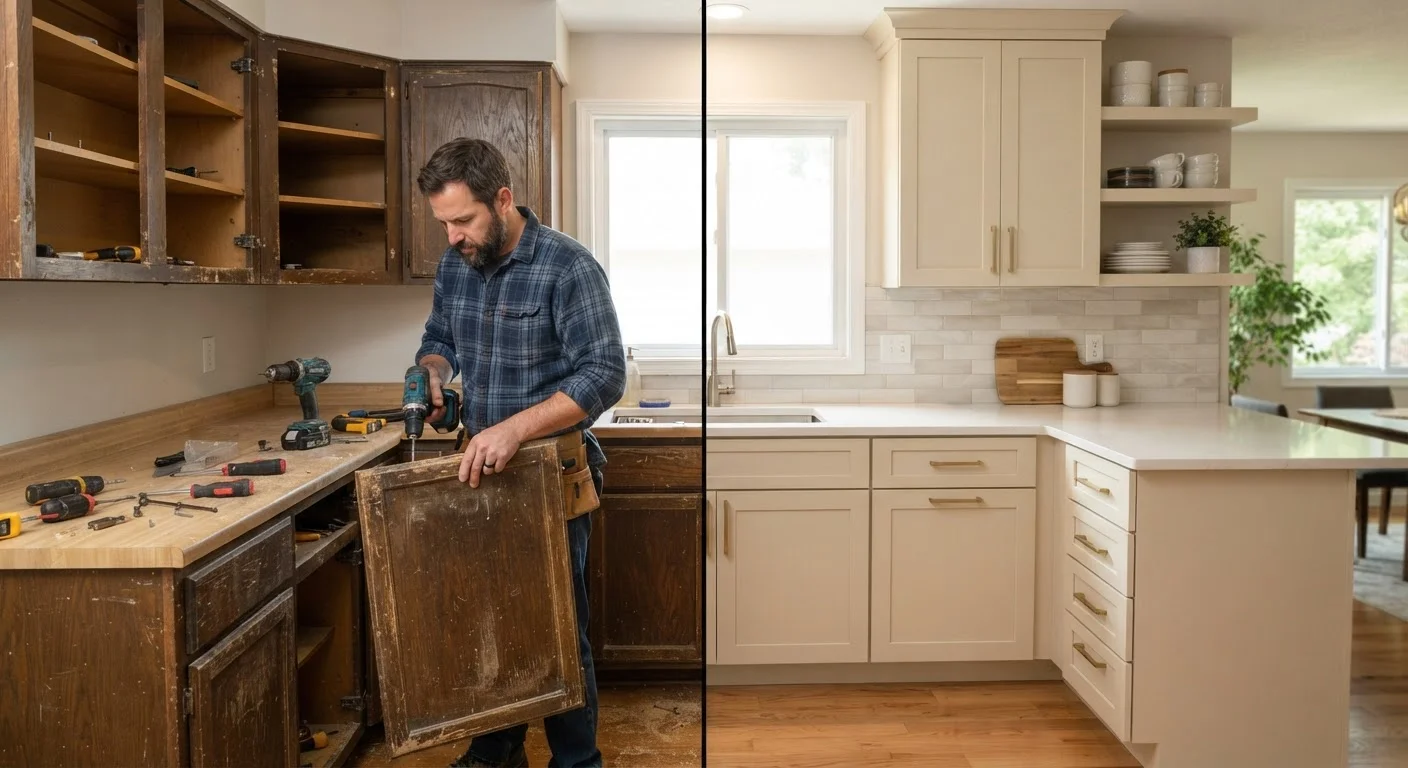
Understanding what happens during each process makes the decision much clearer. Cabinet refacing preserves your existing cabinet boxes - the plywood or particleboard carcasses attached to your walls - while replacing every visible surface. That means new door fronts, drawer fronts, and a veneer or laminate applied to the exposed frame faces. Hardware, hinges, and sometimes interior shelving are replaced at the same time. The result looks like a new kitchen; the bones are the same.
Full cabinet replacement strips everything out: boxes, doors, hardware, and often the toe kicks. New cabinets - either stock, semi-custom, or custom-built - are installed from scratch. This process typically requires more time, generates more waste, and costs more, but it opens up the possibility of changing what goes where.
Before diving into either path, it's worth reviewing the broader renovation planning process. Our renovation planning guide covers permits, timelines, and contractor vetting that apply to both options.
How to Assess Your Cabinet Boxes
The single most important factor in this decision is the current condition of your cabinet boxes. Open every door and drawer, and look honestly at what you find.
- Check for water damage. Soft spots, swelling, or dark staining near the sink base or dishwasher indicate moisture infiltration. Refacing over damaged boxes will not solve the underlying problem.
- Test for squareness. Doors that swing open on their own or gaps that run unevenly across the face frame suggest the boxes have shifted or warped. A refacer will inspect this - badly racked boxes may not hold new doors properly.
- Look at the interior finish. Refacing changes only external surfaces. If your interior shelves are stained, peeling, or poorly dimensioned for your storage needs, replacement may address more pain points.
- Check drawer slide hardware. Many refacing projects include new drawer slides, but if the drawer box itself is falling apart, that's a separate cost to factor in.
| Criterion | Cabinet Refacing | Full Replacement |
|---|---|---|
| Relative cost | Lower (typically 40-60% of replacement) | Higher, varies by cabinet type |
| Timeline | 2-5 days typical | 1-3 weeks or more |
| Kitchen disruption | Partial - kitchen stays usable | Full - kitchen non-functional |
| Layout change possible | No | Yes |
| Requires sound cabinet boxes | Yes - essential | No - boxes are removed |
| Waste generated | Low | High |
| Interior storage change | Limited | Fully customizable |
If your boxes pass a basic inspection - solid, square, and dry - refacing is almost always a realistic option worth pricing out.
Cost and Disruption: A Realistic Picture
Cost ranges vary significantly by region, kitchen size, and material choices, so treat any figures here as directional rather than firm quotes. As a general pattern, refacing tends to run roughly 40-60% of the cost of full replacement for a comparable kitchen. That gap narrows when replacement uses stock cabinetry and widens when custom cabinetry is involved.
40-60%
Typical cost of refacing vs. replacement
Industry estimates consistently place refacing at roughly half the cost of full cabinet replacement for similar kitchen sizes, though local labor markets vary considerably.
2-5 days
Typical refacing project duration
Most professional refacing projects on standard kitchens are completed within a week, compared to multi-week timelines common with full replacement.
Disruption is a factor that homeowners often underestimate with full replacement. Expect your kitchen to be largely non-functional for several days to a few weeks depending on scope - countertops must typically come off, plumbing under the sink is disconnected, and appliances may need to be pulled. Refacing, by contrast, usually keeps the kitchen partially usable throughout the process, since the boxes stay in place.
Both approaches may involve countertop replacement if you're changing door height or depth, so factor that into your overall budget. If a full gut renovation is on your radar, our bathroom remodel planning walkthrough illustrates how trade sequencing works in practice - the same logic applies to kitchens.
Layout and Functionality Limits
Refacing cannot move walls, add new cabinet runs, or change the footprint of your kitchen. If your primary frustration is that a corner cabinet wastes space, that the island you've always wanted doesn't exist, or that a wall blocks natural light, refacing won't help. Those are layout problems, and layout problems require full replacement - or sometimes structural work beyond cabinetry entirely.
Full replacement, on the other hand, pairs naturally with a broader kitchen rethink. You can reconfigure the work triangle, add a pantry cabinet, raise uppers to the ceiling, or switch from framed to frameless construction. For homeowners planning a more open layout, our open-plan living overview is worth reading before you pull permits.
One often-overlooked middle path: replacing only specific problem cabinets while refacing the rest. This hybrid approach works when a single run - say, the base cabinets under a leaking sink - needs full replacement while the uppers are in fine shape. A skilled installer can often match new doors closely enough that the difference is minimal.
A Word on Permits and Resale
Cabinet refacing typically does not require a building permit in most US jurisdictions since it involves no structural, electrical, or plumbing changes. Full replacement may trigger permit requirements if any wall modifications, electrical upgrades, or plumbing relocations are involved - always verify with your local building department before starting work. From a resale standpoint, both approaches can update a kitchen's appeal, but consult a local real estate professional if resale value is a primary driver of your decision.
Once cabinetry decisions are settled, don't overlook interior organization. Our kitchen organization guide walks through building a functional storage system from the ground up - useful whether your cabinets are brand new or newly refaced.