

Key Takeaways
- No single signal tells the full story — always read multiple body parts together.
- Ears forward and relaxed muscles typically signal confidence or calm curiosity.
- A wagging tail does not always mean a happy dog; height and speed matter greatly.
- Whale eye, lip licking, and yawning are often stress signals owners overlook.
- Context — environment, history, and the dog's normal baseline — shapes every signal.
Why Body Language Is a Dog's Primary Language
Dogs are fundamentally social animals whose ancestors relied on nuanced physical signaling to coordinate within groups. While they have learned to vocalize around humans, the vast majority of canine communication remains nonverbal. Understanding that language is one of the most practical skills any owner can develop.
Behavioral researchers describe a dog's body as a continuous broadcast — posture, movement, and micro-expressions all transmitting information simultaneously. When owners learn to tune in, everyday interactions become clearer, early distress is easier to spot, and the relationship deepens. For a complementary look at how vocalizations fit into this picture, see our guide on decoding what dogs are responding to when they bark.
Practice reading your own dog's body language during calm moments — when you know they're relaxed — so you have a clear mental baseline to compare against during stressful situations.
Behavioral deviations are only meaningful if you know what 'normal' looks like for that specific dog, since individual variation is significant across breeds and personalities.
When meeting an unfamiliar dog, let them approach you rather than reaching toward them, and watch whether their weight shifts forward with relaxed muscles or back with a closed mouth before accepting contact.
Approach behavior is one of the most reliable indicators of genuine comfort versus polite tolerance, and misreading it is a common cause of unexpected nips.
Reading Ears, Eyes, and Facial Signals
Ears
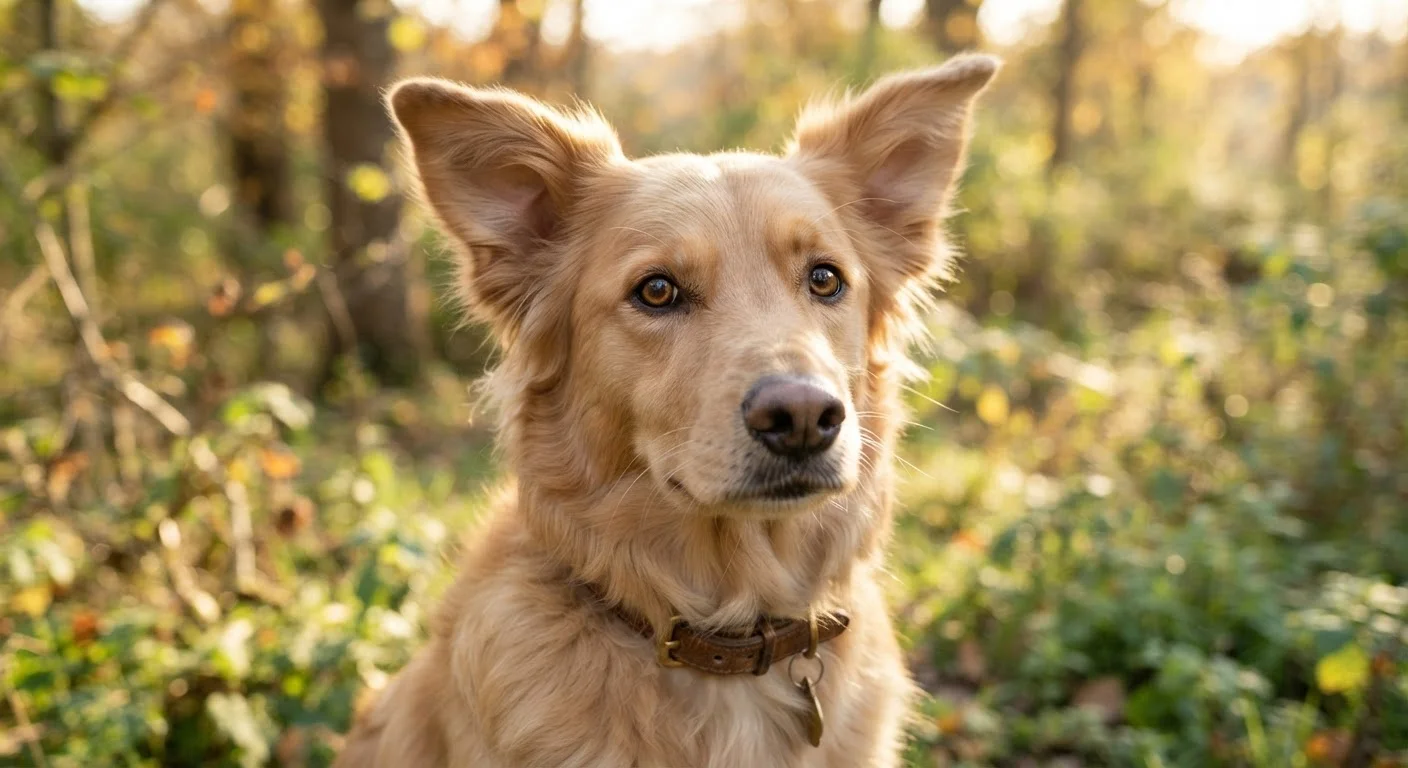
Ear position is one of the fastest-changing and most expressive signals a dog offers. Ears rotated forward and held upright typically indicate alertness or curiosity. Ears pinned flat against the skull — sometimes called "airplane ears" — generally signal fear, submission, or appeasement. A loose, slightly back position often accompanies a relaxed, friendly state.
Breed anatomy matters here. Floppy-eared dogs have less range of motion, so look for subtle shifts at the base of the ear rather than dramatic changes in position.
Eyes
Soft, almond-shaped eyes with normal-sized pupils indicate a calm dog. Hard, unblinking stares directed at another animal or person can be a precursor to conflict. Whale eye — when a dog turns its head slightly away but keeps its gaze fixed, revealing the white sclera — is a recognized appeasement or stress signal that owners frequently miss.
Mouth and Face
A relaxed open mouth with a slightly lolling tongue usually reflects comfort. A tightly closed mouth, repeated lip licking unrelated to food, or rapid yawning in a non-tired context are calming signals — ways dogs attempt to de-escalate tension in themselves or others. A wrinkled muzzle and exposed teeth signal a warning, though this should always be read alongside overall posture before drawing conclusions.
What the Body, Posture, and Coat Reveal
Overall Posture
Weight distribution tells a quick story. A dog leaning forward with weight over the front paws is engaged — possibly assertive or aroused. Weight shifted back onto the haunches often indicates uncertainty or a readiness to retreat. A dog that makes itself small, tucking limbs in and lowering its head, is communicating submission or fear.
Piloerection
Piloerection — commonly called hackles — refers to the involuntary raising of fur along the spine from neck to tail. It signals emotional arousal, but not necessarily aggression; excitement, fear, and uncertainty can all trigger it. Think of it like goosebumps: an automatic physiological response, not a choice. Our article on what a dog's coat reveals about health and mood explores additional coat-related signals worth knowing.
Play Bow
The play bow — front end lowered, rear end elevated — is one of the clearest friendly signals in the canine repertoire. It functions as a social invitation and often punctuates play sessions as a reset signal after rougher interactions.
Never Punish Stress Signals
Growling, lip lifting, and other warning signals are a dog's way of communicating discomfort before escalating. Punishing these behaviors can suppress the warning without addressing the underlying emotion, increasing the risk of a bite without prior signal. If your dog is regularly displaying warning signals, consult a certified professional behaviorist rather than attempting to correct the behavior through discipline alone.
Decoding the Tail: Speed, Height, and Direction
A wagging tail is widely interpreted as happiness, but the reality is more layered. Tail position and wag characteristics each carry distinct meaning.
- High, stiff wag: Often signals arousal or assertiveness — not necessarily friendliness.
- Low, slow wag: Frequently accompanies uncertainty or mild stress.
- Loose, mid-height wag involving the whole rear: The classic happy, relaxed greeting signal.
- Tail tucked under the belly: A strong indicator of fear or submission.
Research from animal behavior scientists has also suggested that the direction of a tail wag — slightly more to the right versus the left — may correlate with different emotional states, though this is still an active area of study and not practically observable by the naked eye in most cases. If you're curious how feline tail communication compares, our guide on what cat tail positions communicate offers an interesting contrast.
Reading the Whole Dog: Context Is Everything
No single signal should be read in isolation. A tucked tail on a dog in a new environment carries different weight than the same tail tuck at home with familiar people. Experienced trainers and behaviorists emphasize building a mental picture of a dog's baseline — its normal resting posture, typical energy, and default facial expression — before interpreting deviations.
Ask yourself three questions when reading a dog's body language:
- What is this dog's individual normal? Every dog has a personal baseline shaped by genetics, history, and personality.
- What is happening in the environment right now? Loud noises, unfamiliar dogs, or sudden movements all shift signals rapidly.
- Are multiple signals pointing in the same direction? Consistency across ears, eyes, posture, and tail is far more reliable than any single cue.
~65%
Human communication that is nonverbal
Behavioral communication researchers broadly estimate that most interpersonal meaning is conveyed nonverbally — a parallel that helps owners appreciate why dogs rely so heavily on physical signals.
18+
Distinct ear positions identified in dogs
Canine ethologists studying dog communication have catalogued more than eighteen distinguishable ear orientations that carry social meaning across contexts.
When Body Language Signals a Problem
Some body language clusters deserve immediate attention. A dog that is rigid and still, holding direct eye contact, with a high stiff tail and closed mouth is displaying pre-conflict tension — back away calmly and create space rather than approaching or attempting to reassure with touch.
Persistent stress signals — repeated yawning, lip licking, avoidance, low posture, and reluctance to engage — in a dog's own home may indicate chronic anxiety or an underlying physical issue. Pain, in particular, can dramatically alter a dog's body language and social behavior. Our guide on recognizing pain signals in pets covers the overlap between distress behavior and physical discomfort in more detail.
If a dog's behavior changes suddenly or significantly without an obvious environmental cause, a veterinary consultation is always a worthwhile first step. Body language is data — and sometimes that data is telling you something medical, not just emotional.
This article is for general informational and educational purposes only and does not constitute veterinary or behavioral advice. Always consult a qualified veterinarian or certified animal behaviorist for concerns about your individual dog's health or behavior.