

| Primary communication function | Emotional state and social intent signaling |
| Tail positions with distinct meanings | At least 8 recognized positions |
| Piloerection (puffed tail) trigger | Fear or acute aggression response |
| Tail-up greeting used by | Cats with friendly, familiar relationships (Feline behavioral research literature) |
| Rapid side-to-side lashing indicates | Irritation or agitation — not happiness |
| Tail wrapping signals | Affection and social bonding |
Why the Tail Is Your Cat's Emotional Broadcast
Cats can't tell you how they feel in words, but their tails are remarkably expressive. Feline tail communication is a genuine signaling system — shaped by evolution and refined through social interaction — that conveys emotional state, intent, and arousal level in real time. Understanding it helps you respond more thoughtfully to your cat and deepens the trust between you.
Tail signals don't operate in isolation. For the most accurate read, observe the tail alongside ear position, whisker angle, body posture, and vocalizations. That said, the tail often provides the clearest, fastest signal — especially across a room. Think of it as the headline, with the rest of the body filling in the story. If you're also curious about how dogs broadcast their feelings, our guide to dog body language offers a useful comparison.
| Primary communication function | Emotional state and social intent signaling |
| Tail positions with distinct meanings | At least 8 recognized positions |
| Piloerection (puffed tail) trigger | Fear or acute aggression response |
| Tail-up greeting used by | Cats with friendly, familiar relationships (Feline behavioral research literature) |
| Rapid side-to-side lashing indicates | Irritation or agitation — not happiness |
| Tail wrapping signals | Affection and social bonding |
Tail Positions and What They Signal
Each distinct tail position maps to a recognizable emotional state. Here's how to decode them:
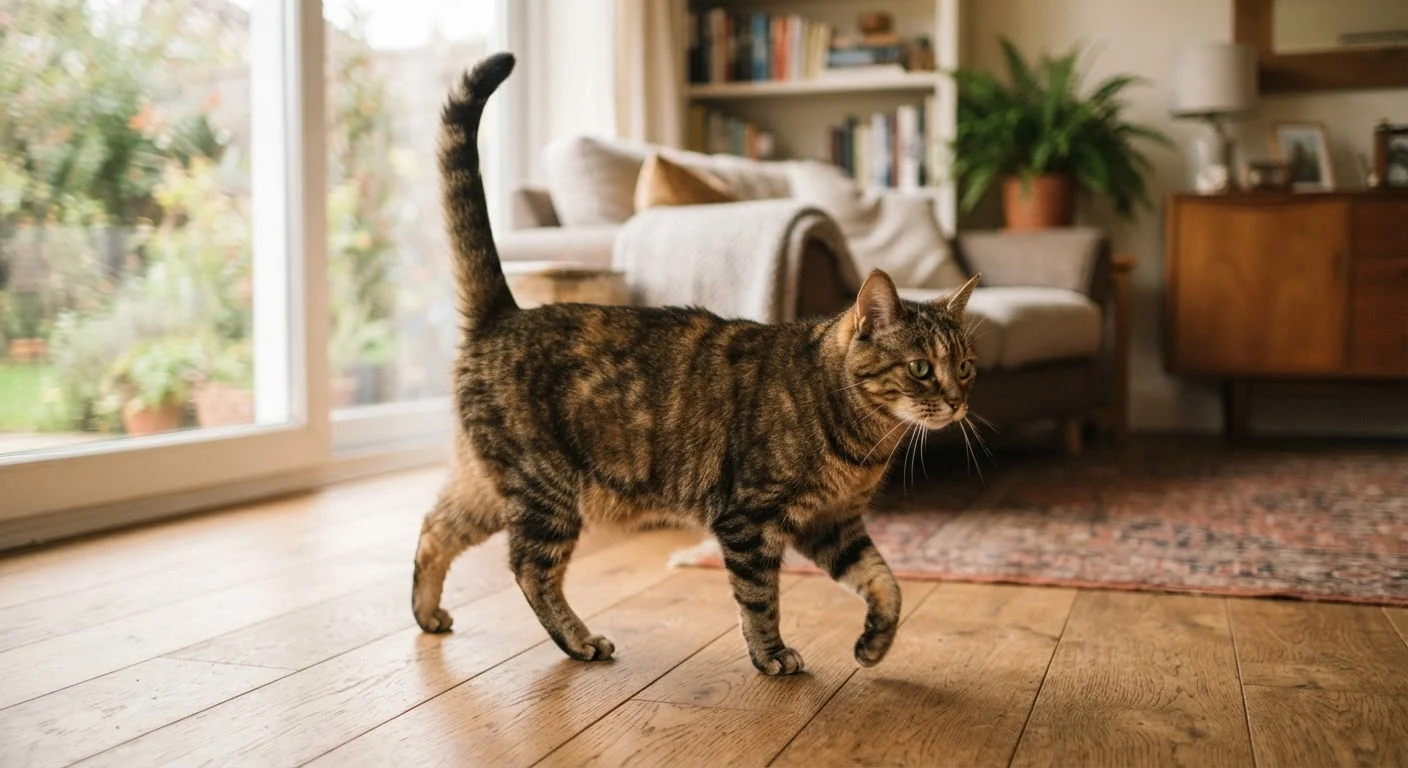
- Tail held high and vertical
- Your cat is confident, content, and socially open. Cats greet familiar people and other cats they like this way — it's essentially a friendly wave. A small hook or curl at the very tip adds warmth and playful curiosity.
- Tail held high with a quiver or rapid vibration
- Strong positive excitement, often seen when a cat approaches someone it loves. This motion is the same one used during urine marking, but without the spray it signals pure happiness. Territorial marking is a related but distinct behavior.
- Tail carried low or tucked between the legs
- Submission, anxiety, or discomfort. A tucked tail is a signal your cat wants to reduce conflict or feels threatened. Check the broader context — what changed in the environment recently?
- Tail puffed out (piloerection)
- The hair along the tail stands on end, making it look like a bottle brush. This is an involuntary fear or aggression response — your cat is startled or feels genuinely threatened. Give the cat space rather than attempting reassurance through touch.
- Tail lashing or whipping side to side rapidly
- Irritation, frustration, or high agitation. This is not the same as a dog's happy wag. If you see this during petting, stop — continued contact may lead to a bite or scratch.
- Slow, gentle swaying or flick at the tip
- Mild interest or focus, often seen during play or when watching prey. It signals mental engagement without alarm.
- Tail wrapped around another cat or around a person's leg
- Affection and social bonding. It's the feline equivalent of a gentle hug.
- Tail held straight out, parallel to the ground
- Neutral alertness — your cat is attentive and evaluating its surroundings without strong positive or negative feeling.
Piloerection
The involuntary bristling of fur along the tail (or body) caused by tiny muscles contracting in response to fear or aggression. It makes the cat appear larger as a defensive display.
Tail quiver
A rapid vibration of a vertically held tail, typically expressing strong positive excitement or affection toward a person or companion animal.
Tail carriage
The habitual or momentary position at which a cat holds its tail relative to its body. Changes in typical tail carriage can reflect shifts in mood or physical comfort.
Arousal level
The degree of emotional activation a cat is experiencing — ranging from calm and relaxed to highly alert, fearful, or agitated. Tail movement speed and position both reflect arousal level.
Displacement signal
A behavior that appears out of context and indicates internal conflict or mild stress — such as a slow tail flick during an otherwise neutral interaction.
When Tail Signals Suggest Something Worth Watching
Most tail communication reflects normal emotional fluctuations, but persistent changes in how a cat holds or moves its tail can sometimes warrant a closer look. A cat that consistently carries its tail low, repeatedly tucks it, or seems reluctant to move it normally may be experiencing physical discomfort — tail injuries, nerve issues, or pain elsewhere in the body can all affect tail carriage and movement.
If your cat's tail behavior changes noticeably without an obvious environmental cause, it's worth a conversation with your veterinarian. Our article on signs your pet is in pain covers the broader behavioral and physical signals to watch for. Similarly, a cat that seems frequently agitated or fearful — evidenced by repeated tail lashing and piloerection — may be experiencing chronic stress. Our guide on pet stress signals can help you identify potential triggers.
Understanding tail language also helps bust some common misconceptions. If you've ever believed cats are simply aloof or impossible to read, our piece on common cat behavior myths offers a reassuring, research-grounded perspective.
This article is for general informational purposes only and is not a substitute for veterinary advice. If you have concerns about your cat's health or behavior, please consult a qualified veterinarian.