

Key Takeaways
- Wet food contains 70–80% moisture, making it a meaningful source of daily hydration for cats and dogs.
- Dry kibble is more calorie-dense per ounce, which makes portion control and weight management easier to track.
- Neither format is universally superior—the right choice depends on your pet's age, health status, and preferences.
- Cats, as obligate carnivores with low thirst drives, often benefit significantly from wet food's moisture content.
- Many veterinarians support a mixed-feeding approach that combines the advantages of both formats.
- Always check that any food carries an AAFCO nutritional adequacy statement appropriate for your pet's life stage.
Option A
Wet Pet Food
The moisture-rich, palatable option for targeted health support.
Best for: Pets needing extra hydration, picky eaters, seniors, or animals with dental or urinary health concerns.
Option B
Dry Pet Food (Kibble)
The convenient, calorie-dense staple for everyday feeding.
Best for: Pet owners seeking a cost-effective, easy-to-store option for generally healthy adult pets.
If your cat has a history of urinary tract issues or kidney disease
Wet Pet Food
Higher moisture content supports urinary tract health and kidney function by increasing overall fluid intake, which cats rarely compensate for by drinking more water.
If you have a healthy, active adult dog and convenience is a priority
Dry Pet Food (Kibble)
Kibble is easy to measure, stores well, and provides consistent, calorie-dense nutrition without the shorter shelf life of opened wet food.
If your pet is a senior or has reduced appetite or missing teeth
Wet Pet Food
Soft texture is easier to chew, and the stronger aroma of wet food tends to appeal to pets whose sense of smell has diminished with age.
If weight management is a current health goal
Dry Pet Food (Kibble)
Kibble's standardized calorie density makes it simpler to measure precise portions, and some formulations are specifically designed for calorie restriction.
If your pet is healthy but you want to optimize overall nutrition and palatability
Wet Pet Food
A mixed-feeding routine—wet food for hydration and palatability, kibble for convenience—can offer a balanced approach your vet may also endorse.
The Core Difference: It's Mostly About Water
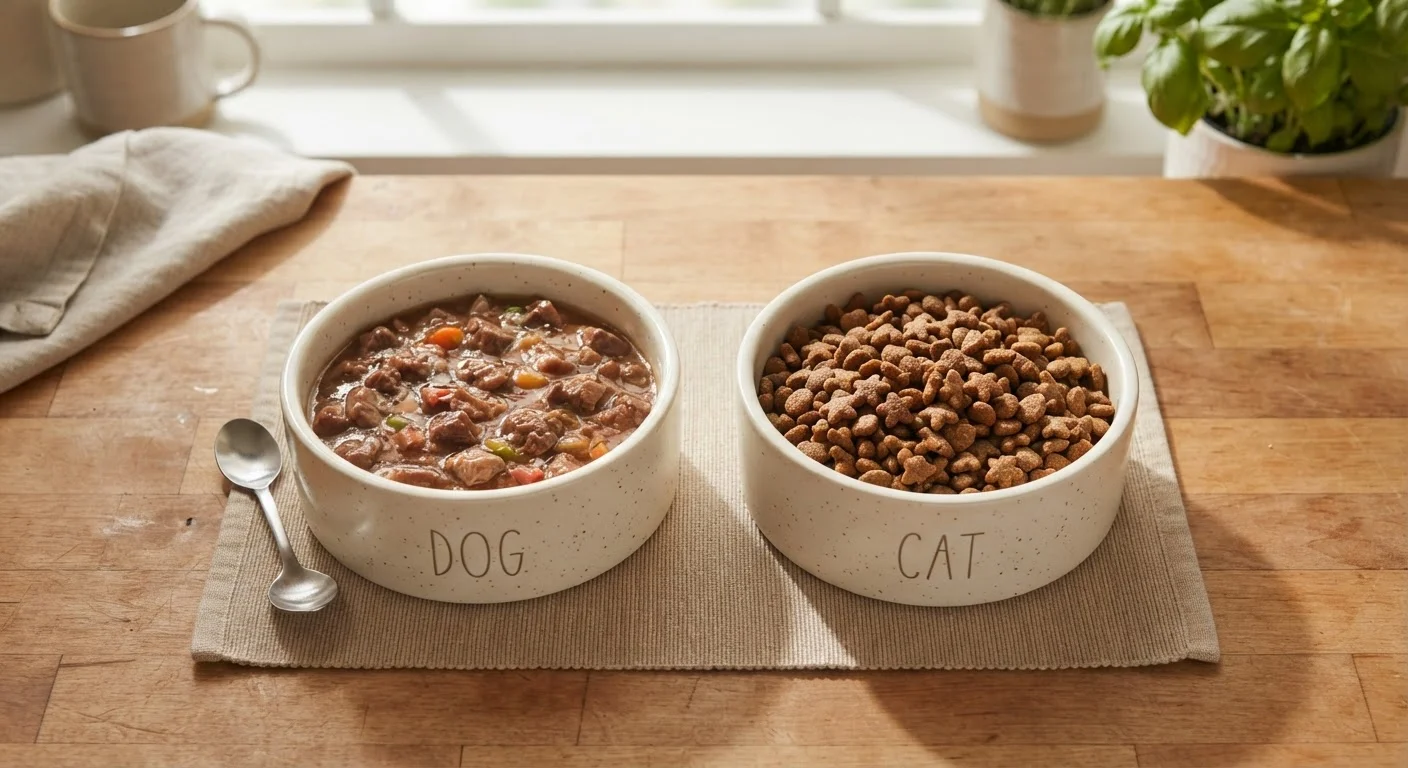
The most fundamental distinction between wet and dry pet food is moisture content. Wet food—sometimes called canned food or pâté—typically contains 70–80% water, while dry kibble generally clocks in at around 10% moisture or less. That gap has real downstream consequences for digestion, satiety, caloric density, and organ health.
Because so much of wet food's weight is water, it delivers fewer calories per ounce than kibble. This isn't a flaw—it means pets often feel fuller on a lower caloric load, which can help with weight management. However, it also means feeding costs can be higher when wet food is used exclusively for larger breeds.
Dry kibble's low moisture content is what gives it its long shelf life and convenient handling. Kibble can sit in an open bag for weeks, whereas an opened can of wet food must be refrigerated and used within a few days. For multi-pet households or busy owners, that practical difference matters. For a deeper look at how hydration interacts with nutrition more broadly, see how water interacts with what your pet eats.
| Criterion | Wet Pet Food | Dry Pet Food (Kibble) |
|---|---|---|
| Moisture content | 70–80% | ~10% or less |
| Calories per ounce | Lower (due to water weight) | Higher, calorie-dense |
| Shelf life (opened) | 2–3 days refrigerated | Weeks in a sealed bag |
| Palatability | Generally higher aroma and appeal | Variable; texture less appealing to some |
| Ease of portion control | Moderate (cans vary in size) | Easy to measure precisely |
| Dental considerations | Soft; no mechanical abrasion | Some kibble designed for plaque reduction |
| Best for urinary health | Yes, especially for cats | Less so without added water intake |
| Typical cost per serving | Higher, especially for large dogs | Generally lower |
Why Moisture Content Matters More for Cats Than Dogs
Cats evolved in arid environments and have a naturally low thirst drive—they are biologically conditioned to obtain most of their fluid from prey, which is itself roughly 70% water. When cats eat only dry kibble, many don't compensate by drinking enough from a bowl, which can contribute to chronic low-grade dehydration and place strain on the kidneys and urinary tract over time.
This doesn't mean dry food is harmful to cats by default, but it does mean moisture intake deserves more deliberate attention in feline care. Veterinarians frequently recommend wet food—either exclusively or as part of a mixed-feeding routine—for cats prone to urinary crystals, feline idiopathic cystitis, or early-stage kidney disease. Always discuss specific dietary changes with your veterinarian before making them.
Dogs are generally more efficient drinkers and less prone to the same degree of moisture-related complications, though individual health profiles vary considerably. Senior dogs, for instance, may also benefit from wet food's texture and higher water content.
70–80%
Moisture in wet pet food
The high water content of canned pet food mirrors the natural moisture found in whole prey, which is the dietary baseline cats evolved around.
~10%
Moisture in dry kibble
Kibble's low moisture content extends shelf life but means pets—especially cats—may not meet daily fluid needs through food alone.
3 of 4
Veterinarians who recommend mixed feeding
Veterinary surveys commonly find that a substantial majority of practitioners support combining wet and dry food rather than relying exclusively on one format.
Nutrient Profiles, Processing, and Label Literacy
Both wet and dry pet foods can be nutritionally complete—the format alone doesn't determine quality. What matters is whether the food meets established nutritional standards for your pet's life stage. In the United States, the AAFCO sets model nutrient profiles that reputable manufacturers use as a benchmark. Look for an AAFCO nutritional adequacy statement on the label before anything else.
One nuance worth understanding: because wet food contains so much water, the dry matter basis comparison is more meaningful than the percentages shown on the label. For example, a wet food listing 8% protein actually delivers a higher protein concentration on a dry matter basis than the raw label suggests. Our guide to decoding pet food labels walks through guaranteed analysis and how to interpret those numbers accurately.
Processing methods differ between formats too. Kibble is typically extruded at high heat, which can reduce some heat-sensitive nutrients—these are usually added back through supplementation. Wet food is processed at lower temperatures in sealed containers, which may preserve certain nutrients better, though both formats are engineered to meet the same nutritional standards when properly formulated. For perspective on how processing affects food broadly, understanding food processing on a spectrum offers useful context.
This article provides general pet care information and is not a substitute for personalized veterinary advice. Always consult a licensed veterinarian before making significant changes to your pet's diet, especially if your pet has an existing health condition.