

| Regulated label sections | Ingredient list, guaranteed analysis, AAFCO statement, feeding directions, manufacturer contact (AAFCO Model Pet Food Regulations) |
| Ingredient list order | By pre-processing weight (heaviest first) (FDA Pet Food Labeling Requirements) |
| Moisture content: typical dry food | Approximately 10% (General industry reference) |
| Moisture content: typical wet food | 75–85% (General industry reference) |
| AAFCO feeding trial duration (minimum) | 26 weeks for adult maintenance (AAFCO Official Publication) |
| "Holistic" — regulated definition? | No — no legal definition in US pet food regulation (AAFCO Model Pet Food Regulations) |
The Ingredient List: Order Matters, But Context Is Everything
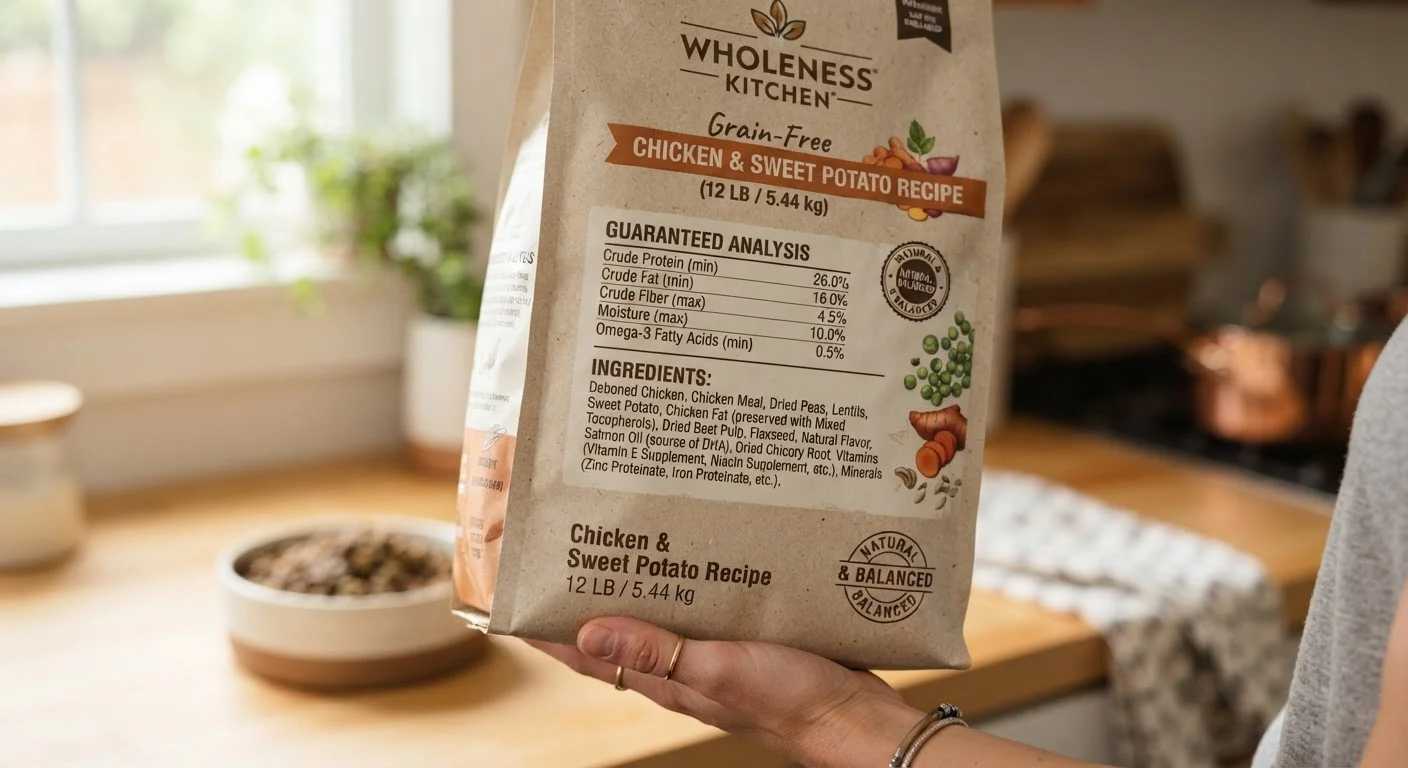
Pet food ingredients are listed by weight before processing — the heaviest ingredient appears first. That sounds reassuring when you see "chicken" at the top, but the picture is more nuanced. Raw chicken is roughly 70% water; once cooked and dried, it shrinks considerably. A dry food listing "chicken" first may still deliver more protein from a grain or meal ingredient listed third or fourth.
Ingredient splitting is another pattern worth recognizing. A manufacturer might list "ground corn," "corn gluten meal," and "corn flour" separately — each falls lower on the list individually than they would if combined. This isn't necessarily harmful, but it can make a grain-heavy food appear more meat-forward than it is.
Named meals — such as "chicken meal" or "salmon meal" — are actually concentrated protein sources with most moisture already removed. They can be a perfectly appropriate ingredient, often delivering more protein per pound than their whole-meat counterparts. What you generally want to avoid are vague terms like "meat meal" or "animal by-product meal" without a named species, as these offer less transparency about sourcing. For a broader look at how labels work from the ground up, see our full label reading guide.
AAFCO
The Association of American Feed Control Officials, a voluntary membership organization that establishes model regulations and nutritional standards for pet food in the United States. AAFCO does not directly regulate pet food but sets the standards that most states adopt into law.
Guaranteed Analysis
A mandatory label panel showing minimum percentages of crude protein and crude fat, and maximum percentages of crude fiber and moisture. These are legal minimums and maximums — not exact nutrient values.
Ingredient Splitting
A labeling practice in which a single ingredient (such as corn) is listed under multiple forms (corn flour, corn gluten meal, ground corn) so that each entry appears individually lower on the ingredient list than the combined ingredient would.
Dry-Matter Basis
A calculation method that removes the effect of moisture content when comparing the nutrient levels of two different pet foods, making it possible to compare wet and dry foods fairly.
Named Meal
An ingredient such as "chicken meal" or "salmon meal" that has been rendered and dried to remove most moisture. Named meals are concentrated protein sources and can be a high-quality ingredient when the species is clearly identified.
Life Stage Labeling
An AAFCO-required designation specifying which life stage a food is formulated for — such as adult maintenance, growth and reproduction, or all life stages. A food must be nutritionally appropriate for the life stage it claims to support.
Guaranteed Analysis: What the Numbers Actually Tell You
The guaranteed analysis panel lists minimum percentages of crude protein and crude fat, plus maximum percentages of crude fiber and moisture. These are legal guarantees to the FDA and AAFCO standards — not precise nutritional values. "Crude" simply refers to the measurement method, not quality.
One common confusion arises when comparing wet and dry foods. A wet food showing 8% protein isn't nutritionally inferior to a dry food at 28% — the difference is almost entirely water content. To make a fair comparison, calculate both on a dry-matter basis by dividing the nutrient percentage by (100 minus the moisture percentage). This levels the playing field significantly.
| Regulated label sections | Ingredient list, guaranteed analysis, AAFCO statement, feeding directions, manufacturer contact (AAFCO Model Pet Food Regulations) |
| Ingredient list order | By pre-processing weight (heaviest first) (FDA Pet Food Labeling Requirements) |
| Moisture content: typical dry food | Approximately 10% (General industry reference) |
| Moisture content: typical wet food | 75–85% (General industry reference) |
| AAFCO feeding trial duration (minimum) | 26 weeks for adult maintenance (AAFCO Official Publication) |
| "Holistic" — regulated definition? | No — no legal definition in US pet food regulation (AAFCO Model Pet Food Regulations) |
Guaranteed analysis tells you nothing about ingredient quality, digestibility, or how bioavailable a nutrient actually is for your pet. Two foods can show identical numbers while differing enormously in how well a dog or cat can actually absorb and use those nutrients. If you're also curious how these concepts compare to human food labels, this primer on reading nutrition labels offers useful parallel context.
AAFCO Statements: The One Line Worth Finding
Somewhere on the label — often near the ingredient list or on the bottom panel — you should find a statement referencing AAFCO (Association of American Feed Control Officials) nutritional standards. This is one of the most meaningful pieces of information on the package.
There are two forms this statement can take. A food formulated to meet AAFCO nutrient profiles was developed to hit established minimum levels on paper. A food that passed AAFCO feeding trials was actually tested in animals over a defined period. Both are legitimate, but feeding trials represent a higher bar for real-world performance.
The statement also specifies life stage: "all life stages," "adult maintenance," or "growth and reproduction." A food labeled only for adult maintenance is not formulated to support a growing puppy or a pregnant cat — life stage specificity matters for your pet's health. For more on how diet intersects with common myths, our nutrition myth fact-check separates marketing claims from what veterinary science supports.
When to Talk to Your Vet About Diet
Label literacy is a useful starting point, but individual pets have specific needs based on age, breed, health status, and activity level. If your pet has a diagnosed condition, is at an unusual weight, or is approaching a life-stage transition (puppy to adult, adult to senior), a veterinarian or board-certified veterinary nutritionist is the right resource for personalized guidance. No label — however well you read it — can replace that professional relationship.
This article is for general informational and educational purposes only and is not a substitute for professional veterinary advice. Always consult your veterinarian with questions about your pet's specific dietary needs.
Marketing Terms That Carry No Regulatory Weight
Pet food packaging is full of words designed to appeal to health-conscious owners — many of which have no legal definition in the context of pet food regulation. Understanding which terms are regulated and which are marketing copy helps you focus on what genuinely matters.
- "Natural" — Has a loose AAFCO definition (no synthetic chemicals in the final product), but does not speak to ingredient quality, sourcing, or nutritional value.
- "Holistic" — Has no regulatory definition whatsoever in pet food. Any brand can use it freely.
- "Human-grade" — Only meaningful if the manufacturer can substantiate the entire production process meets USDA standards for human food. Most uses of this phrase are unverified marketing.
- "Premium" or "Ultra-premium" — No legal standard. These terms do not require higher-quality ingredients.
- "Grain-free" — Describes what's absent, not what's present. Grain-free foods substitute other carbohydrate sources and are not automatically superior. The FDA has investigated a potential link between grain-free diets and dilated cardiomyopathy in dogs, though research is ongoing.
The ingredient list, guaranteed analysis, and AAFCO nutritional adequacy statement are the three sections regulators actually require. Everything on the front of the bag is largely unregulated. Putting most of your attention on the back panel is a practical, evidence-grounded habit. If you're navigating wet versus dry options alongside label reading, our wet vs. dry food comparison explains how format affects what those labels mean in practice.