

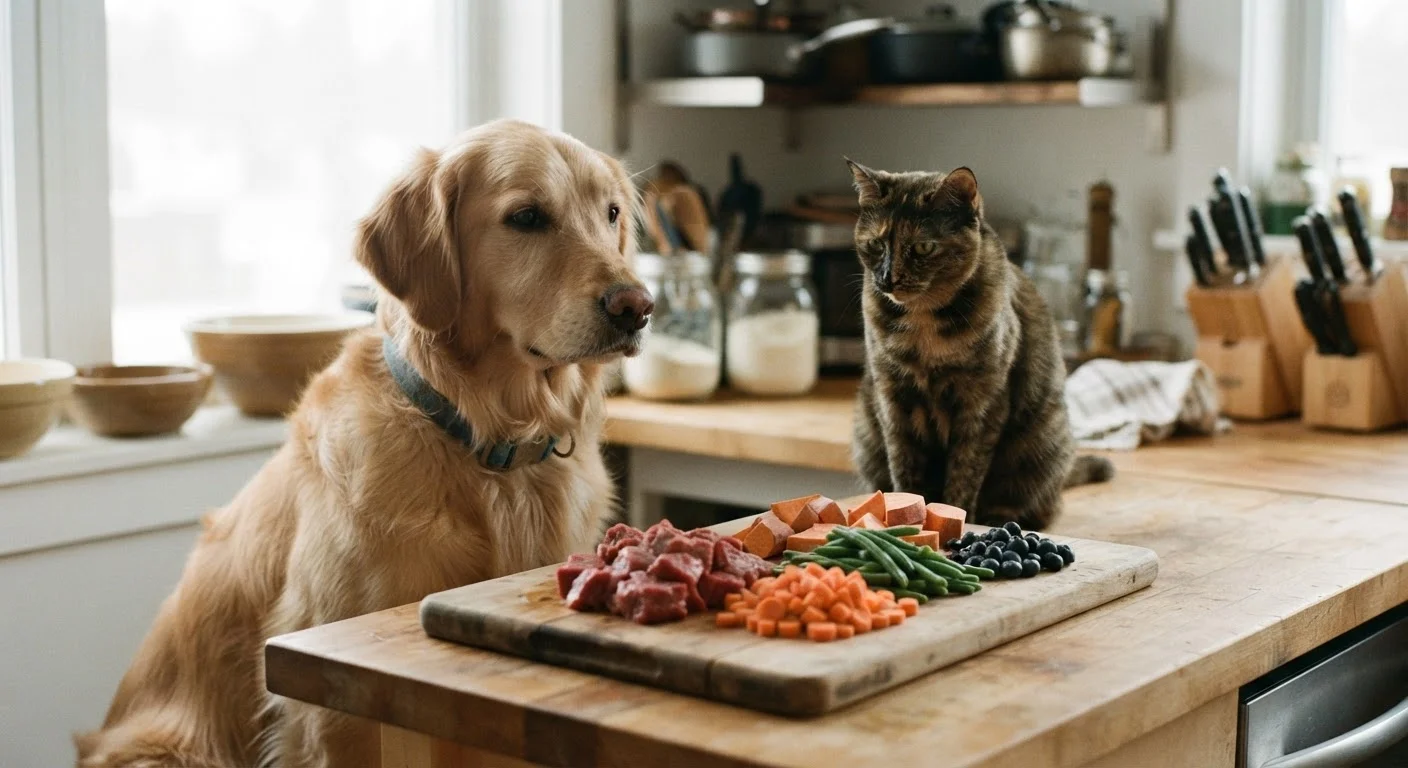
Key Takeaways
- Raw diets carry documented food-safety risks, including bacterial and parasitic contamination that can affect pets and humans.
- No large-scale peer-reviewed trials currently confirm that raw diets outperform nutritionally complete commercial foods.
- Homemade raw meals are frequently nutritionally unbalanced unless formulated by a board-certified veterinary nutritionist.
- Wolves and dogs share ancestry but have meaningfully different digestive biology and domestication adaptations.
- Any significant dietary change for your pet should be discussed with your veterinarian before implementation.
Why Raw Feeding Sparks Such Strong Opinions
Few topics in pet nutrition generate as much passion as raw diets. Advocates describe transformative results — shinier coats, better digestion, higher energy. Critics, including most major veterinary bodies, point to measurable safety concerns. The gap between these positions often comes down to how people weigh personal observation against controlled research, and how well they understand what the science currently can and cannot tell us.
This article works through the most common beliefs about raw feeding and checks each one against available veterinary guidance and food-safety evidence. The goal isn't to tell you what to feed your pet — that conversation belongs with your vet — but to help you evaluate the claims you'll encounter. For a broader look at nutrition labels and marketing language, see our guide on decoding pet food labels.
Myth
Raw diets are what dogs and cats evolved to eat, so they must be healthier than processed food.
Fact
Dogs have undergone significant genetic adaptation to domestication, including changes in starch digestion, and cats' wild diet is not directly replicated by typical raw feeding recipes.
The evolutionary argument is appealing but oversimplified. Dogs diverged from wolves thousands of years ago and have accumulated genetic changes — including additional copies of the amylase gene — that improve their ability to digest starchy foods. This doesn't make kibble optimal, but it does undermine the idea that dogs are biologically identical to wolves. For cats, obligate carnivores do have specific protein and nutrient needs, but a prey-based wild diet is far more varied and nutritionally complex than most homemade raw recipes. Evolutionary biology tells us something about what animals can tolerate; it doesn't automatically tell us what is best in a domestic context.
Myth
Raw meat is safe because pets' stomachs are acidic enough to kill any harmful bacteria.
Fact
Gastric acid reduces but does not eliminate pathogen risk, and dogs and cats can shed harmful bacteria in their feces even without appearing sick.
Stomach acidity provides some protection, but it is not a reliable sterilization system. Studies have detected Salmonella, Listeria monocytogenes, and E. coli in the feces of dogs fed raw meat diets — including animals that showed no obvious signs of illness. This matters because it creates a transmission pathway to people in the household, particularly children, older adults, pregnant individuals, and immunocompromised people. The U.S. Centers for Disease Control and Prevention (CDC) and the U.S. Food and Drug Administration (FDA) have both flagged raw pet food as a documented source of human foodborne illness clusters. The risk is not theoretical.
Myth
Feeding raw automatically produces a shinier coat and better digestion.
Fact
Improvements in coat condition and digestion reported by raw feeders are largely anecdotal and may reflect overall dietary improvement rather than anything unique to raw food.
Many owners who switch to raw simultaneously move from a low-quality commercial food to a higher-protein, lower-filler diet. Any improvement they observe may stem from the general nutritional upgrade rather than the raw component specifically. Coat quality and digestive health are influenced by protein quality, fat profile, hydration, and overall caloric adequacy — factors present in well-formulated cooked and commercial diets too. Rigorous controlled trials comparing matched nutritional profiles in raw versus cooked formats are lacking, so the claim that raw as such produces these benefits remains unsubstantiated by current peer-reviewed evidence.
Myth
Bones in a raw diet are safe and a great source of calcium.
Fact
Raw bones carry real risks including tooth fractures, choking, gastrointestinal obstruction, and internal puncture injuries.
Proponents distinguish between raw bones (softer) and cooked bones (which splinter more easily), and that distinction has some validity — cooked bones are considered more dangerous. However, raw bones are not risk-free. Veterinary emergency records include cases of tooth fractures, esophageal obstruction, gastric perforation, and intestinal blockage linked to raw bone consumption. The risk varies by bone type, animal size, and chewing behavior, but no bone type is universally safe. Calcium needs in companion animals are well-established and can be met through formulated diets or veterinarian-approved supplementation without the mechanical and pathogen risks that bones introduce.
Myth
Commercial pet foods are full of harmful fillers and offer no real nutritional value.
Fact
Regulated commercial pet foods meeting AAFCO nutritional profiles are formulated to provide complete and balanced nutrition, though ingredient quality and formulation vary across products.
The Association of American Feed Control Officials (AAFCO) sets nutrient profiles that commercial foods labeled "complete and balanced" must meet. This doesn't mean all commercial foods are equivalent — ingredient quality, digestibility, and manufacturing practices differ. But the blanket claim that commercial foods are nutritionally empty misrepresents how the regulatory framework works. Understanding label terminology helps here: our article on reading a pet food label explains what terms like "complete and balanced" actually mean versus pure marketing language.
What the Evidence Actually Supports — and Where Gaps Remain
The honest summary of raw diet research is that it is still limited in scope and quality. Small observational studies have suggested associations between raw feeding and certain health markers, but association is not causation, and most studies lack control groups, long follow-up periods, or sufficient sample sizes to draw firm conclusions. Veterinary organizations including the American Veterinary Medical Association (AVMA) and the American Animal Hospital Association (AAHA) have published position statements advising against raw protein diets, citing pathogen risks — particularly for Salmonella, Listeria, and Toxoplasma — that can affect both animals and the humans who handle their food.
Food Handling Safety Is Non-Negotiable
If you do feed raw, standard food-safety practices are essential: use separate cutting boards and utensils, wash hands thoroughly after handling raw meat or pet bowls, sanitize food preparation surfaces, and store raw pet food away from human food. These steps reduce — but do not eliminate — the risk of cross-contamination. The FDA provides publicly available guidance on safe raw pet food handling practices.
Nutritional completeness is a separate but equally important concern. Research published in peer-reviewed veterinary journals has found that a large proportion of homemade raw recipes — even those sourced from popular books or websites — do not meet established nutrient profiles for dogs or cats. Deficiencies in calcium, phosphorus, iodine, and essential fatty acids are among the most commonly documented. A board-certified veterinary nutritionist can formulate a balanced raw diet, but this is meaningfully different from following a generic online recipe.
If you're weighing raw against other formats, our comparison of wet food versus dry food covers how nutrient profiles differ across commercial options. And for a broader check on nutrition claims, the common pet nutrition myths article addresses several overlapping misconceptions.
This article provides general educational information about pet nutrition and is not a substitute for personalized veterinary advice. Always consult a licensed veterinarian before making significant changes to your pet's diet.