

Key Takeaways
- Yield to circulating traffic before entering a roundabout - never assume you have the right of way.
- Roundabouts reduce fatal and injury crashes significantly compared to traditional stop-and-signal intersections.
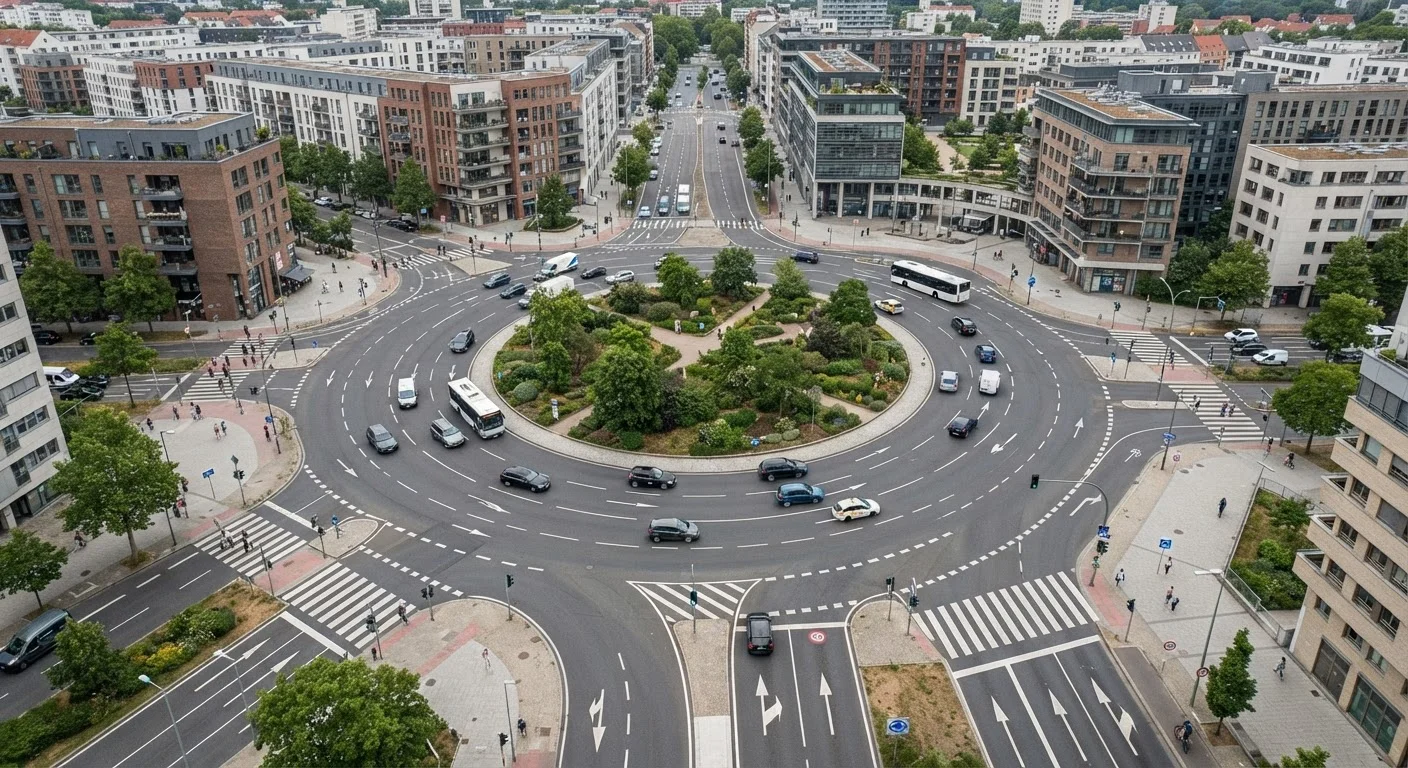
- Lane choice inside a multi-lane roundabout matters; selecting the wrong lane causes most driver errors.
- Pedestrians and cyclists have specific right-of-way protections at roundabout crosswalks.
- Speed inside a roundabout should rarely exceed 15-20 mph for safe navigation.
Why Roundabouts Trip Up American Drivers
The United States has added thousands of roundabouts over the past two decades, yet surveys consistently show that a significant share of US drivers remain uncertain about how to use them correctly. The confusion isn't about intelligence - it's about familiarity. Most American drivers learned on a grid of four-way stops and signalized intersections. Roundabouts operate on a fundamentally different logic, and without clear instruction, drivers default to old habits that don't apply.
The result is hesitation, wrong-lane entry, improper yielding, and occasionally the kind of near-miss that puts people off roundabouts entirely. The irony is that when used correctly, roundabouts are among the safest intersection designs available. Research from the Insurance Institute for Highway Safety (IIHS) indicates roundabouts reduce fatal crashes at intersections by roughly 90% and injury crashes by about 75% compared with stop-sign or signal-controlled equivalents.
For context on how merging-related confusion at other intersection types develops, see our guide on merging onto highways - many of the same yield-and-gap-judgment skills apply.
Myth
The driver entering the roundabout has the right of way over drivers already inside.
Fact
Entering drivers must always yield to traffic already circulating inside the roundabout.
This is the single most dangerous misconception about roundabouts. Unlike a four-way stop where arrival order determines priority, a roundabout gives continuous right-of-way to vehicles already in the circle. Entering drivers wait at the yield line until a safe gap opens - they never force their way in. Treating the entry like a stop sign where you take your turn will cause collisions.
Myth
You should stop inside the roundabout to let other cars enter.
Fact
Stopping inside a roundabout disrupts flow and creates rear-end collision risk - circulating traffic does not yield to entering vehicles.
Once you are inside the roundabout, you maintain your position. Stopping mid-circle confuses drivers behind you and stalls the intersection. The yield obligation belongs entirely to those entering, not those circulating. If you feel pressure to stop for an entering driver, resist it - proceed at a safe, steady speed and trust that entering drivers are required to wait for you.
Myth
Roundabouts are too complicated for large trucks and emergency vehicles.
Fact
Modern roundabouts are specifically engineered to accommodate oversize vehicles through apron designs and wide entry radii.
Most roundabouts include a truck apron - a slightly raised paved ring around the central island that large vehicles can mount with their rear wheels while their front wheels track the outer lane. Emergency vehicles use roundabouts routinely. If you see an emergency vehicle approaching, pull to the right and stop before the roundabout entry, not inside it, as you would at any intersection. For more on sharing roads with large vehicles, see our guide to sharing the road with trucks.
Myth
You can switch lanes inside a roundabout whenever you need to.
Fact
Lane changes inside a multi-lane roundabout are dangerous and generally prohibited by road rules in most states.
The correct approach is to choose your lane before you enter and stay in it through your exit. Changing lanes mid-circle puts you in the blind spot of adjacent drivers who are also navigating a curve at the same time. If you miss your exit because you're in the wrong lane, the safest action is to complete another loop and exit correctly - not to cut across lanes.
Myth
Roundabouts cause more backups than traffic lights because there's no green phase to batch traffic.
Fact
Roundabouts typically move traffic more efficiently than signals at comparable intersection volumes.
Traffic signals force all directions to stop in rotation, creating queues even when cross-traffic is minimal. Roundabouts allow continuous movement when gaps exist, which reduces overall delay. The Federal Highway Administration has documented average delay reductions of 13-23% at locations converted from signals to roundabouts. They do have practical upper limits - very high-volume intersections may still require signals - but for most suburban and rural settings, roundabout throughput compares favorably.
Roundabout Rules That Catch Drivers Off Guard
Beyond the individual myths, a few practical points deserve emphasis. First, lane discipline in multi-lane roundabouts is the single greatest source of driver error. If you're turning right or going straight, use the right lane. If you're going straight, turning left, or making a U-turn, use the left lane. When in doubt, follow the pavement markings - they're there specifically to reduce ambiguity.
Second, speed management is built into the geometry. A well-designed roundabout forces entry speeds down through curvature, so drivers who feel the need to brake hard are likely entering too fast. Approach at a speed that allows comfortable yielding - typically 15-20 mph - and let the road's shape do the rest.
Third, pedestrians and cyclists have dedicated crosswalks set back from the circulatory roadway. Drivers exiting the roundabout must yield to pedestrians at these crossings, just as they would at any marked crosswalk. This is an area where drivers sometimes let their guard down after the perceived complexity of the roundabout itself is behind them.
For a broader look at how intersection behavior changes across environments, the article on urban vs. rural driving hazards covers how road design expectations shift depending on where you're driving. And if you want to brush up on the signs that direct you into and around roundabouts, our US road signs field guide is a useful reference.
Don't Stop Inside a Roundabout
Stopping mid-circle to let entering traffic in is one of the most common - and dangerous - roundabout errors. Drivers behind you have no warning, and rear-end collisions in curved roadways are difficult to avoid. If an entering driver looks like they're pulling out, hold your line at a safe, steady speed. The right-of-way is yours once you're inside.