

Key Takeaways
- Rural roads account for a disproportionately high share of US traffic fatalities despite carrying less overall traffic.
- Urban driving demands constant split-second attention to pedestrians, cyclists, and complex intersections.
- Higher rural speeds mean crash forces are far greater, reducing survivability without seatbelts and proper vehicle control.
- City drivers face more frequent incidents; rural drivers face fewer but more deadly ones.
- Wildlife, poor road markings, and slow emergency response compound rural crash outcomes.
- Both environments require deliberate habit adjustments - the same routine that works in one setting can increase risk in the other.
Option A
Urban Driving
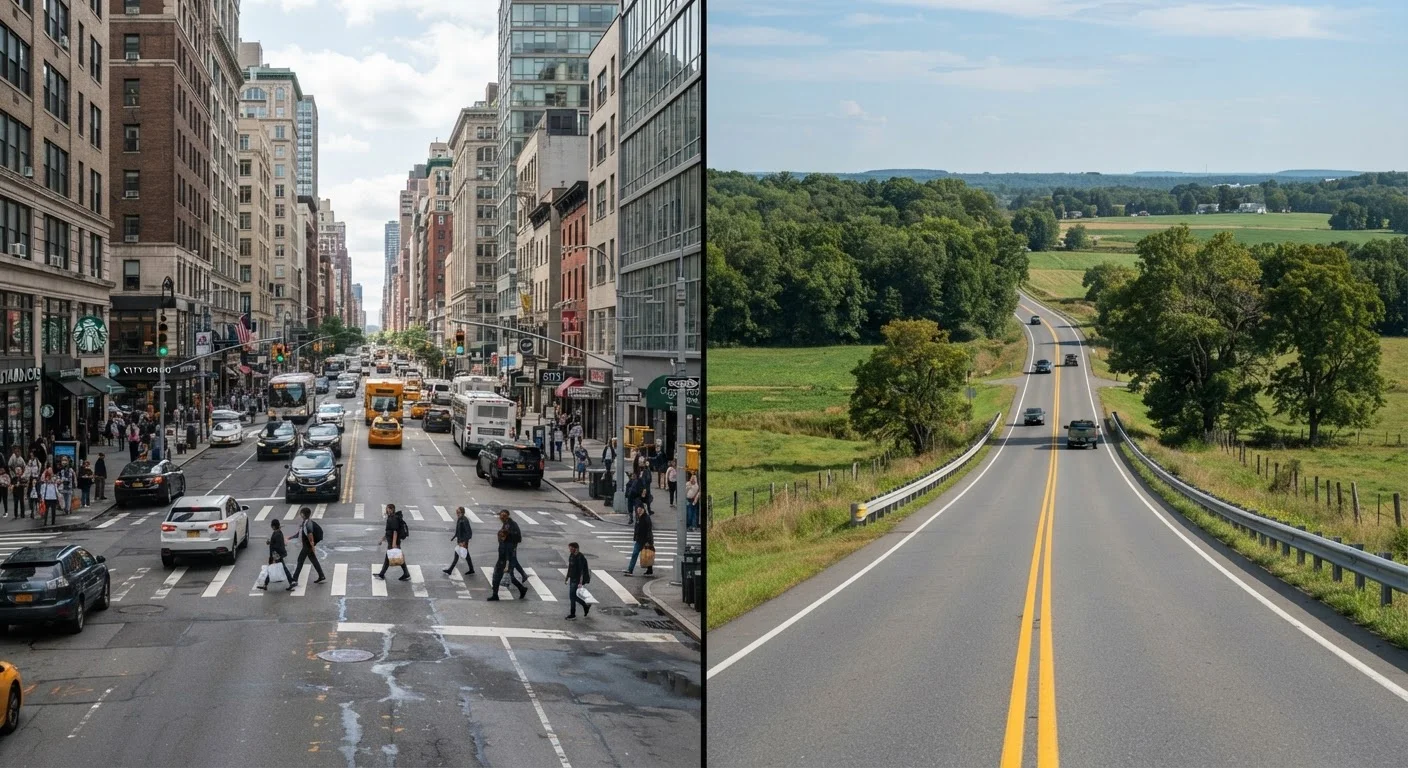
High-density, low-speed environments where attention never rests.
Best for: Drivers who need to manage constant stop-and-go traffic, pedestrians, cyclists, and complex intersections in city environments.
Option B
Rural Driving
Open roads where speed and isolation create underestimated dangers.
Best for: Drivers who cover long stretches of undivided highway, deal with wildlife, and have limited access to emergency services.
If you drive primarily in dense city traffic
Urban Driving awareness strategies
Focus on intersection scanning, pedestrian anticipation, and managing short following distances - the hazards are frequent but typically lower-speed.
If you regularly drive on rural two-lane highways
Rural Driving awareness strategies
Prioritize speed management, fatigue monitoring, and wildlife vigilance - crashes are less frequent but far more likely to be fatal.
If you split time between city and rural environments
Both sets of strategies
Consciously shift your mental model when the environment changes; the habits that keep you safe on a country road can lull you into complacency in city traffic, and vice versa.
Why the Fatality Numbers Tell Different Stories
A common assumption is that more cars in a tighter space automatically means more danger. The data complicates that picture. According to the National Highway Traffic Safety Administration (NHTSA), rural roads consistently account for roughly half of all US traffic fatalities despite carrying a minority of total vehicle miles traveled. The reason is simple physics: higher speeds mean dramatically more kinetic energy in a crash, and rural roads offer less of the infrastructure - guardrails, median barriers, adequate lighting - that absorbs that energy.
Urban roads see more crashes in raw numbers, largely because more interactions occur per mile. But a low-speed fender-bender at a city intersection and a head-on collision on an undivided two-lane highway are categorically different events. Understanding which environment you're in - and what that environment demands of you - is the first step toward adjusting your behavior appropriately.
The Urban Hazard Profile: Density, Distraction, and Conflict Points
City driving is defined by its density of conflict points - intersections, crosswalks, bike lanes, bus stops, parking garage exits, and delivery vehicles blocking travel lanes. Each of these is a location where the paths of different road users cross, and each crossing is an opportunity for error.
Pedestrians and cyclists are the most vulnerable road users in urban settings. According to NHTSA data, the overwhelming majority of pedestrian fatalities occur in urban areas. Left-turn crashes at signalized intersections are a particular risk, because drivers are scanning oncoming traffic while pedestrians legally enter the crosswalk. Roundabouts address some of these conflict points by eliminating the left turn entirely, but they introduce their own learning curve for many US drivers.
Stop-and-go congestion also elevates rear-end collision rates, and urban environments concentrate distracted driving behavior - navigation apps, unfamiliar streets, and the visual noise of storefronts and signage all compete for attention. The practical adjustment is disciplined scanning: check mirrors frequently, look two to three vehicles ahead in traffic, and treat every intersection as a potential conflict zone regardless of your signal color.
| Criterion | Urban Driving | Rural Driving |
|---|---|---|
| Primary hazard type | Pedestrians, cyclists, intersections | High-speed crashes, wildlife, fatigue |
| Crash frequency | Higher - more conflict points | Lower - fewer interactions |
| Crash severity | Typically lower-speed impact | Often high-speed, more fatal |
| Infrastructure quality | Signals, crosswalks, lighting | Often unlit, unmarked shoulders |
| Emergency response time | Minutes in most areas | Can exceed 30 minutes |
| Key driver adjustment | Intersection scanning, pedestrian awareness | Speed management, fatigue monitoring |
The Rural Hazard Profile: Speed, Isolation, and the Unexpected
Rural roads appear forgiving - open stretches, light traffic, scenic surroundings - but that appearance masks a specific set of dangers. The core issue is speed combined with reduced infrastructure. Many rural two-lane roads lack center rumble strips, have soft shoulders that drop away sharply, and offer minimal lighting after dark. A momentary drift at 65 mph carries consequences that the same lapse at 25 mph simply does not.
Wildlife strikes are a genuine hazard, particularly at dawn and dusk when deer and other large animals are most active. Unlike urban hazards that often give a fraction of a second of warning, animal crossings are abrupt and unpredictable. Slowing below posted limits in known wildlife corridors and scanning the road edges is a practical mitigation, not an overly cautious one.
Fatigue is another rural-specific amplifier. Long, monotonous stretches reduce cognitive engagement, increasing the risk of microsleep - brief, involuntary episodes of unconsciousness that can last several seconds. At highway speeds, several seconds of inattention covers hundreds of feet. Night driving compounds this risk significantly, since rural roads rarely have the ambient lighting that keeps city drivers more alert.
Emergency response times in rural areas are also substantially longer than in urban ones, which means crash outcomes are more severe not only because of speed but because help arrives later. Wearing a seatbelt, which dramatically improves survival odds in high-speed crashes, is non-negotiable in any environment - but its importance is especially acute on rural roads where crash forces are higher and assistance is further away.
~49%
Rural share of US traffic fatalities
NHTSA data consistently shows rural roads account for roughly half of all US traffic deaths despite lower overall traffic volume.
3 sec
Minimum safe following distance
The three-second rule is a widely recognized baseline, but safety authorities recommend extending it at rural highway speeds or in poor conditions.
~76%
Pedestrian fatalities occurring in urban areas
NHTSA figures indicate the large majority of pedestrian deaths occur in urban environments, reflecting the density of foot traffic and vehicle interactions.
Adapting Your Habits When the Environment Changes
Many drivers develop habits calibrated to the environment they drive in most often and then carry those habits unchanged into unfamiliar settings. A rural commuter who is accustomed to open roads and light traffic may underestimate pedestrian density when driving through an unfamiliar city. Conversely, a city driver transitioning to a rural highway may underestimate safe following distances at higher speeds or fail to account for the absence of street lighting after dark.
Highway-specific habits like tailgating are more dangerous than many drivers realize, because stopping distances at rural road speeds require far more space than most people maintain. A good rule of thumb remains the three-second following-distance rule, and that minimum should extend further in adverse weather. For guidance on how rain, snow, and fog alter stopping distance and vehicle control, see how conditions change the rules.
The underlying skill in both environments is deliberate situational awareness - reading the road type you're on, identifying its specific risk profile, and adjusting speed, following distance, and scanning behavior accordingly. Neither urban nor rural driving is inherently safer. They are differently dangerous, and treating them as such is what separates reactive drivers from genuinely skilled ones.