

Key Takeaways
- Nighttime driving fatalities are disproportionately high despite lower overall traffic volume after dark.
- Human vision loses depth perception and peripheral range significantly in low-light conditions.
- Slowing down, managing headlight aim, and reducing interior glare are concrete steps that improve night safety.
- Fatigue compounds every night-driving risk - recognizing drowsiness cues early is critical.
- Rural roads at night carry distinct hazards compared to lit urban streets.
Why Darkness Is a Fundamentally Different Driving Environment
Most drivers treat night driving as daytime driving with the headlights switched on. That framing understates the risk. According to the National Safety Council, roughly half of all traffic fatalities occur at night, even though nighttime accounts for a much smaller share of total miles driven.
The core reason is physiological. Human eyes rely on cone cells for sharp, color-accurate vision - and cones need light to function well. In low-light conditions, the visual system shifts toward rod cells, which detect motion but deliver poor resolution and no color distinction. The result: your ability to judge distance, spot stationary objects, and read contrast at the edge of your headlight beam degrades significantly after sunset.
Peripheral vision narrows too. At highway speeds, the field of useful vision can contract from roughly 180 degrees in daylight to a much tighter cone at night. Hazards that would register instantly in daylight - a pedestrian, a deer, road debris - may enter your field of view without triggering a fast enough response. That is not carelessness. It is the predictable consequence of how human vision works in darkness.
Understanding this shifts the task from simply reacting to hazards to actively managing conditions so hazards are detectable in time. See also how weather compounds these same challenges: driving in rain, snow, and fog.
Best Practices for Safer Night Driving
The following practices address the specific mechanisms through which darkness raises risk. Applied consistently, they meaningfully reduce exposure to the most common nighttime hazards.
Reduce your speed to stay within your actual stopping distance.
Standard low-beam headlights illuminate roughly 160-200 feet ahead. At 60 mph, a vehicle needs approximately 240 feet to stop. That gap - known as 'overdriving your headlights' - means you cannot stop in time for an object at the edge of your beam. Slowing down is the only reliable fix.
Keep headlights properly aimed and lenses clean.
Yellowed or cracked headlight lenses can reduce light output by up to 80 percent compared to clear ones. Misaimed beams either under-illuminate the road ahead or blind oncoming drivers. Neither problem is fixed by switching to high beams.
Use high beams actively on unlit roads and dim them appropriately for oncoming traffic.
Many drivers leave high beams off out of habit or uncertainty about when they are appropriate. On unlit highways with no approaching traffic within several hundred feet, high beams nearly double your visible range - a significant safety margin.
Reduce interior light and screen brightness to protect night vision.
Bright instrument clusters, infotainment screens, and GPS units create glare that forces your pupils to contract, reducing sensitivity to the darker road environment. Even small adjustments matter on a long drive.
Increase following distance beyond the standard three-second rule.
Reaction time does not get faster at night, but hazard detection time increases because objects appear later in your visual field. A larger gap provides the buffer that slower detection requires.
Schedule regular eye exams, particularly if night vision seems noticeably worse than it once was.
Conditions such as cataracts, uncorrected refractive error, and night myopia (the tendency of some eyes to shift slightly out of focus in low light) all worsen night driving performance. Many drivers attribute this to 'getting older' without seeking correction that is often available.
Managing Fatigue and the Drowsy Driving Risk
Darkness does not just impair vision - it disrupts the body's circadian rhythm and triggers melatonin release, making drivers progressively more fatigued. The hours between midnight and 6 a.m. are peak periods for drowsy-driving crashes according to the National Highway Traffic Safety Administration (NHTSA).
Recognize Drowsiness Before It Peaks
Fatigue impairs judgment gradually, which makes it easy to underestimate how impaired you already are. If you find yourself yawning repeatedly, drifting between lanes, or struggling to remember the last few miles, treat these as hard signals to stop - not warnings to push through. A 15-20 minute rest stop is far safer than attempting to 'power through' on a long nighttime trip.
Warning signs of fatigue include repeated yawning, lane drift, missing exits, and heavy eyelids. If these appear, pulling over safely and resting is the only effective response. Caffeine can provide temporary alertness but cannot replace sleep, and its effect is unreliable on severely sleep-deprived drivers. Night-driving risk does not exist in isolation from other hazardous habits - speeding and tailgating are even more dangerous after dark when stopping distances and reaction times are already stretched.
Special Considerations for Rural Night Driving
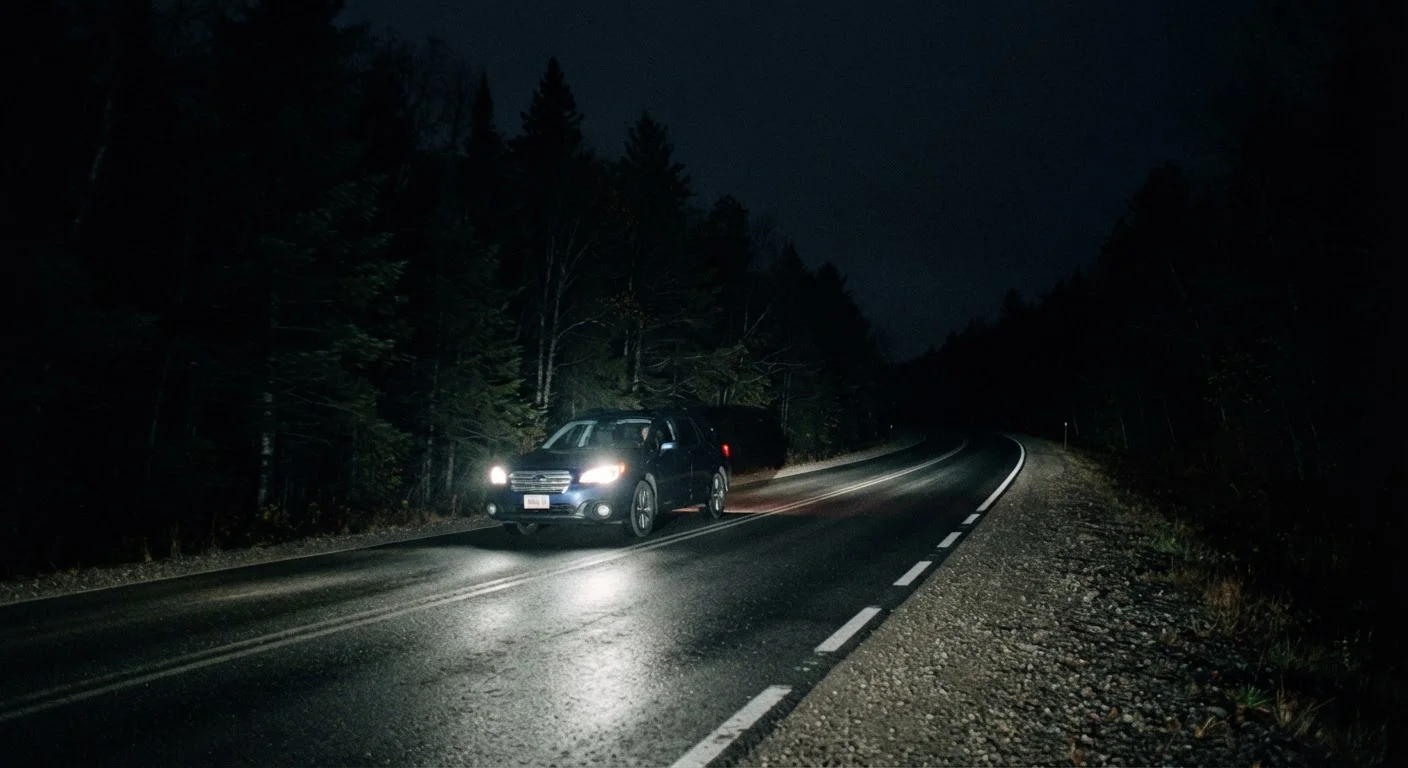
Rural roads at night remove the ambient streetlighting that urban drivers often take for granted. This creates unique challenges: animals crossing without warning, unmarked intersections, and road edges that effectively disappear beyond the headlight beam. Large trucks - whose blind spots and braking distances are already significant - are harder to judge at night. Understanding how trucks move and stop becomes even more important in unlit conditions where their size is harder to read visually.
Rural driving at night also means longer emergency response times, so a breakdown or collision carries higher secondary risk. Urban and rural roads demand different driving strategies in daylight - those differences are amplified after dark.
Animal Crossings Peak After Dark
Dawn and dusk are peak activity periods for deer and other large animals, but genuine risk extends through the night - particularly in the fall breeding season. Rural stretches in the upper Midwest, mid-Atlantic, and parts of the Southeast carry higher deer-collision rates. Slow down and scan the road shoulders actively in any area with posted wildlife crossing signs, and be aware that where one animal crosses, others often follow.
Keep an eye on your dashboard as well. A warning light that appears manageable in daylight can signal a real problem that becomes more serious in a remote night-driving situation. Know what your dashboard warning lights mean before you head out on a long nighttime drive.