

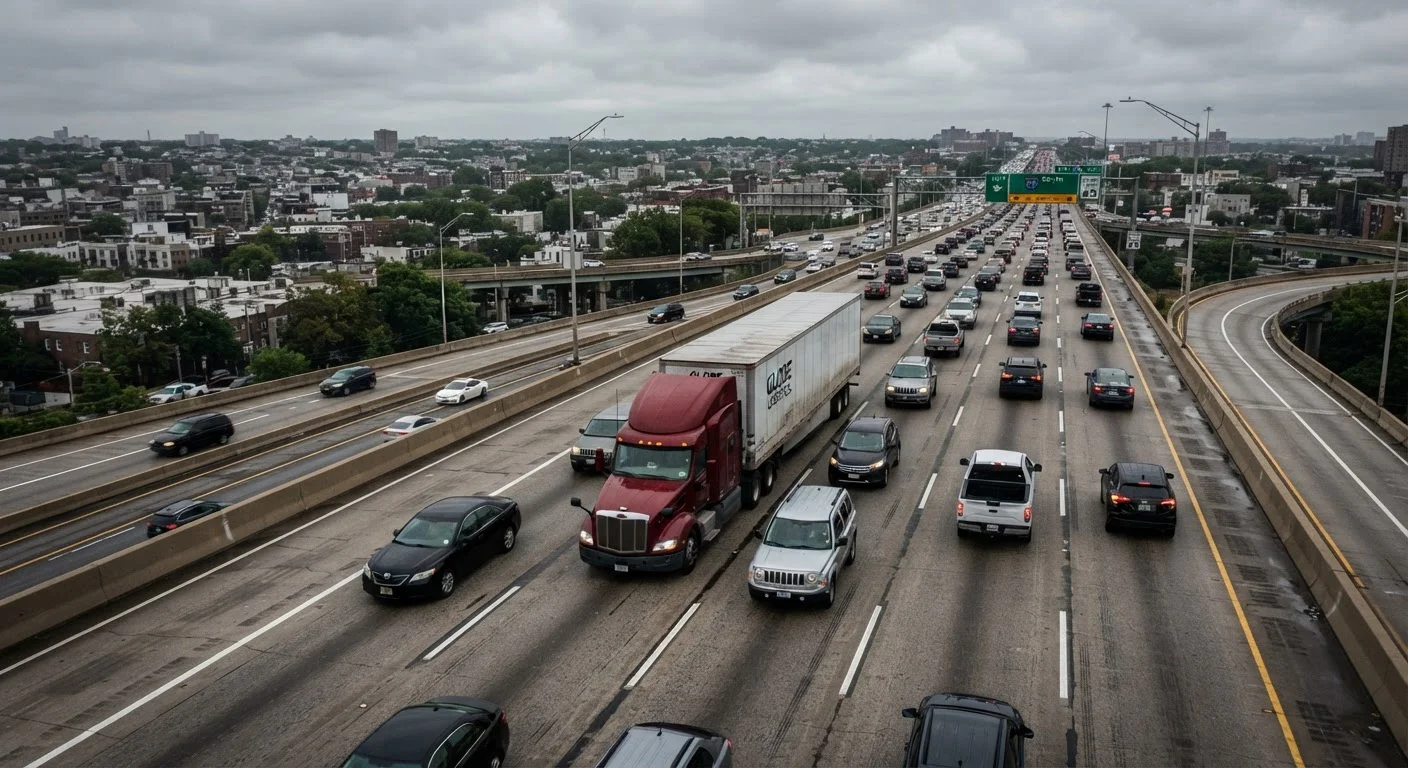
Key Takeaways
- Large trucks have four major blind spots where passenger cars become completely invisible to the driver.
- A fully loaded semi-truck at highway speed can take nearly two football fields to stop completely.
- Cutting in front of a truck after passing and braking is one of the most dangerous things a driver can do.
- Trucks need significantly more space to complete turns - especially right turns at intersections.
- Positioning yourself where you can see the truck's mirrors is the clearest way to confirm you are visible.
Why Trucks Behave So Differently Than Cars
A fully loaded tractor-trailer can weigh up to 80,000 pounds - roughly 20 to 30 times heavier than the average passenger car. That mass difference doesn't just affect braking; it governs how the vehicle steers, accelerates, turns, and responds to wind gusts or road conditions. Drivers who treat trucks as oversized cars on the highway are working with a flawed mental model, and that gap in understanding is where crashes happen.
Commercial truck drivers are professionally trained to manage these dynamics. The gap is often on the passenger car side - drivers who don't know what a truck can and can't see, or how much stopping room it genuinely needs. Closing that knowledge gap is a practical safety skill, not a niche concern. Common highway habits that feel routine can turn especially dangerous around large trucks.
The Four Blind Spots Every Driver Should Know
Federal Motor Carrier Safety Administration (FMCSA) guidelines identify four primary "no zones" around a commercial truck - areas where a passenger car can be entirely invisible to the driver:
- Directly behind the trailer: Truck mirrors cannot see straight back. If you can't see the truck's mirrors, the driver cannot see you.
- Directly in front of the cab: Due to the cab's height, anything within roughly 20 feet of the front bumper disappears from view.
- The right side: This is the largest blind spot - spanning multiple lanes and extending far back from the cab. Never linger in this zone.
- The left side: Smaller than the right but still substantial, covering roughly one lane width alongside and behind the cab.
The practical rule is simple: if you cannot see the truck driver's face in one of their side mirrors, assume they cannot see you. Adjust your position before that assumption costs you.
Braking Distance: The Number Drivers Underestimate
At 65 mph, a fully loaded semi-truck requires approximately 525 feet to stop - that's longer than one and a half football fields, according to FMCSA stopping-distance estimates. A passenger car traveling at the same speed stops in roughly 300 feet under comparable conditions. Wet roads, worn brakes, or downhill grades push those numbers further apart.
This stopping distance reality has direct behavioral implications. Cutting in front of a truck after passing - then slowing down or braking - gives the driver almost no margin to avoid a rear-end collision. The truck's size doesn't make the impact safer; it makes it catastrophically worse. After passing a truck, maintain your speed and put several car lengths of distance between you before moving back into the lane.
Equally, following a truck closely is its own hazard. You lose visibility of road conditions ahead, and if the truck brakes hard, your reaction time - plus your own stopping distance - may not be enough. Tailgating at highway speeds is dangerous in any situation; behind a truck, the consequences are amplified.
Turns, Merges, and Right-of-Way Realities
Large trucks require significantly more space to complete turns, particularly right turns. A truck may swing left before turning right to prevent the trailer from jumping the curb or striking a fixed object. If you're sitting in the right lane at an intersection next to a truck signaling right, do not pull forward alongside it - the trailer will arc into that space regardless of whether you're there.
On highways, trucks need longer gaps to merge safely. If you see a truck signaling to change lanes, the courteous and safe response is to adjust your speed to create space rather than racing to close the gap. Merging conflicts between passenger cars and trucks are a consistent source of sideswipe incidents. Understanding merge dynamics is important in any context, but critical when a truck is involved.
Practical Positioning Habits That Reduce Your Risk
Safe driving around trucks isn't about fear - it's about consistent positioning habits that keep you visible and give both vehicles adequate reaction room. Pass trucks decisively: move through their blind spot quickly rather than cruising beside the cab for extended periods. On multi-lane highways, the left lane offers better visibility and reduces time spent in the right-side blind zone.
Maintain increased following distance when behind a truck - a gap of at least four seconds at highway speeds is a commonly cited guideline, though more room is always better. This also protects you from road debris that can fall or blow off trailer loads. Before any long trip, a quick pre-trip safety check that includes mirror adjustment and tire pressure gives you the best baseline for sharing the road safely.
Driving around large trucks comfortably is a skill built through awareness rather than avoidance. Trucks are a permanent part of US roads - understanding how they operate makes every highway trip safer for everyone on it.
This article provides general driver education and safety information. Always follow local traffic laws and posted signage. For commercial driving regulations, consult FMCSA resources or your state's department of motor vehicles.