

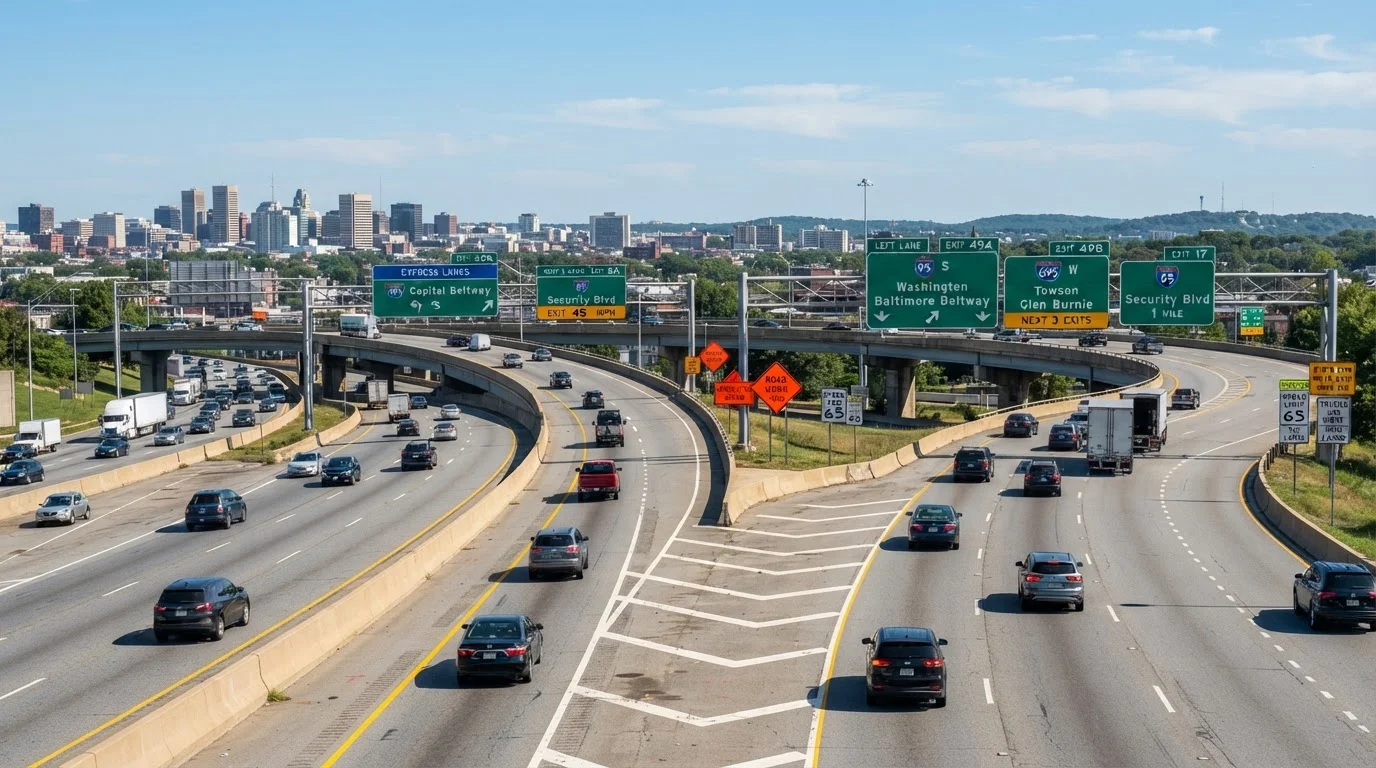
How the US Sign System Is Organized
American road signs follow a standardized system defined by the MUTCD, a federal document that governs sign design across all 50 states. The system sorts signs into three functional categories: regulatory, warning, and guide. Within those categories, shape and color do most of the communicating - even before a driver reads a single word.
Understanding this logic is the foundation of defensive driving: when you can read a sign's intent from its silhouette alone, you process hazards faster and react earlier.
Regulatory Signs: Rules You Must Follow
Regulatory signs carry legal weight. Ignoring them is a traffic violation, not just poor judgment. Most are white with black or red text and come in rectangular or specialized shapes.
- Stop (octagon, red): Come to a complete stop at the marked line. Proceed only when the intersection is clear and you have the legal right of way.
- Yield (downward triangle, red/white): Slow and give way to conflicting traffic. You do not always need to stop, but you must if necessary. Yield signs are common at roundabout entries.
- Speed Limit (white rectangle): Displays the statutory maximum for that segment. Note that limits can apply even without a sign - see our piece on posted vs. statutory speed limits for how that works.
- No U-Turn / No Left Turn (white circle, red slash): The prohibition sign family uses a red circle with a diagonal slash over the restricted action.
- One Way (black on white, horizontal arrow): Traffic flows in the arrow direction only.
- Do Not Enter / Wrong Way (red rectangle): Typically paired at divided highway exits. Wrong Way signs face drivers who have entered against traffic flow.
MUTCD
The Manual on Uniform Traffic Control Devices is a Federal Highway Administration document that standardizes road sign design, placement, and meaning across all US states and territories.
Regulatory Sign
A sign that legally requires a specific driver action or restriction. Violating a regulatory sign is a traffic offense.
Warning Sign
A sign that alerts drivers to a road condition, geometry change, or hazard ahead. Warning signs are advisory but ignoring them increases collision risk.
Guide Sign
A sign that provides navigation, destination, distance, or traveler-service information. Color coding indicates road type or service category.
Advisory Speed
A recommended speed, shown on a supplemental plate below a warning sign, that indicates a safe speed for a specific curve or condition - not a legally enforced limit.
Variable Message Sign (VMS)
An electronic overhead sign displaying real-time traffic information such as dynamic speed limits, incidents, or alerts. Messages carry the same legal standing as equivalent static signs.
Warning Signs: Hazards Ahead
Warning signs are diamond-shaped and yellow (or fluorescent yellow-green for pedestrian, bicycle, and school zones). They alert you to conditions requiring heightened attention - they do not impose a legal obligation, but disregarding them increases crash risk.
- Curve / Winding Road: Indicates the road geometry changes ahead. An advisory speed plate below the diamond suggests a safe entry speed for the curve.
- Intersection Ahead: Cross, T, or Y shapes signal an upcoming junction that may not be immediately visible.
- Merge / Lane Ends: Critical for highway merging. The lane-ends variant means traffic must join the adjacent lane; adjust speed and position early.
- Truck Rollover / Steep Grade: Found on mountain roads and sharp ramps. Relevant when sharing the road with large trucks, which need much more distance to brake on descents.
- School Zone (fluorescent yellow-green pentagon): The pentagonal shape is unique to school advance warning signs and is instantly recognizable even at distance.
Guide Signs: Navigation and Information
Guide signs direct drivers toward destinations, services, and points of interest. Color encodes the road type:
- Green: Highway and freeway destinations, exit numbers, and distances.
- Blue: Traveler services - fuel, food, lodging, hospitals, and rest areas.
- Brown: Recreational areas, national parks, scenic routes, and cultural sites.
- Orange: Temporary work-zone or detour information (technically a subcategory of warning/regulatory use).
Exit signs deserve special attention. In most states, exits are numbered by milepost, so Exit 47 is near mile marker 47. A small panel showing a distance to the exit - typically 1 mile and ½ mile advance signs - gives you time to position safely in the correct lane before the ramp.
Staying alert to guide signage is also part of avoiding distracted driving: last-second lane changes to reach an exit are a common cause of collisions.
Special-Purpose and Temporary Signs
Beyond the three primary categories, several sign types serve specific situations:
- Construction / Work Zone (orange): Fines are typically doubled in active work zones under state law. Flaggers have the same authority as a traffic control device.
- Railroad Crossings (round yellow advance warning; X-shaped crossbuck at the track): The crossbuck sign itself is a regulatory sign - you must yield to trains.
- HOV / Managed Lane (white on black or white on green): High-occupancy vehicle lanes specify a minimum passenger count and often time-of-day restrictions on a supplemental panel.
- Variable Message Signs (VMS): Electronic overhead signs that display real-time conditions - dynamic speed limits, incident alerts, or Amber Alerts. Their messages carry the same legal weight as static signs of the same category.
If your vehicle's dashboard alerts are prompting unfamiliar behaviors on the road, pairing sign knowledge with a review of dashboard warning lights gives you a more complete picture of what your car and the road are communicating simultaneously.