

Key Takeaways
- Soil is made of mineral particles, organic matter, water, air, and microorganisms - all of which affect plant health.
- Texture (the sand/silt/clay ratio) determines how well your soil drains and holds nutrients.
- Soil pH controls which nutrients plants can actually absorb, even if those nutrients are present.
- A simple jar test or inexpensive soil test kit reveals what you're working with before you plant.
- Compost is the most reliable, low-cost way to improve almost any soil type.
- Knowing your soil type helps you decide whether raised beds or in-ground planting suits your space.
Garden Soil
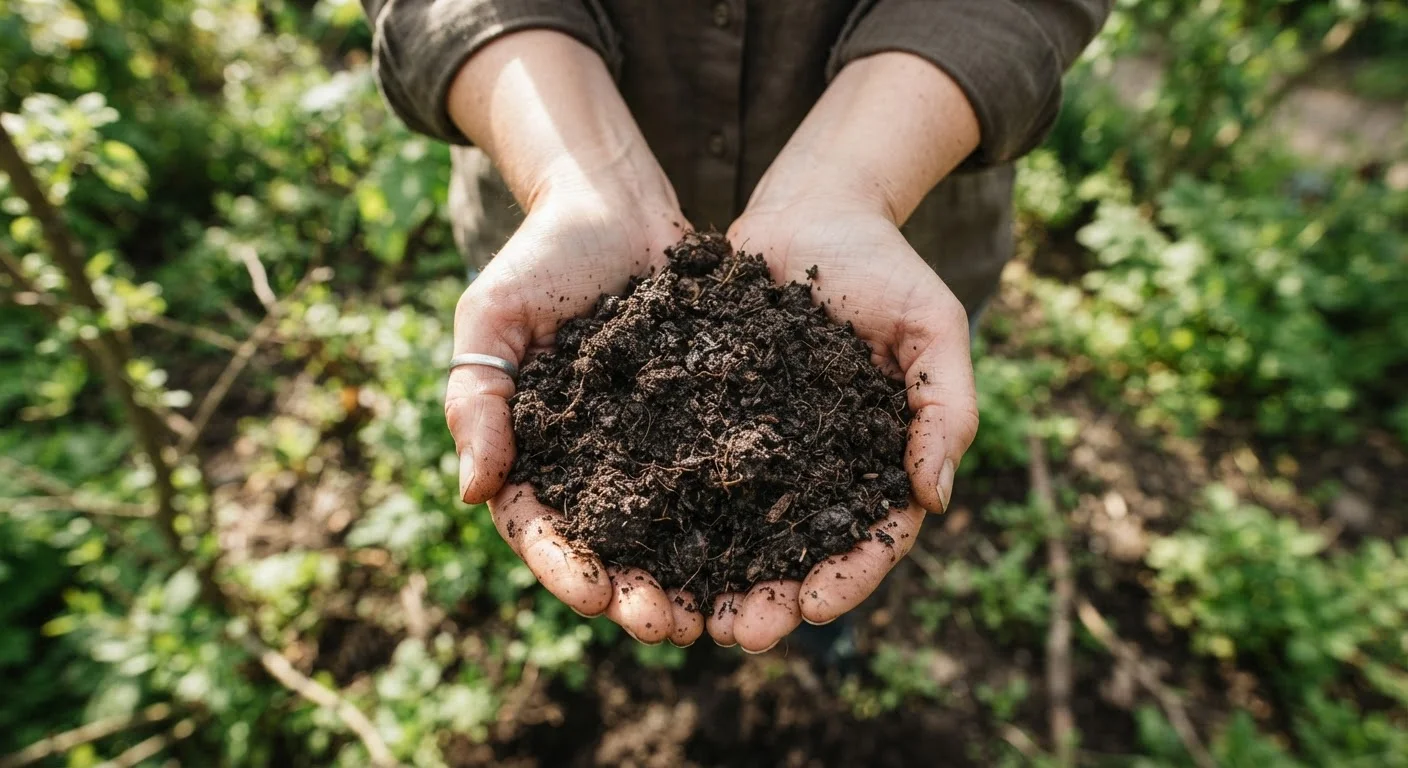
Garden soil is the upper layer of earth in which plants grow. It's a living mixture of mineral particles (sand, silt, and clay), organic matter, water, air, and billions of microorganisms. Understanding what's in your soil - and how it behaves - is the single most useful thing you can do to become a more successful gardener.
Soil scientists classify soil texture by the relative proportions of sand (0.05-2 mm), silt (0.002-0.05 mm), and clay (< 0.002 mm) particles; these proportions govern drainage, aeration, and nutrient retention.
The Four Building Blocks of Soil
Every garden bed - whether a backyard plot or a raised planter - is built on the same four-part foundation: mineral particles, organic matter, water, and air. Get any one of these significantly out of balance and plants will struggle, even with attentive watering and fertilizing.
Mineral particles come from weathered rock and are classified by size into sand, silt, and clay. Sand particles are the largest and create space for air and drainage. Clay particles are microscopic, hold water and nutrients tightly, but compact easily. Silt falls in the middle - smooth to the touch and moderately fertile.
Organic matter - decomposed leaves, plant debris, and animal material - is what gives healthy soil its dark color, crumbly texture, and ability to feed plants over time. Even a small percentage of organic matter dramatically changes how soil behaves. It's the primary reason home composting is so widely recommended: finished compost is one of the most effective ways to raise organic matter content in almost any soil type.
Water and air share the pore spaces between particles. Roots need both - oxygen for cellular respiration and moisture to transport nutrients. Soil that's too compacted or waterlogged squeezes out air; soil that drains too fast can't hold enough water for roots to absorb.
~45%
Mineral content in average topsoil
Soil science literature consistently describes healthy topsoil as roughly 45% mineral particles, 25% water, 25% air, and 5% organic matter by volume.
1 billion+
Microorganisms per teaspoon of healthy soil
USDA Natural Resources Conservation Service estimates that a single teaspoon of productive soil contains more than one billion bacteria alone, underscoring soil as a living ecosystem.
6.0-7.0
Optimal pH range for most vegetables
Most cooperative extension programs across the US recommend this pH range as the target for common food crops, where nutrient availability is broadest.
Soil Texture: Why Sand, Silt, and Clay Ratios Matter
The proportion of sand, silt, and clay in your soil - its texture - is one of the most predictive factors in how your garden performs. You can't change texture easily, but knowing it tells you exactly what adjustments to make.
Sandy soil drains quickly (often too quickly), doesn't hold nutrients well, and warms up fast in spring. It's easy to work but needs more frequent watering and organic amendments.
Clay soil retains water and nutrients well but drains poorly, compacts under foot traffic, and can crack when dry. It's slow to warm in spring and can suffocate roots if waterlogged.
Loam - the gardener's ideal - is a roughly balanced mixture of all three particle types plus organic matter. It drains well without drying out too fast and holds nutrients efficiently.
A quick home test: fill a jar with soil and water, shake it, then let it settle for 24 hours. Sand sinks first, silt in the middle, clay on top. The visible layers give you a rough visual of your texture ratio - no lab required.
Texture also affects your choice of growing method. Heavy clay, for example, is one of the most common reasons gardeners switch to raised beds. See our comparison of raised beds and in-ground planting for a full breakdown of when each approach makes sense.
Soil pH: The Control Knob for Nutrient Availability
Soil pH measures how acidic or alkaline your soil is on a scale from 0 to 14, with 7 being neutral. Most garden plants thrive between 6.0 and 7.0 - a slightly acidic range where essential nutrients like nitrogen, phosphorus, potassium, and iron are most chemically available to roots.
Here's the key insight: nutrients can be present in your soil but still unavailable to plants if pH is off. Iron, for instance, becomes less accessible above pH 7.5, causing yellowing leaves even when iron exists in the soil. Phosphorus locks up in both very acidic and very alkaline conditions.
“The nation that destroys its soil destroys itself. The way to keep the soil healthy is to keep organic matter going back into it.”
— Franklin D. Roosevelt, 32nd President of the United States, known for promoting soil conservation initiatives
Common pH problems and their causes:
- Too acidic (below 6.0): Often found in high-rainfall areas, under conifers, or in heavily fertilized beds. Ground limestone is typically used to raise pH gradually.
- Too alkaline (above 7.5): Common in arid regions and areas with limestone bedrock. Elemental sulfur or acidifying organic matter can help lower it over time.
Before adjusting pH, test first. Many cooperative extension offices - usually run through land-grant universities - offer low-cost or free soil testing. Adjusting pH is a slow process measured in seasons, not days, so accurate baseline data matters before making changes.
Once you understand your soil, pairing it with the right plants becomes much more straightforward. Matching light conditions is equally important - our guide on placing plants where they'll survive covers that side of the equation.
How to Start Improving Your Soil Right Now
The good news: most soil problems are fixable with patience and consistent effort. You rarely need to replace soil entirely.
Step 1 - Test before you amend. A basic soil test tells you pH, nitrogen, phosphorus, and potassium levels. It removes guesswork and prevents over-amendment, which can create new imbalances.
Step 2 - Add organic matter. Compost is effective across nearly all soil types - it loosens clay, helps sandy soil retain moisture, and feeds soil microorganisms that support plant health. Work 2-3 inches into the top 6-8 inches of soil each season.
Step 3 - Protect the surface. Bare soil is vulnerable to compaction, erosion, and moisture loss. Mulching keeps soil temperature stable, retains moisture, and feeds organic matter as it breaks down. Our article on mulching technique and timing explains the specifics in detail.
Step 4 - Avoid compaction. Walk on designated paths, not planting beds. Avoid tilling wet soil, especially clay. Healthy soil has structure - repeated disturbance collapses it.
Step 5 - Think in seasons, not days. Significant soil improvement takes one to three growing seasons of consistent effort. Document what you add and observe how plants respond - that feedback loop is the most reliable guide you have.
Before each growing season, run through a structured prep routine. Our pre-season garden readiness checklist walks through soil prep alongside all the other tasks worth doing before you plant.
Start With a Soil Test - Every Time
Before adding any amendment - lime, sulfur, fertilizer, or compost - invest in a basic soil test. Many US state cooperative extension services offer tests for under $20, and they tell you exactly what your soil needs rather than forcing you to guess. Amending without testing is one of the most common reasons well-intentioned gardeners get poor results.